Phoenix Robotic Arm Camera Sees Possible Ice
June 1, 2008 Camera on Arm Looks Beneath NASA Mars Lander

Image Credit: NASA/JPL-Caltech//University of Arizona/Max Planck Institute

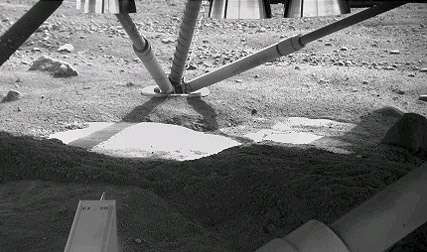
A view of the ground underneath NASA's Phoenix Mars Lander adds to evidence that descent thrusters dispersed overlying soil and exposed a harder substrate that may be ice.

The image received Friday night from the spacecraft's Robotic Arm Camera shows patches of smooth and level surfaces beneath the thrusters.

"This suggests we have an ice table under a thin layer of loose soil," said the lead scientist for the Robotic Arm Camera, Horst Uwe Keller of Max Planck Institute for Solar System Research, Katlenburg- Lindau, Germany.

The Robotic Arm Camera on NASA's Phoenix Mars Lander captured this image underneath the lander on the fifth Martian day, or sol, of the mission. Descent thrusters on the bottom of the lander are visible at the top of the image.

This view from the north side of the lander toward the southern leg shows smooth surfaces cleared from overlying soil by the rocket exhaust during landing. One exposed edge of the underlying material was seen in Sol 4 images, but the newer image reveals a greater extent of it. The abundance of excavated smooth and level surfaces adds evidence to a hypothesis that the underlying material is an ice table covered by a thin blanket of soil.

The bright-looking surface material in the center, where the image is partly overexposed may not be inherently brighter than the foreground material in shadow.

"We were expecting to find ice within two to six inches of the surface," said Peter Smith of the University of Arizona, Tucson, principal investigator for Phoenix. "The thrusters have excavated two to six inches and, sure enough, we see something that looks like ice. It's not impossible that it's something else, but our leading interpretation is ice."

Source: NASA


print this article email this article download pdf blog this article bookmark this article     Stumble it Digg this share on Facebook retweet share on Reddit add to delicious
Rate this story - 4.7 /5 (36 votes)

Rank Filter

Move the slider to adjust rank threshold, so that you can hide some of the comments.


Display comments: newest first

  • BeastOfBodmin - Jun 01, 2008
    • Rank: not rated yet
    Water ice or CO2 ice?
  • vlam67 - Jun 01, 2008
    • Rank: not rated yet
    I will wait until the Thermal and evolved gas (TEGA) analyzer gets off the picket line and starts working before passing comments. Lets hope the only remaining heating filament will do the job of ionizing the sample's volatiles. Otherwise all we will have are unanalyzed samples scooped up and inconclusive but pretty pictures.
  • Gregori - Jun 01, 2008
    • Rank: 3.8 / 5 (4)
    Water ice or CO2 ice?


    on no, Vanilla Ice ice baby..
  • h0dges - Jun 01, 2008
    • Rank: 2 / 5 (4)
    Water ice or CO2 ice?


    on no, Vanilla Ice ice baby..

    Save this comment for Digg, for Beast Of Bodmin has posed a good question as CO2s freezing point is -57*C, the temperature at Phoenix's location approaches this and the atmosphere is about 95.72% CO2.
  • Mayday - Jun 01, 2008
    • Rank: 5 / 5 (2)
    Is there any way the Phoenix Lander Team could develop a proper Mission Website that could feed us current information on the mission?

    The "site" we are directed to now is not good, simply put. The reports are old and really light on information -- It's mainstream press/classroom level stuff with no depth. And the "raw" images are very small.

    If this is not possible, could someone from the mission please explain why the information is being held so close to the vest?

    I'd like a better understanding of the "short circuit" issues. And some reasonable timeline for coming activities. It seems that sitting on Mars for a week without even attempting to touch the surface with the digging tool is wasting precious opportunity. Mars is a hostile place. And just because we've landed does not mean the risk to the equipment is past. If one has the ability to do science then one should get on with it, before another gremlin bites.

    I'm sure there are many out here like myself who would appreciate a more open and transparent science ethic from the team.

    I have just deleted the Arizona Site from my bookmarks (I particularly loved that their "comments" system has no "send" or "post comment" capability. I know funny, and that's funny.) The info is just too out of date. Sad when local newspapers can keep up with an "official" site.

    Public Relations has always been the bane of NASA. I am a huge fan of aggressive and continued space exploration, but with this kind of support for your fans it is really getting more and more difficult to stay enthused.

    I would apreciate some information on this.
  • Gregori - Jun 01, 2008
    • Rank: 5 / 5 (2)
    Water ice or CO2 ice?


    on no, Vanilla Ice ice baby..

    Save this comment for Digg, for Beast Of Bodmin has posed a good question as CO2s freezing point is -57*C, the temperature at Phoenix's location approaches this and the atmosphere is about 95.72% CO2.


    Ahwell, I was just pullin' his arm! :D Its an important question that will be anwsered in the comming days and weeks. I think NASA thinks it water ice, that why they tageted the mission for that location and time of year.
  • Mayday - Jun 01, 2008
    • Rank: 4 / 5 (5)
    I'm surprised no one has made the obvious comment, so here goes:

    "That's not ice, it's the floor of the photo studio!"

    My apologies. I could not resist. :-)

  • k_m - Jun 01, 2008
    • Rank: 4 / 5 (1)
    I'm surprised no one has made the obvious comment, so here goes:

    "That's not ice, it's the floor of the photo studio!"

    My apologies. I could not resist. :-)

    Damn! beat me to it.
    yep, the dumped playground sand and pea gravel on the set of Michael Jackson's Billy Jean video.
    That's the reason for the 'short circuit'- if they do anything it'll give the game up.
  • Mayday - Jun 01, 2008
    • Rank: 1 / 5 (1)
    If the footpads had casters on the underside, the arm would be able to pull the lander around. Like a backhoe on a river dredge.

    And has anyone said anything about that one small but very bright object off near the horizon? Oh yeah, it's always the parachute.

    I just know that someday they are going to equip one of these rigs with a pair of binoculars. I just know it.
  • Suzu - Jun 01, 2008
    • Rank: 5 / 5 (1)
    So where are the high res images of this? It's quite annoying looking at these small pics.
  • Mayday - Jun 01, 2008
    • Rank: 3.7 / 5 (3)
    I have to suspect that there is more to this than meets the eye. A week to "check out the systems" and publish not a single high-rez image? Is there a problem with the high-gain uplink? Is the Orbiter chewing them up in translation? Did someone in vehicle assembly take the joke about substituting their camera phone seriously?

    More to come.
  • MiddleBassIsland - Jun 01, 2008
    • Rank: 5 / 5 (2)
    The most detailed picture is at the Phoenix site at http://phoenix.lp...gID=1040&cID=34. You can download a 192kb version that can be enlarged better than the web version here. The Phoenix Mission's home page is at http://phoenix.lp...na.edu/.
  • MikeMarianiMD,FAAP - Jun 01, 2008
    • Rank: 5 / 5 (1)
    These "scientists" have inferred that they see ice because it is smooth?
    Happily, previous comments have indicated skepticism in this regard. For example, solid CO2 is offered by h0dges as an alternative. Though not a materials scientist, I can think of several further alternatives myself.
    It is interesting. Hopefully, further actual data will be forthcoming.

  • Graeme - Jun 02, 2008
    • Rank: 5 / 5 (2)
    Alternatives such as salt pan, or white rock, or frost coated rock.
  • PieRSquare - Jun 02, 2008
    • Rank: 3.7 / 5 (3)
    The small bright object you see is the headlights of the dune buggy that is driven by the leprechaun coming to protect his pot of space-gold that pheonix landed on (it's shiny, it must be gold!) You might want to put some holes in those tinfoil hats, I think you're overheating.
    But seriously, folks... If it's ice, it's water ice. Daytime highs are -30 which is too warm for frozen CO2. It was sent there because they know the place is loaded with water ice very close to the surface.
    The image of the ice(?) is from the shovel camera which is supposed to help with practical tasks like helping with digging and checking to see if the foot pads are on firm ground so it can dig safely, not to make pretty pictures. The camera on top of the lander produces 1024x1024 black and white images, just like Spirit and Opportunity. They only end up as color because multiple exposures are shot through filters and combined to produce approximate color and only end up producing big images by taking several shots and stitching them together. The lander is stationary and the landscape doesn't that change much so they've got lots of time to see it all. Pictures aren't the primary purpose of this mission anyhow, these missions are about doing science, the entertainment factor is a bonus.
  • mrlewish - Jun 02, 2008
    • Rank: 5 / 5 (2)
    All that money and they send a black and white camera?
  • vlam67 - Jun 03, 2008
    • Rank: not rated yet
    All that money and they send a black and white camera?

    I wouldn't be surprised. After all they have to pay the salaries for the scientists, marked-up profits for the contractors who make the parts,etc, etc, blah blah blah. After all, it's a capitalistic system. Nobody is doing nothing for free, nor for science, for that matter. No wonder no detailed breakup of hardware costs are ever willingly disclosed. You wouldn't like to see the filaments cost $90.95, Made in Taiwan, or the cameras fitted are the "most cost effective" that will fit the hardware's costs allocations, would you?
    Never mind the science. there is nothing wrong with it, but the costs...unless you are the Pentagon, I don't see anyway the status quo will improve in our lifetime.
  • PieRSquare - Jun 04, 2008
    • Rank: 1 / 5 (1)
    The camera is black and white because it is meant to be used with filters used to show scientifically interesting wavelengths. All CCDs are actually black and white, they're basically photon counters. The reason we get color images out of our cameras is because each pixel is built from a 2x2 array of sensors. One sensor has a blue filter, one has a red filter and two of those have a green filter (human eyes are more sensitive to green wavelengths). They take the four values and then convert them to a pixel of a specific color. You could do that to a camera sent on one of these missions but then you couldn't use that camera for a variety of wavelengths which would hobble the science.

June 1, 2008 all stories

Comments: 18

4.7 /5 (36 votes)
  • Stumble this up

  • Digg this

  • share this

  • hide
  • Related Stories

  • Frost-Covered Phoenix Lander Seen in Winter Images
    created Nov 05, 2009 | popularity not rated yet | comments 0
  • Mars Orbiter Completes First Phase of Science Mission
    created Dec 12, 2008 | popularity not rated yet | comments 0
  • Phoenix Lander Digs and Analyzes Soil as Darkness Gathers
    created Oct 09, 2008 | popularity not rated yet | comments 0
  • Phoenix Monitors Frosty Clumps on its Struts
    created Sep 09, 2008 | popularity not rated yet | comments 0
  • Ice Cold Sunrise on Mars
    created Aug 27, 2008 | popularity not rated yet | comments 0


  • hide
  • Relevant PhysicsForums posts

  • The shape of our solar system's orbits.
    created Nov 07, 2009
  • Above or Below the Line of Nodes
    created Nov 07, 2009
  • Supernova vs. Nova?
    created Nov 07, 2009
  • Supernova's Gamma Rays and Comets
    created Nov 06, 2009
  • More from Physics Forums - General Astronomy

Other News

Planetary Society plans new 'solar sail'

Space & Earth / Space Exploration

created 5 minutes ago | popularity not rated yet | comments 0

(AP) -- Four years after its first solar sail ended up in the ocean instead of orbit, The Planetary Society announced Monday that by the end of 2010 it will try again to launch a spacecraft that will be propelled by the ...


Australian scientists call for urgent 'global cooling' to save coral reefs

Space & Earth / Environment

created 45 minutes ago | popularity not rated yet | comments 0

(PhysOrg.com) -- Australian marine scientists have issued an urgent call for massive and rapid worldwide cuts in carbon emissions, deep enough to prevent atmospheric CO2 levels rising to 450 parts per million (ppm).


L-R: Chiwetel Ejiofor, Amanda Peet and John Cusack at the premiere of "2012"

NASA on crusade to debunk 2012 apocalypse myths

Space & Earth / Space Exploration

created 5 hours ago | popularity not rated yet | comments 0

The world is not coming to an end on December 21, 2012, the US space agency insisted Monday in a rare campaign to dispel widespread rumors fueled by the Internet and a new Hollywood movie.


NASA satellites see Ida spreading out before landfall

NASA satellites see Ida spreading out before landfall

Space & Earth / Earth Sciences

created 1hour ago | popularity not rated yet | comments 0

NASA's Aqua and Terra satellites are keeping a close eye on Tropical Storm Ida, and both have instruments aboard that show her clouds and rains are already widespread inland over the U.S. Gulf coast states. ...


Antarctica glacier retreat creates new carbon dioxide store

Antarctica glacier retreat creates new carbon dioxide store

Space & Earth / Earth Sciences

created 10 hours ago | popularity 4.3 / 5 (3) | comments 0

Large blooms of tiny marine plants called phytoplankton are flourishing in areas of open water left exposed by the recent and rapid melting of ice shelves and glaciers around the Antarctic Peninsula. This ...