Fatal mine collapse covered 50 acres
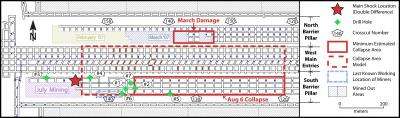
New calculations show that the deadly Crandall Canyon mine collapse – which registered as a magnitude-3.9 earthquake – began near where miners were excavating coal and quickly grew to a 50-acre cave-in, University of Utah seismologists say in a report on the tragedy.
The University of Utah Seismograph Stations estimated the size of the collapse is about four times larger than was thought shortly after the time of the Aug. 6, 2007, disaster that resulted in the deaths of six miners and, 10 days later, three rescuers.
The seismologists' 53-page report has been submitted to the journal Seismological Research Letters and to federal Mine Safety and Health Administration (MSHA) investigators. Among the key findings:
-- Seismological and other data suggest the size of the area that collapsed in the nearly horizontal mine measured 920 meters (3,018 feet) from east to west – extending from about mine crosscut 143 to crosscut 120 – and measured 220 meters (722 feet) from north to south – a total of 50 acres. A crosscut is a north-south tunnel in this mine.
-- During the collapse, the space between the mine's roof and floor decreased by an average of only 1 foot, but enough coal and rock exploded from the mine's walls to fill much of the collapse area with rubble that likely prevented further collapse.
-- The collapse likely lasted only seconds – leaving no time for escape – and not for misery-prolonging minutes as some miners' families have feared. The misconception arose from the fact seismic waves reverberate for much longer than the collapse or earthquake that generated them.
-- The mine collapse was followed in August by 37 measurable aftershocks, clustered near the east and inferred west ends of the collapse area, probably from post-collapse stress and from a vertical crack on the west end of the collapsed block of rock.
-- Seismologists recalculated the epicenter of the magnitude-3.9 mine collapse, and found it "was within the mine boundary and very close to where the miners were working," says the study's lead author, seismologist Jim Pechmann, a research associate professor of geology and geophysics at the University of Utah Seismograph Stations.
They did this "relocation" using new techniques, calibrated by data from five seismometers placed above and near the mine after the collapse and by the known location of the magnitude-1.6 coal "burst" on Aug. 16 that killed three rescuers and injured six others.
The epicenter is the point on the ground surface above a seismic event's hypocenter, which is the underground point where the event begins.
The location of the preliminary epicenter calculated soon after the collapse was 0.4 miles outside the mine boundary and 0.6 miles to the west-southwest of the relocated epicenter. It was somewhat inaccurate partly because the nearest seismic station at the time of the collapse was 12 miles away, says seismologist Walter Arabasz, director of the University of Utah Seismograph Stations and a co-author of the new report. "That led some to conclude the seismic event was separate from the mine collapse."
Arabasz and other seismologists insisted from the day of the collapse that available evidence indicated the magnitude-3.9 seismic event was the mine collapse itself. The mine's owner argued it was a natural quake that triggered the collapse.
By showing the recalculated epicenter was within the mine boundary and near active mining, the new study adds strong evidence that the quake was the collapse itself.
"As seismologists, we're as certain as we can be that the seismic event registered as a magnitude-3.9 shock was due to the collapse of the mine and not a naturally occurring earthquake," Arabasz says.
Pechmann and Arabasz conducted the study with seismologists Kris Pankow and Relu Burlacu, both of the Seismograph Stations, and with Michael K. "Kim" McCarter, chair and professor of mining engineering at the University of Utah. The study was funded by the State of Utah and the U.S. Geological Survey.
Arabasz says all the information in the report has been given to MSHA investigators, but "we don't have full access to their information, so we had to develop our interpretations, to a significant extent, independent of key information in the mine."
Scientists usually don't release studies until they are published in journals. But in this case, there have been numerous requests for the information, which is a matter of public interest, so researchers released the report now. They delayed the release a couple of weeks at MSHA's request to give the agency time to inform disaster victims' families.
Evidence of a Vertical Crack during the Mine Collapse
Soon after the Aug. 6 collapse, Utah seismologists gained support from University of California, Berkeley, and Lawrence Livermore National Laboratory seismologists, who said their analysis of the seismic recordings revealed implosive, downward movement – like a mine collapse and not like shearing motion along a fault.
The California seismologists also have submitted a report of their work to Seismological Research Letters. Pechmann says the new Berkeley paper shows that while seismic waves from the Aug. 6 mine collapse are incompatible with a natural earthquake, about 20 percent of the seismic energy released came from vertical shearing motion.
"The mostly likely explanation is a vertical, north-south crack in the roof of the mine that developed along the western edge of the collapse," with the ground on the east side of the crack dropping downward, Pechmann says.
He emphasizes that seismic records show the shearing motion "did not occur at the start of collapse. It cannot be interpreted as an earthquake that triggered the collapse."
Size of the Collapse
MSHA initially estimated the collapse extended 680 meters (2,231 feet) east to west – or from crosscut 137 to crosscut 120 – and at least 80 meters (262 feet) north to south, the study says, quoting an MSHA official. That is about 13 acres.
Pechmann says his team's "model," which shows a 50-acre collapse beginning at crosscut 143, is "based on seismological data, available underground observations, and constraints on how much collapse could occur given the amount of coal left in the pillars.
"It's not the only possible scenario to describe the collapsed area, but it fits all the available data we have," he adds. "The epicenter was near the western end of our proposed collapse area, suggesting the collapse started at the western end, and propagated mostly eastward" toward the mine entrance.
How did the calculated 1-foot roof collapse have such deadly consequences?
Pechmann says that within the collapsed area, only 37 percent of coal had been removed, and the rest was left behind in support pillars. "If those pillars shatter and covert to rubble – and if the coal increases 40 percent in volume when it shatters – then the closure you can get between the roof and the floor averages 0.3 meters [1 foot]." The roof can only collapse that far "because it gets stopped by the rubble," he adds.
Collapse Began Near Where Miners Worked
The seismology report notes that the MSHA-approved 2007 amended mining plan called for removing coal from east-west tunnels called "entries" and from north-south tunnels, or crosscuts, leaving behind pillars about 110 feet long and 60 feet wide.
"The next phase of the plan was to mine coal in some of these pillars, working from west to east and allowing the roof around these pillars to collapse," the report says.
The study shows the collapse hypocenter "was right at the edge of where miners were removing pillars in July and early August," Pechmann says. The last known working location of the six miners was just east of where those pillars were removed.
How Long the Collapse Lasted
The report says: "Some people have interpreted a four-minute seismic signal duration reported for the Crandall Canyon main shock … as indicative of an extraordinarily long collapse duration. In reality, the duration of the collapse was probably only a few seconds, at most, as evidenced by reports that the surface building at the Crandall Canyon mine portal vibrated for a few seconds at the time."
Seismologists could not directly measure how long the Aug. 6 collapse lasted, but note that seismic waves reverberate many times longer than an actual quake or collapse.
"The collapse probably happened within just a few seconds and was not a long, drawn-out affair," Pechmann says. "There would have been no time for anybody to get out of the way. It would have happened too fast for that."
He notes the deadly Aug. 16 "bump" that ended rescue efforts lasted a minute on seismographs, "but underground observers said it was essentially instantaneous."
A History of Mine-Related Seismicity
Mining-induced seismicity is common in Utah's Wasatch Plateau-Book Cliffs coal mining region, where more than 17,000 seismic events (most weaker than magnitude 3) were attributed to underground mining from 1978 through August 2007. Less than 2 percent of the area's seismicity originates from natural earthquakes.
The researchers noted that from Jan. 1, 2007, until the Aug. 6 collapse and within 1.9 miles of it, there were 28 seismic events large enough to be detected and located. Of those, eight (all magnitude 1.9 or weaker) happened within 2.5 weeks before the collapse, and 15 (all 1.8 or less) happened in late February and early March.
"These events occurred primarily in areas where there was concurrent or recent mining activity," the report states.
A large "bounce" on March 10, 2007, forced miners to abandon the north side of the active part of the mine due to damage in the event, and shift to the south side, where thicker pillars were left during mining but where the August tragedy occurred.
"We didn't see any indication of accelerating seismic activity in the hours before the [Aug. 6] collapse," Pechmann says. "We specifically looked for that."
Afterward, many aftershocks likely were "continued failures of pillars supporting the roof due to stresses induced by the original collapse," Pechmann says. "And some aftershocks may have been due to adjustments within the roof."
Source: University of Utah


