Phoenix Lander Leaves 'Footprints' on Mars
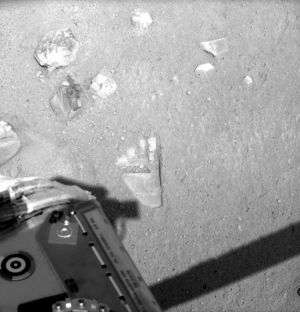
June 2, 2008 Phoenix's 'Footprints' on Mars

This view from the Surface Stereo Imager on NASA's Phoenix Mars Lander shows the first impression –- dubbed Yeti and shaped like a wide footprint -- made on the Martian soil by the robotic arm scoop on Sol 6, the sixth Martian day of the mission, (May 31, 2008). Touching the ground is the first step toward scooping up soil and ice and delivering the samples to the lander's onboard experiments. The Phoenix Mission is led by the University of Arizona, Tucson, on behalf of NASA. Project management of the mission is by NASA's Jet Propulsion Laboratory, Pasadena, Calif. Spacecraft development is by Lockheed Martin Space Systems, Denver. Image Credit: NASA/JPL-Caltech/University of Arizona

NASA's Phoenix Mars Lander reached out and touched the Martian soil for the first time on Saturday, May 31, the first step in a series of actions expected to bring soil and ice to the lander's experiments.

The lander's Robotic Arm scoop left an impression that resembles a footprint at a place provisionally named Yeti in the King of Hearts target zone, away from the area that eventually will be sampled for evaluation.

The impression in the soil was captured by Phoenix's Stereo Surface Imager. Features and locations around the Phoenix lander are being named for fairy tale and mythological characters.

"This first touch allows us to utilize the Robotic Arm accurately. We are in a good situation for the upcoming sample acquisition and transfer," said David Spencer, Phoenix's surface mission manager from NASA's Jet Propulsion Laboratory in Pasadena, Calif.

Phoenix's Robotic Arm Camera also took a number of images of the "Snow Queen" site of what is believed to be exposed ice under the lander.

"What we see in the images is in agreement with the notion that it may be ice, and we suspect we will see the same thing in the digging area," said Uwe Keller, Robotic Arm Camera lead scientist from the Max Planck Institute for Solar System Research, Katlenburg-Lindau, Germany.

Source: NASA


print this article email this article download pdf blog this article bookmark this article     Stumble it Digg this share on Facebook retweet share on Reddit add to delicious
Rate this story - 4.1 /5 (19 votes)

Rank Filter

Move the slider to adjust rank threshold, so that you can hide some of the comments.


Display comments: newest first

  • zbarlici - Jun 02, 2008
    • Rank: 4.5 / 5 (2)
    when they finally send humans to the moon or Mars, i wonder what name they will give to the first poop left on the planet surface...?
  • aussiecarter - Jun 02, 2008
    • Rank: 3.7 / 5 (3)
    perhaps a less intelligible alien tribe will keep it as an artifact of worship.
  • Mercury_01 - Jun 02, 2008
    • Rank: not rated yet
    I was under the impression that this lander couldnt move. can it?

June 2, 2008 all stories

Comments: 3

4.1 /5 (19 votes)
  • Stumble this up

  • Digg this

  • share this

  • hide
  • Related Stories

  • A Mars Rover Named 'Curiosity'
    created Oct 30, 2009 | popularity not rated yet | comments 0
  • Scientists see water ice in fresh meteorite craters on Mars
    created Sep 24, 2009 | popularity not rated yet | comments 0
  • Biosphere 2 Opens Phoenix Mars Lander Exhibit
    created Sep 18, 2009 | popularity not rated yet | comments 0
  • Mars data published in Science this week
    created Jul 02, 2009 | popularity not rated yet | comments 0
  • Many characteristics of Mars, including ice, are similar to Earth
    created Jul 02, 2009 | popularity not rated yet | comments 0


  • hide
  • Relevant PhysicsForums posts

  • Gravity on Mars
    created 10 hours ago
  • Question about the orbit between Mars and Earth
    created 18 hours ago
  • SIMBAD/NED help
    created 22 hours ago
  • Black hole confusion
    created Nov 14, 2009
  • More from Physics Forums - General Astronomy

Other News

Close-up movie shows hidden details in the birth of super-suns

Close-up movie shows hidden details in the birth of super-suns (w/ Video)

Space & Earth / Astronomy

created 9 hours ago | popularity 4.8 / 5 (4) | comments 0

(PhysOrg.com) -- The constellation of Orion is a hotbed of massive star formation, most prominently in the Great Nebula that sits in Orion's sword. The glowing gas of the Nebula is powered by a group of young ...


NASA 'Drops' Next Generation Robotic Lander During Autonomous Tests

NASA 'Drops' Next Generation Robotic Lander During Autonomous Tests

Space & Earth / Space Exploration

created 6 hours ago | popularity 4.7 / 5 (3) | comments 1

(PhysOrg.com) -- NASA has successfully completed a series of autonomous "drop" tests of a robotic lander test article - in a record 10 months - to demonstrate the ability to perform a controlled landing on ...


Ghostly 'Spokes' Puff Out From Saturn's Ring's

Ghostly 'Spokes' Puff Out From Saturn's Ring's (w/ Video)

Space & Earth / Space Exploration

created 5 hours ago | popularity 5 / 5 (1) | comments 0

(PhysOrg.com) -- Massive, bright clouds of tiny ice particles hover above the darkened rings of Saturn in an image captured by the Cassini spacecraft on Sept. 22, 2009, around the time of Saturn's equinox. ...


Volatile gas could turn Rwandan lake into a freshwater time bomb

Space & Earth / Earth Sciences

created 7 hours ago | popularity 5 / 5 (2) | comments 3

A dangerous level of carbon dioxide and methane gas haunts Lake Kivu, the freshwater lake system bordering Rwanda and the Republic of Congo.


Space shuttle Atlantis lifts off on supply mission (AP)

Space shuttle Atlantis lifts off on supply mission

Space & Earth / Space Exploration

created 5 hours ago | popularity 3.5 / 5 (2) | comments 0

(AP) -- With 100 Internet-savvy NASA fans cheering on the shuttle and churning out constant Twitter updates, Atlantis sailed smoothly into orbit Monday with six astronauts and a full load of spare parts for ...