Nanotech process produces plastics that are 10 times more stretchable
June 2nd, 2008 Fibers

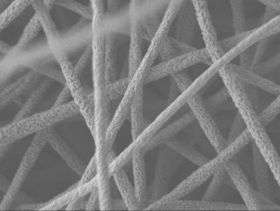
Scientists report development of a plastic that is 10 times more stretchable than that of the original material. Above is a micrograph of the electrospun nano-sized fibers. Credit: Courtesy of the American Chemical Society

Move over, Rumplestiltskin. Researchers in China report the first successful “electrospinning” of a type of plastic widely used in automobiles and electronics. The high-tech process, which uses an electric charge to turn polymers into thin fibers in the presence of electricity, produced plastic mats that can stretch 10 times more without breaking than the original material and could lead to new uses for the plastic, they say. Their study is scheduled for the June 10 issue of ACS’ Macromolecules.

In the new study, Zhao-Xia Guo and colleagues point out that the original plastic, called polyoxymethylene (POM), is an engineering staple known for its metal-like hardness, light weight, and resistance to chemicals. However, the material is relatively brittle, limiting its applications.

Although many different types of plastics have been electrospun into fibers with extended uses and properties, researchers have been unable to spin POM into fibers until now, the researchers say.

They report that POM could be turned into nano-sized fibers — thousands of times thinner than the width of a single hair — after first dissolving it in a solution called HFIP and then undergoing electrospinning. The process resulted in POM mats with improved stretchability, or ductility, high porosity, and high surface area. Such features could extend the plastic’s uses to a wide range of industrial, electronic and medical applications, the researchers say.

Source: ACS


print this article email this article download pdf blog this article bookmark this article     Digg this Stumble it share on Facebook share on Reddit add to delicious save to Yahoo! bookmarks
4.2/5 after 22 votes


June 2nd, 2008 all stories
Nanotechnology / Nanomaterials

Comments: 0
Rank: 4.2/5 after 22 votes

  • Stumble this up

  • Digg this

  • Share it:
  • share on Facebook
  • share on MySpace
  • share on Slashdot
  • rss-newsfeed
  • share on Google
  • share on Reddit
  • add to delicious
  • save to Yahoo! bookmarks
  • share on Windows Live
  • Add to Mixx!
Rating: 4.2/5 after 22 votes

  • Related Stories

  • MicroRNAs hold promise for treating diseases in blood vessels
    created 3 hours ago | popularity not rated yet | comments 0
  • Stress in the womb can last a lifetime, say researchers behind new exhibit
    created Jun 30, 2009 | popularity not rated yet | comments 0
  • The faster they come: How social status is negotiated among fishes
    created Jun 28, 2009 | popularity not rated yet | comments 0
  • 3D printing for new tissues and organs
    created Jun 18, 2009 | popularity not rated yet | comments 0
  • Memories may be formed throughout the day, not just while sleeping
    created Jun 16, 2009 | popularity not rated yet | comments 0

Tags


  • Physicists Demonstrate Quantum Memory with Matter Qubits
    Physicists Demonstrate Quantum Memory with Matter Qubits
    Physics / General Physics
    created Jul 03, 2009 | popularity 4.4 / 5 (17) | comments 1
  • 'Holey' Nanosheets for Wastewater Dye Removal
    Nanotechnology / Nanomaterials
    created Jul 01, 2009 | popularity 5 / 5 (5) | comments 1
  • Jellyfish Robot Swims Like its Biological Counterpart
    Jellyfish Robot Swims Like its Biological Counterpart
    Electronics / Robotics
    created Jun 26, 2009 | popularity 4.4 / 5 (8) | comments 1
  • Could Maxwell's Demon Exist in Nanoscale Systems?
    Could Maxwell's Demon Exist in Nanoscale Systems?
    Physics / General Physics
    created Jun 24, 2009 | popularity 4.4 / 5 (18) | comments 29
  • Living Safely with Robots, Beyond Asimov's Laws
    Living Safely with Robots, Beyond Asimov's Laws
    Electronics / Robotics
    created Jun 22, 2009 | popularity 4.6 / 5 (52) | comments 40
  • Other News

    A 'quantum of sol' -- how nanotechnology could hold the key to a solar-powered future

    A 'quantum of sol' -- how nanotechnology could hold the key to a solar-powered future

    Nanotechnology / Nanomaterials

    created Jun 30, 2009 | popularity 3.8 / 5 (13) | comments 16

    (PhysOrg.com) -- A new generation of 'nano-structured' millimetre-sized solar cells that could convert the sun's energy to electricity more than twice as efficiently as current technology, is the subject of ...


    Australian researchers are set to begin human trials of a tiny nano-cell that acts as a "Trojan horse" against cancer

    Hi-tech 'Trojan horse' can kill cancer cells: researchers

    Nanotechnology / Bio & Medicine

    created Jun 29, 2009 | popularity 4.6 / 5 (11) | comments 7

    Australian researchers are set to begin human trials of a tiny nano-cell that acts as a "Trojan horse" against cancer cells, a breakthrough they say may curb the need for debilitating chemotherapy.


    Harnessing Nanoparticles To Track Cancer Cell Changes

    Nanotechnology / Bio & Medicine

    created Jul 03, 2009 | popularity not rated yet | comments 1

    The more dots there are, the more accurate a picture you get when you connect them. Cancer researchers adopting that philosophy have developed a new imaging technology that could give scientists the ability to simultaneously ...


    'Holey' Nanosheets for Wastewater Dye Removal

    Nanotechnology / Nanomaterials

    created Jul 01, 2009 | popularity 5 / 5 (5) | comments 1

    (PhysOrg.com) -- Researchers have discovered that extremely thin sheets of nickel oxide with hexagonally shaped holes can absorb hazardous dyes from wastewater nearly as well as the best traditional methods, but are recyclable. ...


    Computer-Guided Nanoparticle Therapy Destroys Tumors

    Nanotechnology / Bio & Medicine

    created Jun 29, 2009 | popularity 5 / 5 (11) | comments 0

    Gold nanoshells are among the most promising new nanoscale therapeutics being developed to kill tumors, acting as antennas that turn light energy into heat that cooks cancer to death. Now, a multi-institutional research team ...