A computer that can 'read' your mind
June 2nd, 2008 A computer that can 'read' your mind

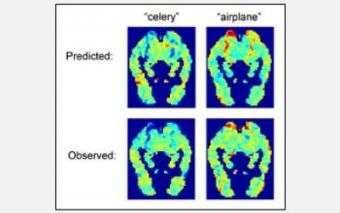
Predicted fMRI images for "celery" and "airplane" show significant similarities with the observed images for each word. Red indicates areas of high activity, blue indicates low activity. Credit: Courtesy of Science

For centuries, the concept of mind readers was strictly the domain of folklore and science fiction. But according to new research published today in the journal Science, scientists are closer to knowing how specific thoughts activate our brains. The findings demonstrate the power of computational modeling to improve our understanding of how the brain processes information and thoughts.

The research was conducted by a computer scientist, Tom Mitchell, and a cognitive neuroscientist, Marcel Just, both of Carnegie Mellon University. Their previous research, supported by the National Science Foundation (NSF) and the W.M. Keck Foundation, had shown that functional magnetic resonance imaging (fMRI) can detect and locate brain activity when a person thinks about a specific word. Using this data, the researchers developed a computational model that enabled a computer to correctly determine what word a research subject was thinking about by analyzing brain scan data.

In their most recent work, Just and Mitchell used fMRI data to develop a more sophisticated computational model that can predict the brain activation patterns associated with concrete nouns, or things that we experience through our senses, even if the computer did not already have the fMRI data for that specific noun.

The researchers first built a model that took the fMRI activation patterns for 60 concrete nouns broken down into 12 categories including animals, body parts, buildings, clothing, insects, vehicles and vegetables. The model also analyzed a text corpus, or a set of texts that contained more than a trillion words, noting how each noun was used in relation to a set of 25 verbs associated with sensory or motor functions. Combining the brain scan information with the analysis of the text corpus, the computer then predicted the brain activity pattern of thousands of other concrete nouns.

In cases where the actual activation patterns were known, the researchers found that the accuracy of the computer model's predictions was significantly better than chance. The computer can effectively predict what each participant's brain activation patterns would look like when each thought about these words, even without having seen the patterns associated with those words in advance.

"We believe we have identified a number of the basic building blocks that the brain uses to represent meaning," said Mitchell. "Coupled with computational methods that capture the meaning of a word by how it is used in text files, these building blocks can be assembled to predict neural activation patterns for any concrete noun. And we have found that these predictions are quite accurate for words where fMRI data is available to test them."

Just said the computational model provides insight into the nature of human thought. "We are fundamentally perceivers and actors," he said. "So the brain represents the meaning of a concrete noun in areas of the brain associated with how people sense it or manipulate it. The meaning of an apple, for instance, is represented in brain areas responsible for tasting, for smelling, for chewing. An apple is what you do with it. Our work is a small but important step in breaking the brain's code."

In addition to representations in these sensory-motor areas of the brain, the Carnegie Mellon researchers found significant activation in other areas, including frontal areas associated with planning functions and long-term memory. When someone thinks of an apple, for instance, this might trigger memories of the last time the person ate an apple, or initiate thoughts about how to obtain an apple.

"This suggests a theory of meaning based on brain function," Just added.

The work could eventually lead to the use of brain scans to identify thoughts and could have applications in the study of autism, disorders of thought such as paranoid schizophrenia, and semantic dementias such as Pick's disease.

Officials at NSF say they are excited and intrigued by these findings. "This has been an interesting project to watch," said Kenneth Whang, a program officer at NSF who is responsible for the grant to Mitchell and Just. "They started with some fundamental ideas from machine learning about how to get the most out of fMRI data, and now they've not only shown the power of their computational approach, but also made headway on one of the most important problems in the understanding of language in the brain."

Whang believes that Mitchell and Just's research will stimulate further research in the field of computational neuroscience. "This opens up all sorts of new possibilities for looking into the fine structure of how patterns of brain activity relate to human thought processes."

Source: National Science Foundation


print this article email this article download pdf blog this article bookmark this article     Digg this Stumble it share on Facebook share on Reddit add to delicious save to Yahoo! bookmarks
4.4/5 after 22 votes

Rank Filter

Move the slider to adjust rank threshold, so that you can hide some of the comments.


Display comments: newest first

  • GBogumil - Jun 02, 2008
    • Rank: 4.5 / 5 (2)
    so when they can get fMRI data at a distance you really WILL need one of those funny tinfoil hats
  • Enthalpy - Jun 02, 2008
    • Rank: not rated yet
    Not by fMRI. By infrared - probably with Raman effect - or by a microwave imaging radar. Exists for over 30 years.

    The results reported here are by no means the most convincing with fMRI. I've seen papers where brains areas were clearly associated with each joint of each finger. Others associated distinct areas with the sounds or with the pronounciation movements of each word. And with a faster imaging than MRI, it must be easier.

    Pity that useful researchers don't have these better imaging techniques. If they had got them 30 years ago, several brains diseases would be curable today.

    Aluminium foil (the modern version of tinfoil for a century) is very uncomfortable and corrodes quickly. Use 4 layers of space blanket instead.

June 2nd, 2008 all stories
Medicine & Health / Research

Comments: 2
Rank: 4.4/5 after 22 votes

  • Stumble this up

  • Digg this

  • Share it:
  • share on Facebook
  • share on MySpace
  • share on Slashdot
  • rss-newsfeed
  • share on Google
  • share on Reddit
  • add to delicious
  • save to Yahoo! bookmarks
  • share on Windows Live
  • Add to Mixx!
Rating: 4.4/5 after 22 votes


Tags


  • Physicists Demonstrate Quantum Memory with Matter Qubits
    Physicists Demonstrate Quantum Memory with Matter Qubits
    Physics / General Physics
    created Jul 03, 2009 | popularity 4.4 / 5 (17) | comments 1
  • 'Holey' Nanosheets for Wastewater Dye Removal
    Nanotechnology / Nanomaterials
    created Jul 01, 2009 | popularity 5 / 5 (5) | comments 1
  • Jellyfish Robot Swims Like its Biological Counterpart
    Jellyfish Robot Swims Like its Biological Counterpart
    Electronics / Robotics
    created Jun 26, 2009 | popularity 4.4 / 5 (8) | comments 1
  • Could Maxwell's Demon Exist in Nanoscale Systems?
    Could Maxwell's Demon Exist in Nanoscale Systems?
    Physics / General Physics
    created Jun 24, 2009 | popularity 4.4 / 5 (18) | comments 29
  • Living Safely with Robots, Beyond Asimov's Laws
    Living Safely with Robots, Beyond Asimov's Laws
    Electronics / Robotics
    created Jun 22, 2009 | popularity 4.6 / 5 (52) | comments 40
  • Other News

    Variations in 5 genes raise risk for most common brain tumors

    Medicine & Health / Genetics

    created 11 hours ago | popularity not rated yet | comments 1

    Common genetic variations spread across five genes raise a person's risk of developing the most frequent type of brain tumor, an international research team reports online in Nature Genetics.


    Researchers highlight new direction for drug discovery

    Medicine & Health / Research

    created 9 hours ago | popularity not rated yet | comments 0

    In a discovery that rebuffs conventional scientific thinking, researchers at Georgetown University Medical Center (GUMC) have discovered a novel way to block the activity of the fusion protein responsible for Ewing's sarcoma, ...


    MicroRNAs hold promise for treating diseases in blood vessels

    Medicine & Health / Research

    created 11 hours ago | popularity not rated yet | comments 0

    A newly discovered mechanism controls whether muscle cells in blood vessels hasten the development of both atherosclerosis and Alzheimer's disease, according to an article published online today in the journal Nature.


    Wind power may have its own environmental problems

    Medicine & Health / Health

    created 10 hours ago | popularity 3.8 / 5 (5) | comments 3

    Wind power generation is expected to be a clean and environmentally friendly natural energy source, but a new kind of environmental problem has surfaced as infrasonic waves caused by windmills are suspected of causing health ...


    Malaysian authorities seize 'Viagra coffee' : report

    Medicine & Health / Health

    created 14 hours ago | popularity not rated yet | comments 1

    Malaysia's health authorities have seized over 20,000 dollars worth of coffee mixed with sildenafil, the main ingredient in erectile dysfunction drug Viagra, a report said Sunday.