Heart of the Crab Pulsar probed -- first direct look into the core of a neutron star
June 2, 2008 Heart of the Crab Pulsar probed -- first direct look into the core of a neutron star

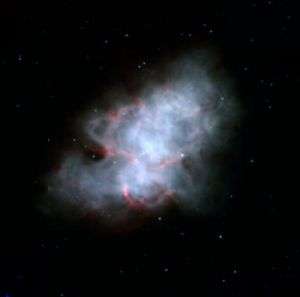
New information about the heart of one of the most famous objects in the sky -- the Crab Pulsar in the Crab Nebula -- has been revealed by an international team of scientists searching for gravitational waves. The team's achievement also is the first direct look into the interior of a neutron star. The research team detected signals from the pulsar -- a rapidly spinning neutron star -- with the Laser Interferometer Gravitational-Wave Observatory (LIGO). Credit: NASA/JPL-Caltech/R. Gehrz (University of Minnesota)

New information about the heart of one of the most famous objects in the sky -- the Crab Pulsar in the Crab Nebula -- has been revealed by an international team of scientists searching for gravitational waves. The team's achievement also is the first direct look into the interior of a neutron star.

The research team detected signals from the pulsar -- a rapidly spinning neutron star -- with the Laser Interferometer Gravitational-Wave Observatory (LIGO). The analysis of the signals reveals that has shown that no more than 4 percent of the energy loss of the pulsar is caused by the emission of gravitational waves. This long-awaited analysis is one of LIGO's first landmark results, bringing the search for gravitational waves into the outskirts of the realm of theoretical predictions made several years ago by Ben Owen, assistant professor of physics at Penn State. Owen is a co-author of the paper describing the discovery, which will be submitted to Astrophysical Journal Letters by the LIGO Scientific Collaboration, a 600-member group in which Penn State plays a key role.

The Crab Nebula, located 6,500 light years away in the constellation Taurus, was formed in a spectacular supernova explosion in 1054. It was visible in daylight for more than three weeks and may briefly have been brighter than the full moon. Ancient Chinese texts referred to the extraordinary event as a "guest star." Today, at the heart of the Crab Nebula, remains an incredibly rapidly rotating neutron star that sweeps two narrow radio beams across the Earth each time it spins. The lighthouse-like radio pulses have given the star the name "pulsar."

"The Crab Pulsar is spinning at a rate of 30 times per second. However, its rotation rate is decreasing rapidly relative to most pulsars, indicating that it is radiating energy at a prodigious rate," says Graham Woan of the University of Glasgow, who co-led the science group that used LIGO data to analyze the Crab Pulsar, along with Michael Landry of the LIGO Hanford Observatory.

Pulsars, which are only 10 km in radius yet contain more mass than the Sun, are almost perfect spheres made up of neutrons. Gravitational waves are ripples in the fabric of space and time and are an important consequence of Einstein's general theory of relativity. Gravitational-wave emission is one of the few physical mechanisms hypothesized for the pulsar's energy loss and the accompanying slowing of its spin, but the scenario that gravitational waves significantly "brake" the Crab pulsar has been disproved by the new analysis. "These results strongly imply that no more than 4 percent of the pulsar's energy loss is due to gravitational radiation," Michael Landry said. "The remainder of the loss must be due to other mechanisms, such as a combination of electromagnetic radiation generated by the rapidly rotating magnetic field of the pulsar and the emission of high-velocity particles into the nebula."

LIGO scientists monitored the neutron star from November 2005 to August 2006 using data from the three LIGO interferometers, which were combined to create a single, highly sensitive detector. They compared the LIGO data with published data about the pulsar's rotation rate from the Jodrell Bank Observatory, looking for a synchronous gravitational-wave signal.

The analysis revealed no signs of gravitational waves -- a result the scientists say is important because it provides information about the pulsar and its structure. They say a perfectly smooth neutron star will not generate gravitational waves as it spins, and that LIGO would have been able to detect gravitational waves from a star whose shape was deformed by only a few meters. Such distortion could occur in a young neutron star, like the Crab Pulsar, whose crust could still be semisolid, or in a star with an enormous magnetic field.

According to Ben Owen, "What LIGO really adds is that we can see more than skin deep. Astronomers see plenty of electromagnetic waves (radio waves, x-rays, and so on) from the Crab, but pulsars are so dense that even the x-rays can't get through the interior and you can only see down to the surface. But gravitational waves can get through, so our result is the first direct look into a neutron star's interior." Joseph Taylor, a Nobel Prize-winning radio astronomer and professor of physics at Princeton University, says, "The physics world has been waiting eagerly for scientific results from LIGO. It is exciting that we now know something concrete about how nearly spherical a neutron star must be, and we have definite limits on the strength of its internal magnetic field."

Looking to the future of research with LIGO, Ben Owen adds, "For a long time particle physicists have predicted a lot of strange possibilities for neutron star interiors, like neutrons dissolving into more fundamental particles called quarks. As LIGO's sensitivity improves, we can explore more of those possibilities. If we see a strong signal in the next couple of years, it will be strong evidence that these strange states of matter exist."


Source: Penn State


print this article email this article download pdf blog this article bookmark this article     Stumble it Digg this share on Facebook retweet share on Reddit add to delicious
Rate this story - 4.2 /5 (23 votes)

Rank Filter

Move the slider to adjust rank threshold, so that you can hide some of the comments.


Display comments: newest first

  • barakn - Jun 02, 2008
    • Rank: 3.3 / 5 (4)
    For a second I was excited that they had finally detected gravity waves, but no, they haven't.
  • Iztaru - Jun 02, 2008
    • Rank: 3.7 / 5 (3)
    They say the lack of gravitational waves gives clues about the structure of the pulsar. But that is assuming the GWs exist and this pulsar has not produced them.

    Their analysis of the structure of the pulsar is void until someone detects an actual gravitational wave.

    I remember a while ago they were very exited because they didn't detected any GWs from a gamma ray burst coming from a nearby galaxy because that ruled-out several scenarios for the source of the burst. But again, it is assuming GWs exist.

    Is there anyone making analysis of these scenarios but assuming GWs do not exist? I think that is a must, until an actual wave can be detected.
  • mgmirkin - Jun 02, 2008
    • Rank: 5 / 5 (2)
    How much more GIGO from LIGO can we stand?

    How do we tell the difference between an INTERESTING null result, a null result that tells us NOTHING, and a null result that completely invalidates the very thing (gravity waves) that LIGO is searching for?

    Shall we start a "null result" counter?
  • thales - Jun 02, 2008
    • Rank: 3 / 5 (2)
    This just in: crosses confirmed to keep vampires at bay! I know because I wore one yesterday and nothing happened.
  • Enthalpy - Jun 02, 2008
    • Rank: 5 / 5 (1)
    I needed several seconds but read the same: still not a single gravity wave detected.

    Are we running into trouble?
    Very spherical neutron star, all right, but what brakes it then?
    Or didn't we understand how to detect GW?

    As for the gamma-ray burst nearby, we didn't collect the expected neutrinos neither, though the detectors were to be sensitive enough. So maybe GRB aren't what we believe, and don't produce any GW.

    Any idea (I mean, with provable figures) how we could produce our own calibrated GW detectable by Ligo?

    Unrelated, but funny: Google put automatically an ad for eBay on this page, telling that eBay has hundreds of models of neutron stars for sale. Brand new in box, I guess?
  • brant - Jun 03, 2008
    • Rank: 1 / 5 (1)
    Holy crap!!!!! What science???/

June 2, 2008 all stories

Comments: 6

4.2 /5 (23 votes)
  • Stumble this up

  • Digg this

  • share this

  • hide
  • Related Stories


  • hide
  • Relevant PhysicsForums posts

  • Semi-major axis from cartesian co-ordinates
    created 2 hours ago
  • Primary Mirror grinding
    created 4 hours ago
  • dark energy can escape black holes.
    created 13 hours ago
  • Are there green, purple and pink stars?
    created Nov 22, 2009
  • Sideral question
    created Nov 21, 2009
  • Doppler shifted blackbody spectrum
    created Nov 21, 2009
  • More from Physics Forums - General Astronomy

Other News

New computer-developed map shows more extensive valley network on Mars

New computer-developed map shows more extensive valley network on Mars

Space & Earth / Space Exploration

created 3 hours ago | popularity 4.5 / 5 (4) | comments 0

New research adds to the growing body of evidence suggesting the Red Planet once had an ocean.


Spitzer Telescope Observes Baby Brown Dwarf

Spitzer Telescope Observes Baby Brown Dwarf

Space & Earth / Astronomy

created 2 hours ago | popularity 4.8 / 5 (5) | comments 0

(PhysOrg.com) -- NASA's Spitzer Space Telescope has contributed to the discovery of the youngest brown dwarf ever observed -- a finding that, if confirmed, may solve an astronomical mystery about how these ...


Supervolcano eruption -- in Sumatra -- deforested India 73,000 years ago

Supervolcano eruption -- in Sumatra -- deforested India 73,000 years ago

Space & Earth / Earth Sciences

created 5 hours ago | popularity 4.3 / 5 (4) | comments 0

A new study provides "incontrovertible evidence" that the volcanic super-eruption of Toba on the island of Sumatra about 73,000 years ago deforested much of central India, some 3,000 miles from the epicenter, ...


The Crab Nebula: A Cosmic Icon

The Crab Nebula: Energy for 100,000 Suns

Space & Earth / Astronomy

created 2 hours ago | popularity 4.7 / 5 (3) | comments 0

(PhysOrg.com) -- A star's spectacular death in the constellation Taurus was observed on Earth as the supernova of 1054 A.D.


Cassini Sends Back Images of Enceladus as Winter Nears

Cassini Sends Back Images of Enceladus as Winter Nears

Space & Earth / Space Exploration

created 1hour ago | popularity 4.5 / 5 (2) | comments 0

(PhysOrg.com) -- NASA's Cassini spacecraft has sailed seamlessly through the Nov. 21 flyby of Saturn's moon Enceladus and started transmitting uncalibrated temperature data and images of the rippling terrain. ...