Newly discovered extrasolar planet is the smallest known and has smallest host star
June 2nd, 2008 Newly discovered extrasolar planet is the smallest known and has smallest host star

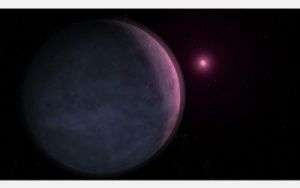
Artist's conception of the newly discovered planet MOA-2007-BLG-192Lb orbiting a brown dwarf "star" with a mass of only 6 percent of that of the Sun. Theory suggests that the 3-Earth-mass planet is made primarily of rock and ice. Observational and theoretical studies of brown dwarfs reveal that they have a magenta color due to absorption by elements such as sodium and potassium in their atmospheres. If the host star has a mass of 9 percent of that of the Sun, at the other end of the margin of error for the new microlensing data, the star would be a red dwarf about 100 times brighter than the brown dwarf, but 1000 times fainter than the Sun. Credit: NASA's Exoplanet Exploration Program

Astronomers have discovered an extrasolar planet only three times more massive than our own, the smallest yet observed orbiting a normal star. The star itself is not large, perhaps as little as one twentieth the mass of our Sun, suggesting to the research team that relatively common low-mass stars may present good candidates for hosting Earth-like planets.

Led by David Bennett of the University of Notre Dame, the international research team presents its findings in a press conference Monday, June 2, 2008 at the American Astronomical Society Meeting in St. Louis, Mo.

"Our discovery indicates that that even the lowest mass stars can host planets," says Bennett. "No planets have previously been found to orbit stars with masses less than about 20 percent that of the Sun, but this finding indicates that even the smallest stars can host planets."

The astronomers used a technique called gravitational microlensing to find the planet, a method that can potentially find planets one-tenth the mass of our own.

The gravitational microlensing technique, which came from Einstein's General Theory of Relativity, relies upon observations of stars that brighten when an object such as another star passes directly in front of them (relative to an observer, in this case on Earth). The gravity of the passing star acts as a lens, much like a giant magnifying glass. If a planet is orbiting the passing star, its presence is revealed in the way the background star brightens. A full explanation of the technique follows this release.

"This discovery demonstrates the sensitivity of the microlensing method for finding low-mass planets, and we are hoping to discover the first Earth-mass planet in the near future," said Bennett.

Using standard nomenclature, the star hosting the newly discovered planet is dubbed MOA-2007-BLG-192L with MOA indicating the observatory, 2007 designating the year the microlensing event occurred, BLG standing for bulge, 192 indicating the 192nd microlensing observation by MOA in that year and the L indicating the lens star as opposed to the background star further in the distance. The planet maintains the name but adds a letter designating it as an additional object in the star's solar system, so it is called MOA-2007-BLG-192Lb.

MOA-2007-BLG-192L resides 3,000 light years away and is classified as either a low-mass hydrogen burning star, one that sustains nuclear reactions in its core as our Sun does, or a brown dwarf, an object like a star yet without the mass to sustain nuclear reactions in its core. The researchers were unable to confirm which category the star fits into due to the nature of the observations and the margin of error.

With support from the National Science Foundation (NSF), Bennett has been one of the pioneers in using gravitational microlensing for detecting low mass planets. He has been working with collaborators around the world to find a number of planets that are ever closer in size to our own.

For the most recent discovery, the research collaborators took advantage of two international telescope collaborations: Microlensing Observations in Astrophysics (MOA), which includes Bennett, and the Optical Gravitational Lensing Experiment (OGLE).

Researchers in New Zealand made the initial measurements of the new planet and its star using the new MOA-II telescope at the Mt. John Observatory. The observatory's MOA-cam3 camera, in one observation, can capture an image of the sky 13 times larger than the area of the full moon. Researchers in Chile made follow-up observations using high angular resolution adaptive optics images at the Very Large Telescope at the European Southern Observatory. Data from the observations was analyzed by scientists around the world hailing from five continents.

"This discovery is very exciting because it implies Earth-mass planets can form around low-mass stars, which are very common," said Michael Briley, NSF astronomer and the officer who oversees Bennett's grant. "It is another important step in the search for terrestrial planets in the habitable zones of other stars, and it would not have been possible without the international collaboration of professional and amateur astronomers devoted to measuring these signals."

A paper describing this result has been accepted for publication in the Astrophysical Journal and is scheduled for publication in the Sept. 1 edition.

Source: National Science Foundation


print this article email this article download pdf blog this article bookmark this article     Digg this Stumble it share on Facebook share on Reddit add to delicious save to Yahoo! bookmarks
4.7/5 after 28 votes

Rank Filter

Move the slider to adjust rank threshold, so that you can hide some of the comments.


Display comments: newest first

  • gopher65 - Jun 02, 2008
    • Rank: not rated yet
    Nice:). When I first heard that they were being (significantly sized) searches using gravitational microlensing I didn't think much would come of it. I'm glad I was wrong:).

June 2nd, 2008 all stories
Space & Earth / Astronomy

Comments: 1
Rank: 4.7/5 after 28 votes

  • Stumble this up

  • Digg this

  • Share it:
  • share on Facebook
  • share on MySpace
  • share on Slashdot
  • rss-newsfeed
  • share on Google
  • share on Reddit
  • add to delicious
  • save to Yahoo! bookmarks
  • share on Windows Live
  • Add to Mixx!
Rating: 4.7/5 after 28 votes

  • Related Stories

  • Astronomers discover pair of solar systems in the making
    created Jul 01, 2009 | popularity not rated yet | comments 0
  • Odd discovery may help refine theories about how planets form
    created Jun 17, 2009 | popularity not rated yet | comments 0
  • Unique sky survey brings new objects into focus
    created Jun 15, 2009 | popularity not rated yet | comments 0
  • Radio telescope images reveal planet-forming disk orbiting twin suns
    created Jun 10, 2009 | popularity not rated yet | comments 0
  • Earth-Venus smash-up possible in 3.5 billion years: study
    created Jun 10, 2009 | popularity not rated yet | comments 0

Tags


  • Physicists Demonstrate Quantum Memory with Matter Qubits
    Physicists Demonstrate Quantum Memory with Matter Qubits
    Physics / General Physics
    created Jul 03, 2009 | popularity 4.4 / 5 (17) | comments 1
  • 'Holey' Nanosheets for Wastewater Dye Removal
    Nanotechnology / Nanomaterials
    created Jul 01, 2009 | popularity 5 / 5 (5) | comments 1
  • Jellyfish Robot Swims Like its Biological Counterpart
    Jellyfish Robot Swims Like its Biological Counterpart
    Electronics / Robotics
    created Jun 26, 2009 | popularity 4.4 / 5 (8) | comments 1
  • Could Maxwell's Demon Exist in Nanoscale Systems?
    Could Maxwell's Demon Exist in Nanoscale Systems?
    Physics / General Physics
    created Jun 24, 2009 | popularity 4.4 / 5 (18) | comments 29
  • Living Safely with Robots, Beyond Asimov's Laws
    Living Safely with Robots, Beyond Asimov's Laws
    Electronics / Robotics
    created Jun 22, 2009 | popularity 4.6 / 5 (52) | comments 40
  • Other News

    Scientists: Silent tremors may foretell next Big One

    Space & Earth / Earth Sciences

    created 50 minutes ago | popularity not rated yet | comments 0

    The seismometer is snugged in its hole and tamped over with dirt. Now it's time for the stomp test.


    California to require sun-blocking car windows

    Space & Earth / Environment

    created 49 minutes ago | popularity not rated yet | comments 0

    New cars sold in California must include windshields that block or absorb the sun's rays beginning in 2012, the state's Air Resources Board recently ruled.


    Steam billows from the cooling towers at a nuclear power generating station in Byron

    Tropical zone expanding due to climate change: study

    Space & Earth / Earth Sciences

    created 2 hours ago | popularity 5 / 5 (2) | comments 0

    Climate change is rapidly expanding the size of the world's tropical zone, threatening to bring disease and drought to heavily populated areas, an Australian study has found.


    The least sea ice in 800 years

    The least sea ice in 800 years

    Space & Earth / Earth Sciences

    created Jul 01, 2009 | popularity 4.1 / 5 (65) | comments 60

    New research, which reconstructs the extent of ice in the sea between Greenland and Svalbard from the 13th century to the present indicates that there has never been so little sea ice as there is now. The ...


    Gas around young galaxy

    Intense heat killed the Universe's would-be galaxies, researchers say

    Space & Earth / Astronomy

    created Jul 01, 2009 | popularity 3.4 / 5 (21) | comments 28

    (PhysOrg.com) -- Our Milky Way galaxy only survived because it was already immersed in a large clump of dark matter which trapped gases inside it, scientists led by Durham University's Institute for Computational ...