Mining for Molecules in the Milky Way
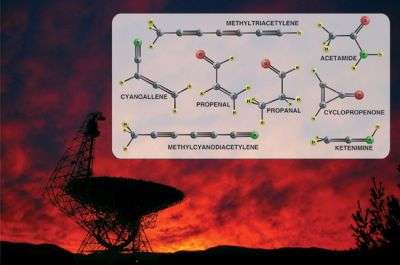
Scientists are using the giant Robert C. Byrd Green Bank Telescope (GBT) to go prospecting in a rich molecular cloud in our Milky Way Galaxy. They seek to discover new, complex molecules in interstellar space that may be precursors to life.
"Clouds like this one are the raw material for new stars and planets. We know that complex chemistry builds prebiotic molecules in such clouds long before the stars and planets are formed. There is a good chance that some of these interstellar molecules may find their way to the surface of young planets such as the early Earth, and provide a head start for the chemistry of life. For the first time, we now have the capability to make a very thorough and methodical search to find all the chemicals in the clouds," said Anthony Remijan, of the National Radio Astronomy Observatory (NRAO).
In the past three years, Remijan and his colleagues have used the GBT to discover ten new interstellar molecules, a feat unequalled in such a short time by any other team or telescope.
The scientists discovered those molecules by looking specifically for them. However, they now are changing their strategy and casting a wide net designed to find whatever molecules are present, without knowing in advance what they'll find. In addition, they are making their data available freely to other scientists, in hopes of speeding the discovery process. The research team presented its plan to the American Astronomical Society's meeting in St. Louis, MO.
As molecules rotate and vibrate, they emit radio waves at specific frequencies. Each molecule has a unique pattern of such frequencies, called spectral lines, that constitutes a "fingerprint" identifying that molecule. Laboratory tests can determine the pattern of spectral lines that identifies a specific molecule.
Most past discoveries came from identifying a molecule's pattern in the laboratory, then searching with a radio telescope for that set of spectral lines in a region of sky. So far, more than 140 different molecules have been found that way in interstellar space.
The new study reverses the process. The astronomers will use the GBT to study a cloud of gas and dust in detail, finding all the spectral lines first, then later trying to match them up to molecular patterns using data-mining software.
The astronomers will make a thorough survey of the interstellar cloud in the wide range of radio frequencies between 300 MHz to 50 GHz. This technique, they said, will allow them to discover molecules that would elude more narrow-range observations.
"This strategy wasn't possible at frequencies between 300 MHz and 50 GHz before the GBT. That telescope's tremendous capabilities enable us to open a whole new era of astrochemistry," said Jan M. Hollis, of NASA's Goddard Space Flight Center.
"Based on earlier studies, there are a number of complex, prebiotic molecules that we think are present in such clouds, but only this wide-net approach with the GBT will capture the evidence we need to discover them," Remijan said.
"Complex organic molecules formed in interstellar space are undoubtedly the fundamental building blocks of astrobiology. The complete inventory of such molecules in this cloud will produce a tremendous advance in our understanding of the physical conditions in that cloud and of the first chemical steps toward life," said Phil Jewell, of the NRAO.
As the survey with the GBT continues, the research team plans to release their data to the scientific community. In addition, they are providing software that will allow other scientists to efficiently "mine" the data for the telltale evidence of new molecules.
"There is a wealth of laboratory data now available about the radio fingerprints of many molecules. Data-mining software will make it possible to efficiently match up the spectral lines seen in the laboratory with ones we observe in the interstellar clouds," said Frank Lovas of the National Institute for Standards and Technology.
The scientists are observing Sagittarius B2(N), a cloud near the center of our Galaxy, some 25,000 light-years from Earth, Numerous molecules have been discovered in that cloud in the past.
Source: National Radio Astronomy Observatory


