Astronomers weigh the coldest brown dwarfs with astronomy's sharpest eyes
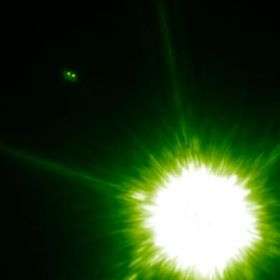
Astronomers have used ultrasharp images obtained with the Keck Telescope and Hubble Space Telescope to determine for the first time the masses of the coldest class of "failed stars," a.k.a. brown dwarfs. With masses as light as 3 percent the mass of the sun, these are the lowest mass free-floating objects ever weighed outside the solar system. The observations are a major step in testing the theoretical predictions of objects that cannot generate their own internal energy, both brown dwarfs and gas-giant planets. The new findings, which are being presented in a press conference today at the American Astronomical Society meeting in St. Louis, show that the predictions may have some problems.
"Mass is the fundamental parameter that governs the life-history of a free-floating object, and thus after many years of patient measurements, we are delighted to report the first masses of the very faintest, coldest brown dwarfs," said Dr. Michael Liu of the Institute for Astronomy at the University of Hawai'i at Mânoa (IfA/UHM). "After weighing these tiny, dim, cold objects, we have confirmed that the theoretical predictions are mostly correct, but not entirely so." The team announcing the results is composed of Dr. Liu, Mr. Trent J. Dupuy (IfA/UHM), and Dr. Michael J. Ireland (University of Sydney).
Brown dwarfs are a class of objects that represent the missing link between the lowest-mass stars and the gas-giant planets, such as Jupiter and Saturn. Brown dwarfs are the faintest and coolest objects that can be directly observed outside the solar system. They emit as little as about 1/300,000 the energy of the sun and have surface temperatures comparable to the inside of a pizza oven (800° F), more than 9,000° F cooler than the surface of the sun.
"Astronomers have measured the energy output and temperatures for a myriad of brown dwarfs. However, the most important property of all is the hardest one to measure--the mass," said Dr. Ireland.
To determine the masses, the team has spent the last several years studying brown dwarfs that occur in binaries, that is two brown dwarfs that are mutually bound together by gravity and orbit each other, in a fashion similar to how Earth orbits the sun. As first shown by Johannes Kepler in the 17th century, the total mass of any binary system can be determined by precisely measuring the orbit's size and how long it takes for the two objects to complete one orbital cycle.
"These are very challenging measurements, because brown dwarf binaries have tiny separations on the sky and orbit each other very slowly. We needed to obtain the sharpest measurements that are possible with current telescopes to precisely monitor their motion," said Mr. Dupuy.
The astronomers obtained images using the 10-meter (400-inch) Keck II Telescope on Mauna Kea, Hawaii. Keck II is equipped with a powerful adaptive optics system that corrects for the blurring of astronomical images caused by turbulence in Earth's atmosphere. The Keck system can also employ a low-power laser to create an "artificial" star to enable such correction for almost anywhere in the sky.
The resulting images have an angular resolution as good as 1/20 of an arc second, about 1/40,000 the diameter of the full moon. A person with vision as sharp as the Keck adaptive optics system would be able to read a magazine that was about a mile away. In fact, the positional accuracy achieved with such sharp images is equivalent to hitting a bull's-eye on a dartboard that is 8,000 miles away.
By regularly monitoring binaries with Keck adaptive optics and analyzing previous data obtained by the Hubble Space Telescope, the team was able to precisely measure the size and duration of the binaries' orbits, and thereby determine the masses.
The team measured the masses of two brown dwarf binaries. One, known as 2MASS 1534-2952AB, is composed of two "methane" brown dwarfs, the coolest type of brown dwarf, which is characterized by the presence of methane gas in their atmospheres. This is the first mass measurement for this type of brown dwarf. The team found that the total mass of 2MASS 1534-2952AB is only 6 percent of the sun's mass, and each brown dwarf in it has a mass of about 3 percent of the sun's (about 30 times the mass of Jupiter). The other binary system, HD 130948BC, is a pair of slightly warmer "dusty" brown dwarfs with a total mass of only 11 percent of the sun's mass and individual masses of about 5.5 percent of the sun's.
Theoretical models predict the masses of brown dwarfs based on their energy output and temperature. But when the team compared their mass measurements to the theoretical predictions, they did not agree. For example, the surface temperature of 2MASS 1534-2952AB was much cooler than expected given its current level of energy output, while HD 130948BC was much warmer.
"While there is general agreement between our data and the predictions, something is not quite right with the theoretical studies of brown dwarfs, either in determining their temperatures or in predicting their energy output. Or perhaps both," said Dr. Liu. "These findings will be a challenge for the theorists, and we are inspired to measure the masses of more brown dwarfs in the coming years to better understand the problem."
The two binaries, located in the constellations of Libra (the Scales) and Bootes (the Herdsman), are about 45-60 light-years from Earth. The two components of each binary have a typical separation of about 2 astronomical units (AU), where 1 AU is the distance from Earth to the sun (93 million miles). This is somewhat larger than the 1.5 AU distance between Mars and the sun. Their orbital periods are about 10-15 years, compared with 2 years for Mars around the sun.
The team's results are described in two upcoming papers submitted to the Astrophysical Journal. This research has been supported by the National Science Foundation and the Alfred P. Sloan Foundation.
First discovered in 1995, brown dwarfs represent a class of objects with masses less than 7 percent the mass of the sun (about 70 times Jupiter's mass). While ordinary stars become hot and dense enough in their interiors to generate their own energy via nuclear fusion, brown dwarfs have insufficient mass to do this, so instead they steadily fade and cool over their lifetime. In many ways, brown dwarfs are very similar to gas-giant planets like Jupiter and Saturn, since both types of objects are unable to steadily generate their own energy and have very low surface temperatures.
Scientists have discovered hundreds of brown dwarfs within 100 light-years of Earth. About 15 percent of them are binary systems. Dr. Adam Burgasser (then at the University of California, Los Angeles, now at MIT) and Dr. Daniel Potter (then at IfA/UH) used the Hubble Space Telescope and the Gemini-North Observatory, respectively, to identify 2MASS 1534-2952AB and HD 130948BC as binaries around 2001.
Source: University of Hawaii at Manoa


