Magnetic Sensor That Brooks No Interference
June 3, 2008 Magnetic Sensor That Brooks No Interference

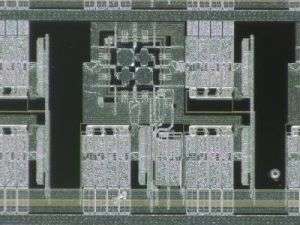
The novel magnetic sensor is capable for the first time of detecting tiny fluctuations in a small magnetic field, and does not allow even a strong magnet to interfere with it. (c) Fraunhofer IIS

Sensors accurately register the slightest temperature fluctuations, the tiniest changes to a magnetic field, or barely perceptible air currents. In some cases, however, there are limits to their accuracy – for instance when a sensor is supposed to register a small fluctuation to a magnetic field in a place where a strong magnetic field already exists.

Take the sensors in a car mirror: If there is a change of driver, the seat and the mirror usually have to be re-adjusted. It would be easier if the position of the seat and the mirror could be saved individually for each driver. With the aid of a tiny chip in the key or a corresponding button on the dashboard, the driver can move these into the correct position at the press of a single button.

There is a tiny magnet in the mirror and another in the seat, whose position is detected by a magnetic sensor and which enables the mirror to be correctly adjusted. The only problem with this system is that the cables which supply the power for heating the mirror and controlling the stepper motor also generate a magnetic field. The sensor therefore sees not only the field generated by the magnet, but also that of the power cable – and comes to the wrong conclusions. Up to now, therefore, such magnetic field sensors have had to be screened. This is difficult and expensive.

A new type of integrated 3-D magnetic field sensor from the Fraunhofer Institute for Integrated Circuits IIS in Erlangen can work without screening. The researchers have arranged several sensors in a pixel cell in such a way that they can measure all three components of the magnetic field in one place. If two of these pixel cells are placed on a chip, the sensor measures not only the magnetic field as such, but also how the position of the magnetic field changes.

"This sensor enables us for the first time to identify magnetic interference fields as such and to separate them from the useful field. The sensor works perfectly even when the interference field is considerably larger than the useful field," says IIS team leader Dr. Hans-Peter Hohe. "There is therefore no need for shielding."

The sensors have another advantage, too: They are suitable for high-temperature applications up to around 150°C and can therefore be utilized in places such as the engine compartment. The sensors have already been tested and developed to a stage where they are suitable for industrial use. To facilitate serial production of the sensors, the researchers used low-cost standard CMOS techniques to manufacture them.

Source: Fraunhofer-Gesellschaft


print this article email this article download pdf blog this article bookmark this article     Stumble it Digg this share on Facebook retweet share on Reddit add to delicious
Rate this story - 4.7 /5 (3 votes)


June 3, 2008 all stories

Comments: 0

4.7 /5 (3 votes)
  • Stumble this up

  • Digg this

  • share this

  • hide
  • Related Stories


  • hide
  • Relevant PhysicsForums posts

  • Laser plasma emission
    created 4 hours ago
  • Achromat lens - magnifying LCD
    created Nov 25, 2009
  • Control System
    created Nov 24, 2009
  • Base Isolation Systems in Skyscrapers?
    created Nov 23, 2009
  • More from Physics Forums - General Engineering

Other News

Building real security with virtual worlds

Technology / Computer Sciences

created 9 hours ago | popularity 4 / 5 (4) | comments 0

(PhysOrg.com) -- Advances in computerized modeling and prediction of group behavior, together with improvements in video game graphics, are making possible virtual worlds in which defense analysts can explore and predict ...


McKinnon, accused of hacking into US military and NASA computers, faces extradition to the United States

UFO-obsessed Briton loses bid to block US extradition

Technology / Other

created 5 hours ago | popularity 4 / 5 (2) | comments 0

A Briton accused of hacking into US military and NASA computers faces extradition to the United States after the British government Thursday rejected last-ditch requests to block the move.


Sony optimistic on 3-D TVs, in-house display (AP)

Sony optimistic on 3-D TVs, in-house display

Technology / Hi Tech

created 15 hours ago | popularity not rated yet | comments 0

(AP) -- A third to a half of the Sony Corp. TV sets sold annually will be packed with 3-D features by the year ending March 2013, a senior executive said Thursday.


Roku adds more 'channels' of video and other digital content

Technology / Telecom

created 9 hours ago | popularity not rated yet | comments 0

Owners of Roku's digital video player will soon have a bunch more channels to choose from.


A worman works on a computer

Half of Euro online travel purchases legally unsafe: EU

Technology / Internet

created 6 hours ago | popularity not rated yet | comments 0

More than half of all people who buy flights, hotel rooms and hire cars online risk being left without compensation if companies fail under outdated law, the EU said Thursday.