A Survivor in Greenland: A Novel Bacterial Species is Found Trapped in 120,000-Year-Old Ice
June 3, 2008 A Survivor in Greenland: A Novel Bacterial Species is Found Trapped in 120,000-Year-Old Ice

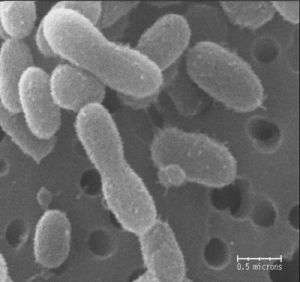
A scanning electron microscope image of the Chryseobacterium greenlandensis bacteria found in a Greenland glacier. Credit: Jennifer Loveland-Curtze, Penn State

A team of Penn State scientists has discovered a new ultra-small species of bacteria that has survived for more than 120,000 years within the ice of a Greenland glacier at a depth of nearly two miles. The microorganism's ability to persist in this low-temperature, high-pressure, reduced-oxygen, and nutrient-poor habitat makes it particularly useful for studying how life, in general, can survive in a variety of extreme environments on Earth and possibly elsewhere in the solar system.

The work will be presented by Jennifer Loveland-Curtze, a senior research associate in the laboratory led by Jean Brenchley, Professor of Biochemistry and Molecular Biology at Penn State, at the 108th American Society for Microbiology General Meeting in Boston, Massachusetts today.

This new species is among the ubiquitous, yet mysterious, ultra-small bacteria, which are so tiny that the cells are able to pass through microbiological filters. In fact, some species have been found living in the ultra-purified water used for dialysis. "Ultra-small cells could be unknown contaminants in media and medical solutions that are thought to have been sterilized using filters," said Loveland-Curtze.

The ultra-small size of the new species could be one explanation for why it was able to survive for so long in the Greenland glacier. Called Chryseobacterium greenlandensis, the species is related genetically to certain bacteria found in fish, marine mud, and the roots of some plants. The organism is one of only about 10 scientifically described new species originating from polar ice and glaciers.

To study the bacterium in the laboratory, the research team, which also includes Senior Research Associate Vanya Miteva, filtered the cells from melted ice and incubated them in the cold in low-nutrient, oxygen-free solutions. The scientists then characterized the genetic, physiological, biochemical, and structural features of the species. The team hopes that its studies of this species, as well as others living in the Greenland glacier, will reveal more about how cells survive and how they may alter their biochemistry and physiology over time.

"Microbes comprise up to one-third or more of the Earth's biomass, yet fewer than 8,000 microbes have been described out of the approximately 3,000,000 that are presumed to exist," said Loveland-Curtze. "The description of this one species is a significant step in the overall endeavor to discover, cultivate, and use the special features held by these organisms."

Source: Penn State


print this article email this article download pdf blog this article bookmark this article     Stumble it Digg this share on Facebook retweet share on Reddit add to delicious
Rate this story - 4.6 /5 (39 votes)

Rank Filter

Move the slider to adjust rank threshold, so that you can hide some of the comments.


Display comments: newest first

  • wsbriggs - Jun 03, 2008
    • Rank: 3.5 / 5 (2)
    Hmmm, does this mean that in the last 150,000 years or so, the Greenland ice sheet was melted, or does this mean that the melting of the bottom due to pressure just keeps the thickness of the sheet somewhat constant? In the latter case, then the bacteria could have be deposited at the top and slowly decended to the level they were found.
  • h0dges - Jun 03, 2008
    • Rank: 4 / 5 (2)
    All it means is that Chryseobacterium greenlandensis has survived in a low-temperature, high-pressure, reduced-oxygen, and nutrient-poor environment for 120,000 years helping us to understand the extreme conditions life can be forced to life in and survive. This article is not about the origins or how they ended up in the ice.
  • Quantum_Conundrum - Jun 03, 2008
    • Rank: not rated yet
    "Microbes comprise up to one-third or more of the Earth's biomass, yet fewer than 8,000 microbes have been described out of the approximately 3,000,000 that are presumed to exist,"
    ---

    See here? "Presumed".

    That is the most unscientific statement. They have catalogued 8,000 species, but for no real reason whatsoever, they assume there are 3,000,000 microbe species on earth.

    Wow, on what grounds is such an assumption made?
  • ofidiofile - Jun 03, 2008
    • Rank: not rated yet
    "They have catalogued 8,000 species, but for no real reason whatsoever, they assume there are 3,000,000 microbe species on earth."

    "Wow, on what grounds is such an assumption made?"

    Well look it up, don't just b1tch about it. If you're here, I assume you can make it to Google or Wikipedia just as easily.

    "...no real reason"? C'mon, that's just lame.
  • nbe - Jun 04, 2008
    • Rank: not rated yet
    What I dislike is "greenlandensis". What was wrong with a proper latinization as "groenlandensis". It would not only be less offensive to Latin (even if dead!), it would even be like the Danish name "Groenland" (being Groenland Danish). Else, we might as well speak about "wolfus" instead of "lupus" or get rid of all Latin if we dislike it so much that it is not English and still part of scientific traditions and history!

June 3, 2008 all stories

Comments: 5

4.6 /5 (39 votes)
  • Stumble this up

  • Digg this

  • share this

  • hide
  • Related Stories


Other News

Scientists visualize how bacteria talk to one another

Scientists visualize how bacteria talk to one another

Biology / Cell & Microbiology

created 9 hours ago | popularity 4.9 / 5 (7) | comments 1

Using imaging mass spectrometry, researchers at the University of California, San Diego have developed tools that will enable scientists to visualize how different cell populations of cells communicate. Their ...


W. Africa's last giraffes make surprising comeback (AP)

W. Africa's last giraffes make surprising comeback

Biology / Ecology

created 18 hours ago | popularity not rated yet | comments 0

(AP) -- A crisp African dawn is breaking overhead, and Zibo Mounkaila is on the back of a pickup truck bounding across a sparse landscape of rocky orange soil.


W. Africa's last giraffes make surprising comeback (AP)

China sends panda expert to Taiwan to aid breeding

Biology / Plants & Animals

created 18 hours ago | popularity not rated yet | comments 0

(AP) -- Nothing like a little time apart to rekindle the affections that could lead to a baby panda.


Laser etching safe alternative for labeling grapefruit

Laser etching safe alternative for labeling grapefruit

Biology / Other

created Nov 03, 2009 | popularity 4.4 / 5 (14) | comments 8

Laser labeling of fruit and vegetables is a new, patented technology in which a low-energy carbon dioxide laser beam is used to label, or "etch" information on produce, thereby eliminating the need for common ...


Wolves, moose and biodiversity: An unexpected connection

Wolves, moose and biodiversity: An unexpected connection

Biology / Ecology

created Nov 02, 2009 | popularity 4.9 / 5 (7) | comments 4

Moose eat plants; wolves kill moose. What difference does this classic predator-prey interaction make to biodiversity?