New Zealand colonised 1000 years later than previously thought
June 3, 2008 New Zealand colonised 1000 years later than previously thought

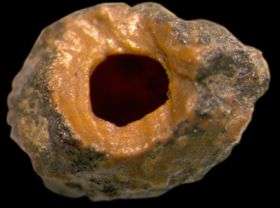
Rat-gnawed matai nut

A University of Adelaide palaeontologist has helped to uncover compelling new evidence that New Zealand was discovered 1000 years later than commonly believed.

Trevor Worthy is part of an international team of four researchers who have used radiocarbon dating of Pacific rat bones and rat-gnawed native seeds to show that humans arrived on New Zealand about 1280-1300AD, not 200BC as previously thought.

The controversial finding has been published today in the prestigious journal Proceedings of the National Academy of Sciences in the United States.

Mr Worthy, from the School of Earth and Environmental Sciences, said the carbon dating results do not support previous claims published in Nature in 1996 that humans visited the country over 2000 years ago.

“”There is no supporting ecological or archaeological evidence for the presence of Pacific rat or humans until 1280-1300AD and the reliability of the bone dating from that first study has been questioned,” he said.

This is the first time that the actual sites involved in the original study have been re-excavated and analysed.

Team leader Dr Janet Wilmshurst from Landcare Research in New Zealand said the dating of the rat bones is consistent with other evidence from the oldest dated archaeological sites in the country.

“As the Pacific rat or kiore cannot swim very far, it can only have arrived in New Zealand with people on board their canoes, either as cargo or stowaways. Therefore, the earliest evidence of the Pacific rat in New Zealand must indicate the arrival of people,” Dr Wilmshurst said.

The dating of the rat bones is also supported by the dating of more than 100 woody seeds, many of which have distinctive tell-tale rat bite marks, preserved in peat and swamp sites from the North and South Islands.

The finding suggests that colonisation of New Zealand did not involve a protracted delay between initial discovery and subsequent colonisation, an idea implicit in earlier theories.

“The first people arriving in New Zealand from tropical east Polynesia initiated an immediate and rapid transformation,” Dr Wilmshurst said.

Mr Worthy, a world bird expert, joined the University of Adelaide from New Zealand in 2005. He has just completed his PhD on fossil waterfowl of Australia and New Zealand.

Source: The University of Adelaide


Rate this story - 4.3 /5 (16 votes)

Rank Filter

Move the slider to adjust rank threshold, so that you can hide some of the comments.


Display comments: newest first

  • nilbud - Jun 03, 2008
    • Rank: 2 / 5 (3)
    Maybe now they'll shut up about their nonsense ancient ways and stop boring us at rugby matches with their dance of the homosexual coward (look it up).
  • grunta - Jun 07, 2009
    • Rank: not rated yet
    and these people are supposed to be scientists ??

    what if ..... as they were making there uncharted trip over, starving aboard their vessels, ate everything they could before they managed landfall, there wouldn't be any rats until others came, which may or may not have been a week later - or 1000 yrs later
    I'm glad you lot don't work out my pay each week

June 3, 2008 all stories

Comments: 2

4.3 /5 (16 votes)

  • hide
  • Related Stories


  • hide
  • Relevant PhysicsForums posts

Other News

Office romance? Not a problem most of time: study

Office romance? Not a problem most of time: study

Other Sciences / Social Sciences

created 14 minutes ago | popularity not rated yet | comments 0

(PhysOrg.com) -- Pam and Jim on The Office. Meredith and McDreamy on Grey's Anatomy. Television shows depict many workplace romances, but in the real world how do co-workers view love on the job? According ...


Pay-for-performance in healthcare

Other Sciences / Economics

created 1hour ago | popularity not rated yet | comments 0

BOSTON--Although the idea of pay-for-performance (P4P) is popular among healthcare policy makers and private insurers, the results do not necessarily translate to the patient.


'Counterfactual' thinkers are more motivated and analytical, study suggests

Other Sciences / Social Sciences

created 1hour ago | popularity 4 / 5 (1) | comments 0 | with audio podcast

(PhysOrg.com) -- "If only I had..." Almost everyone has said those four words at some time. Rather than intensifying regret, '"what if" reflection about pivotal moments in the past helps people to weave a coherent life story, ...


Study: Cell-phone bans while driving have more impact in dense, urban areas

Study: Cell-phone bans while driving have more impact in dense, urban areas

Other Sciences / Social Sciences

created 2 hours ago | popularity not rated yet | comments 1

A new study analyzing the impact of hand-held cell phone legislation on driving safety concludes that usage-ban laws had more of an impact in densely populated urban areas with a higher number of licensed ...


Has the mystery of the Portrait of Maud Abrantes been solved?

Has the mystery of the Portrait of Maud Abrantes been solved?

Other Sciences / Other

created 5 hours ago | popularity not rated yet | comments 0

A century after Amedeo Modigliani painted the Portrait of Maud Abrantes, the mystery behind the painting might be solved. Ofra Rimon, Director and Curator of the Hecht Museum at the University of Haifa, discovered ...