SanDisk Releases Solid-State Drives Aimed at Ultra Low-Cost PCs
June 3, 2008 SanDisk Releases Solid-State Drives Aimed at Ultra Low-Cost PCs

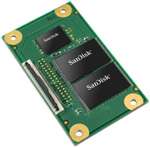
SanDisk Corporation today introduced a line of flash memory-based solid-state drives (SSDs) that are designed for an emerging new category of portable consumer electronics – called Ultra Low-Cost PCs (ULCPC) or 'netbooks' – that allow users to have an enhanced experience while easily surfing the Internet using wireless communication. The SanDisk pSSD (Parallel ATA solid state drive) eliminates the need for a hard disk drive and can store both the operating system and application data for these new devices.

SanDisk is making the new SSD modules available in 4-, 8- and 16-gigabyte capacities, with a streaming read speed of 39 megabytes per second and a streaming write performance of 17MB/s. Supporting both Linux and Microsoft Windows XP operating systems, SanDisk pSSD solid state drives are being shown this week at Computex Taipei.

SanDisk’s pSSD solid state drives, which are expected to be available starting in August, are built using the company’s reliable Multi-Level Cell (MLC) and Single-Level Cell (SLC) flash memory. This technology is produced at fabrication plants in Yokkaichi, Japan, where SanDisk and its partner, Toshiba Corporation, share the output. The two companies have co-developed many of the designs and technologies in NAND flash.

ULCPCs are inexpensive handheld laptops – smaller than a conventional notebook computer but larger than a mobile “smart” phone – that are easy to carry and cost in the range of $250 to $350. They enable consumers to browse the Internet on the go, with a user interface that replicates that of larger PCs. Originally, ULCPCs were developed as low-cost computing solutions for school children in developing nations. But the diminutive devices have caught on with adults, and now manufacturers are rolling out devices that are designed for general consumer use. Other names for these include Ultra-Mobile PC (UMPC) and Mobile Internet Device (MID).

“We’re excited to be involved in this emerging market of ULCPCs, which take the concept of affordability into new directions – ones that are ideally suited to the multiple benefits of SanDisk’s technology,” said Rich Heye, Senior Vice President and General Manager at SanDisk’s Solid State Drives (SSD) Business Unit. “Based on consumer response to some of the first ULCPCs, these devices are quickly developing a popular following. Our new pSSDs are enablers for manufacturers to create what could become the next wave of personal and portable computing devices.”

According to Joseph Unsworth, Research Director at Gartner, “The opportunity for SSDs in the emerging market of ultra low-cost PCs is promising.” Gartner expects the low-cost SSD category to grow from 635,000 units in 2007 to over 33 million units in 2012, and that represents a five-year compound growth rate of 117 percent. “As semiconductor innovation enables more powerful functionality at lower prices, storage requirements will continue to be elastic, providing opportunities for companies that can command compelling low-cost SSD solutions,” said Unsworth.

The ULCPC category includes devices that exclusively use solid state drives, rather than conventional hard disk drives, for the system volume. The devices require small form factor and low power consumption, thus providing a good user experience and a full day’s work on a single battery charge. In addition to providing affordable computing solutions, these PCs are designed to withstand the heat, dust, humidity and unreliable power that can impact performance. Thus, ULCPCs leverage the main advantages of flash-based SSDs including reliability, power consumption, form factor and cost.

Source: SanDisk


print this article email this article download pdf blog this article bookmark this article     Stumble it Digg this share on Facebook retweet share on Reddit add to delicious
Rate this story - 4.4 /5 (17 votes)

Rank Filter

Move the slider to adjust rank threshold, so that you can hide some of the comments.


Display comments: newest first

  • Lord_jag - Jun 03, 2008
    • Rank: 2.5 / 5 (2)
    39mB/sec is faster than SATA-300. I wouldnt mind getting a few of those in a raid system on my laptop. Pretty much shock-proof too. No more HD crashes.
  • Enthalpy - Jun 03, 2008
    • Rank: not rated yet
    Sata-300 is capable of 300MB/s at the interface, even though not everything is data there. Quite more than 39MB/s.

    As a comparison, my P-Ata disks have a contiguous read speed of 78MB/s and their interface transfers 93MB/s on an Ata-100 host and 122MB/s on an Ata-133 host.

    But Flash disks can be faster thanks to their access time. And they are better than 2.5" disks.
    Raid doesn't necessarily improve, and the added Bios time can slow down the boot.

    Don't wait for ssd! Buy an authentic Transcend 266x CF, put it on an adapter CF-Pata44 from pcengines.ch, that's all. Available now, cheaper.

    Adata 266x works also, but writes less quickly. SanDisk Extreme IV (authentic, not asian eBay) are fast but not "fixed" media, it needs tricks to install Win on them.

    From Transcend, you get >40MB/s sustained read speed in Udma/66.

    I gave up Win2k on CF with PIIIs @1650MHz as good 3.5" HD are as fast with this processor, but I have a Win95b on CF with P1mmx 120MHz: clearly better than a 2.5" 4200/min HD.

    Best site (is in French): Dandu.be

June 3, 2008 all stories

Comments: 2

4.4 /5 (17 votes)
  • Stumble this up

  • Digg this

  • share this

  • hide
  • Related Stories

  • The upside of feeling down
    created Nov 09, 2009 | popularity not rated yet | comments 0
  • Fantastic Voyage
    created Nov 02, 2009 | popularity not rated yet | comments 0
  • Study: Some stock repurchase plans just empty promises
    created Oct 07, 2009 | popularity not rated yet | comments 0
  • Rare earths are vital, and China owns them all
    created Sep 28, 2009 | popularity not rated yet | comments 0
  • Toshiba Adds 32nm mSATA And Half-Slim Solid State Drive Modules
    created Sep 21, 2009 | popularity not rated yet | comments 0


  • hide
  • Relevant PhysicsForums posts

  • Control System
    created 20 hours ago
  • Base Isolation Systems in Skyscrapers?
    created Nov 23, 2009
  • Need to interview a Computer Hardware Engineer for school project
    created Nov 23, 2009
  • transient heat transfer
    created Nov 23, 2009
  • More from Physics Forums - General Engineering

Other News

Qualcomm's next e-book to use a mirasol display

Qualcomm's next e-book to use a mirasol display

Electronics / Consumer & Gadgets

created Nov 20, 2009 | popularity 4.7 / 5 (11) | comments 2

(PhysOrg.com) -- Qualcomm subsidiary Mirasol is developing a new e-book reader with a color display that uses ambient light. The reader will be capable of displaying video smoothly, but the new features will ...


Robotic clam digs in mudflats

Electronics / Robotics

created Nov 22, 2009 | popularity 5 / 5 (3) | comments 0

To design a lightweight anchor that can dig itself in to hold small underwater submersibles, Anette (Peko) Hosoi of MIT borrowed techniques from one of nature's best diggers -- the razor clam.


"Walky" Project (Keio University in Tokyo)

iPhone Software That Controls Robot Movements (w/ Video)

Electronics / Robotics

created Nov 18, 2009 | popularity 5 / 5 (6) | comments 0

(PhysOrg.com) -- At the graduate school of media design at Keio University in Tokyo, a project called "Walky" is under developed. Researchers have developed specifically designed software for the iPhone that ...


New study to evaluate robots as exercise trainers (w/ Video)

Electronics / Robotics

created Nov 19, 2009 | popularity not rated yet | comments 0

Maja Mataric', who directs the University of Southern California Center for Robotics and Embedded Systems, will lead an effort to evaluate robots as exercise coaches for adults of all ages, with a particular focus on the ...


Review: $100 Palm Pixi is stylish but sluggish (AP)

Review: $100 Palm Pixi is stylish but sluggish

Electronics / Consumer & Gadgets

created Nov 18, 2009 | popularity 1 / 5 (1) | comments 0

(AP) -- Palm Inc. is fighting harder than ever to snag a chunk of the smart phone market, and just six months after releasing the stylish Pre it's back with a lighter, more petite and affordable version called ...