Novel 'noise thermometry' may help redefine international unit of temperature
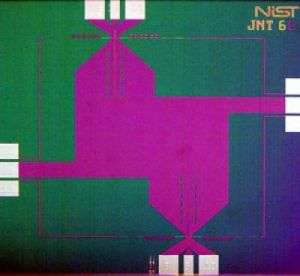
After seven years of work, researchers at the National Institute of Standards and Technology have built a system that relies on the "noise" of jiggling electrons as a basis for measuring temperatures with extreme precision. The system is nearly precise enough now to help update some of the crucial underpinnings of science, including the 54-year-old definition of the Kelvin, the international unit of temperature.
NIST's Johnson noise thermometry (JNT) system, to be described Monday, June 9, at the Conference on Precision Electromagnetic Measurements, represents a five-fold advance in the state of the art in noise thermometry thanks to its use of a unique quantum voltage source combined with recent reductions in systematic errors and uncertainty. It is also simpler and more compact than other leading systems for measuring high temperatures, such as those based on the pressure and volume of gases.
"What's beautiful about our JNT system is that it's so conceptually simple," says project leader Sam Benz. "All the measurements are electrical—they don't require large volumes of gas and mechanical systems that change in different environmental conditions."
As a thermometer, the JNT system will be most useful in the range from approximately 500 K (227 degrees C or 440 degrees F) to 1235 K (962 degrees C or 1763 degrees F). Its most obvious application is as a primary measurement standard (maintained at NIST and other national metrology labs for calibration of thermometers), but it also might be used directly in some industrial thermometry labs.
The recent JNT improvements are especially significant because they may contribute to a separate important measurement problem, the determination of Boltzmann's constant. Several years from now, the international metrology community is expected to fix the value of the Boltzmann constant, used in scientific calculations to relate energy to temperature in particles. The Boltzmann constant, in turn, would then be used to redefine the Kelvin as part of an international effort to link all units to fundamental constants, a more stable and reproducible approach than traditional measurement standards based on physical objects or substances. The current Kelvin is defined in terms of the triple-point temperature of water (273.16 K, or about 0 degrees C and 32 degrees F), or the temperature and pressure at which water's solid, liquid and vapor forms coexist in balance.
The JNT system is the only electrical approach to determining the Boltzmann constant, and is currently among the top three thermometry systems competing for the redefinition, in terms of offering the lowest uncertainties, Benz says.
The NIST system measures very small electrical noise in resistors, a common electronic component, when they are cooled to the water triple point. This "Johnson noise" is caused by the random motion of electrons and is directly proportional to temperature. The unique aspect of the system is the use of precision waveforms—electrical signals—synthesized with a superconducting alternating current (AC) voltage source whose output is based on fundamental principles of quantum mechanics, to calibrate the electronic devices measuring the noise power. This enables the system to match electrical power and thermal-noise power at the triple point of water.
NIST was able to include this capability in the JNT system thanks to its recent development of the first precision instrument for synthesizing fundamentally accurate AC voltages. The quantum nature of the design assures that copies of the system will produce identical results in different laboratories, a feature that is impossible with artifact-based standards.
The most accurate measurement of the Boltzmann constant to date was performed at NIST about two decades ago using acoustic gas thermometry. The JNT system would require further improvements to be competitive with the acoustic method, but Benz thinks this is possible. A downside to the JNT system is its slow speed: It will take about one month to integrate the data to achieve the precision needed to define the Boltzmann constant, Benz says.
Ref: S.P. Benz, H. Rogalla, D.R. White, Jifeng Qu, P.D. Dresselhaus, W.L. Tew and S.W. Nam. 2008. Improvements in the NIST Johnson Noise Thermometry System. To be presented at the Conference on Precision Electromagnetic Measurements, Broomfield, Colo., June 9.
Source: National Institute of Standards and Technology (NIST)


