Milky Way's Inner Beauty Revealed
June 3, 2008 Milky Way's Inner Beauty Revealed

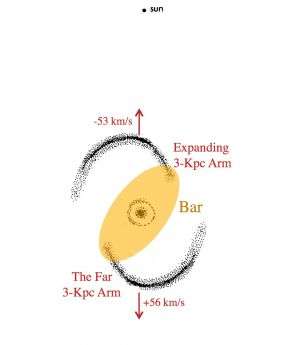
Astronomers Tom Dame and Patrick Thaddeus have found evidence for a far-side counterpart to the expanding 3-kiloparsec spiral arm near the center of the Milky Way. The new arm is a virtual twin to the near arm, which was found 50 years ago. The inner Milky Way therefore shows a beautiful symmetry. Credit: Tom Dame (Harvard-Smithsonian CfA)

We live in the Milky Way galaxy - a disk-shaped collection of about 400 billion stars including the Sun. Many of those stars and much of the dense gas between the stars concentrate into large arms that spiral outward from the galactic center.

Astronomers have worked for decades to map the Milky Way and its spiral arms. They have just discovered a new spiral arm on the far side of the galactic center from Earth, which is a virtual twin of a known arm on the near side of the galactic center. The Milky Way therefore shows a beautiful symmetry, with two matching spiral arms lazily spinning near the galaxy's center.

Tom Dame of the Harvard-Smithsonian Center for Astrophysics (CfA) presented this finding today in a press conference at the 212th American Astronomical Society meeting.

"Our galaxy isn't as messy as many thought. What we have found is evidence of some balance and order, like the yin and yang of Chinese philosophy," said Dame.

The Milky Way has other, larger spiral arms farther out in the galactic disk. This study focuses on the two arms closest to the center of the galaxy,

A 50-year puzzle solved

Fifty years ago, radio astronomers found an unusual spiral arm about 10,000 light-years from the center of the Milky Way along our line of sight. They called it the expanding 3-kiloparsec (3-kpc) arm since 3 kpc equals 10,000 light-years, and it was found to be expanding away from the center at more than 50 kilometer per second. The expanding 3-kpc arm contains about 10 million sun's worth of gas, mostly hydrogen atoms and molecules.

They suspected a similar arm might exist on the far side of the Milky Way, since many other galaxies tend to be symmetrical. But for decades, they were unable to find any evidence for a far-side counterpart of the expanding 3-kpc arm. One reason is that the galactic center is so crowded, with many different hydrogen gas clouds overlapping the same patch of sky.

"Studying the galactic center is like listening to a conversation in the middle of a crowded cocktail party. There's lots of noise," said Dame's CfA colleague Patrick Thaddeus.

Dame and Thaddeus analyzed data obtained using a 1.2-meter-diameter millimeter-wave telescope located at Cerro Tololo Inter-American Observatory in Chile.

When Dame processed the data to highlight large-scale structures very close to the plane of the galaxy, a new feature jumped out at him. The data clearly showed a spiral arm exactly where the far 3-kpc arm should be, with properties like radius, expansion velocity, mass, and brightness that were mirror images of the near 3-kpc arm.

Spiral arms and galactic bar linked

Dame and Thaddeus suspect that the 3-kpc spiral arms are linked to the galactic bar. At the center of the Milky Way, billions of stars inhabit an elongated conglomeration called a stellar bar, which extends for several thousand light-years on either side of the galactic center. As that central bar rotates, it produces large-scale shock waves that likely sculpt the 3-kpc spiral arms and power their outward motions. In fact, theorists believe that those spiral arms connect to the ends of the bar.

"The 3-kiloparsec arms are a natural result of the stellar bar," explained Thaddeus. "We expected that the bar should drive symmetric structure. Now, we have proof that it does."

Dame and Thaddeus confirmed their discovery using 21-centimeter radio measurements of atomic hydrogen collected by colleagues in Australia. Next, they plan to apply for observing time on the Robert C. Byrd Green Bank Telescope to examine the 3-kpc spiral arms in more detail. They also want to extend their observations to greater galactic longitudes as seen from Earth.

"We want to see how far we can chase these arms - hopefully to their origins at the ends of the central bar," said Dame.

Source: Harvard-Smithsonian Center for Astrophysics


print this article email this article download pdf blog this article bookmark this article     Stumble it Digg this share on Facebook retweet share on Reddit add to delicious
Rate this story - 4.7 /5 (39 votes)

Rank Filter

Move the slider to adjust rank threshold, so that you can hide some of the comments.


Display comments: newest first

  • Mercury_01 - Jun 03, 2008
    • Rank: 4 / 5 (3)
    Shoot, y'aint gotta go that far to get a beer, do ya?
  • Mombo_Dogface - Jun 03, 2008
    • Rank: 5 / 5 (2)
    Awesome! We have a galactic bar. :)
  • superhuman - Jun 08, 2008
    • Rank: not rated yet
    I would really like to explore our Galaxy, visit the bar and the central spiral arms! Too bad proper technology is still lightyears away.

June 3, 2008 all stories

Comments: 3

4.7 /5 (39 votes)
  • Stumble this up

  • Digg this

  • share this

  • hide
  • Related Stories

  • Hubble Image Showcases Star Birth in M83, the Southern Pinwheel
    created Nov 05, 2009 | popularity not rated yet | comments 0
  • Swift makes best-ever ultraviolet portrait of Andromeda Galaxy
    created Sep 16, 2009 | popularity not rated yet | comments 0
  • NASA's Spitzer Images Out-of-This-World Galaxy
    created Jul 23, 2009 | popularity not rated yet | comments 0
  • Astrophysicists solve mystery in Milky Way galaxy
    created Jul 09, 2009 | popularity not rated yet | comments 0
  • Poor attention in kindergarten predicts lower high school test scores
    created May 26, 2009 | popularity not rated yet | comments 0


  • hide
  • Relevant PhysicsForums posts

  • Some help with a X-Ray astronomy question please!
    created 15 hours ago
  • Help with Images and Optical Instrument Question..
    created Nov 26, 2009
  • Redshift as a distance indicator
    created Nov 26, 2009
  • Question about 2-body gravity
    created Nov 24, 2009
  • More from Physics Forums - General Astronomy

Other News

Fermi Telescope Peers Deep into Microquasar

Fermi Telescope Peers Deep into Microquasar (w/ Video)

Space & Earth / Astronomy

created 9 hours ago | popularity 4.6 / 5 (5) | comments 0

(PhysOrg.com) -- NASA's Fermi Gamma-ray Space Telescope has made the first unambiguous detection of high-energy gamma-rays from an enigmatic binary system known as Cygnus X-3. The system pairs a hot, massive ...


The Energy Sources of Ultraluminous Galaxies

The Energy Sources of Ultraluminous Galaxies

Space & Earth / Astronomy

created 10 hours ago | popularity 4.4 / 5 (8) | comments 0

(PhysOrg.com) -- Ultraluminous infrared galaxies ((ULIRGs) are galaxies whose luminosity exceeds that of a trillion suns; for comparison, the Milky Way galaxy has a typical (and much more modest) luminosity ...


Space shuttle Atlantis, 7 astronauts back on Earth (AP)

Space shuttle Atlantis, 7 astronauts back on Earth

Space & Earth / Space Exploration

created 10 hours ago | popularity not rated yet | comments 0

(AP) -- Space shuttle Atlantis and its seven astronauts returned to Earth with a smooth touchdown Friday to end an 11-day flight that resupplied the International Space Station.


Herschel takes a peek at the ingredients of the galaxies

Herschel takes a peek at the ingredients of the galaxies

Space & Earth / Astronomy

created 8 hours ago | popularity 4.5 / 5 (2) | comments 0

(PhysOrg.com) -- The European Space Agency has today released spectacular new observations from the Herschel Space Observatory, including the UK-led SPIRE instrument. Spectrometers on board all three Hershel ...


China is set to launch its second moon orbiter next October, state media have reported

China to launch second lunar probe: state media

Space & Earth / Space Exploration

created 15 hours ago | popularity 5 / 5 (4) | comments 0

China will launch its second moon orbiter next October, state media reported Friday, as it powers ahead with a space programme that has sparked concerns abroad.