White Dwarf Lost in Planetary Nebula
June 3, 2008
White Dwarf Lost in Planetary Nebula

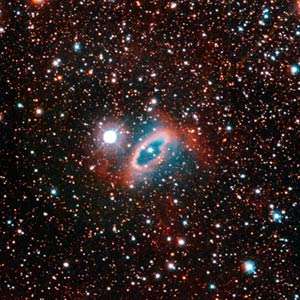
This image of the planetary nebula SuWt 2 reveals a bright ring-like structure encircling a bright central star. The central star is actually a close binary system where two stars completely circle each other every five days. The interaction of these stars and the more massive star that sheds material to create the nebula formed the ring structure. The burned out core of the massive companion has yet to be found inside the nebula. The nebula is located 6,500 light-years from Earth in the direction of the constellation Centaurus. This color image was taken on Jan. 31, 1995 with the National Optical Astronomy Observatory's 1.5-meter telescope at the Cerro Tololo Inter-American Observatory in Chile. Credit: NASA, NOAO, H. Bond and K. Exter (STScI/AURA)

Call it the case of the missing dwarf. A team of stellar astronomers is engaged in an interstellar CSI (crime scene investigation). They have two suspects, traces of assault and battery, but no corpse.

The southern planetary nebula SuWt 2 is the scene of the crime, some 6,500 light-years from Earth in the direction of the constellation Centaurus.

SuWt 2 consists of a bright, nearly edge-on glowing ring of gas. Faint lobes extend perpendicularly to the ring, giving the faintest parts of the nebula an hourglass shape.

These glowing ejecta are suspected to have been energized by a star that has now burned out and collapsed to a white dwarf. But the white dwarf is nowhere to be found.

The mystery deepened when researchers obtained ultraviolet observations in the early 1990's with NASA's International Ultraviolet Explorer satellite, expecting to see signs of a faint but very hot star. But no ultraviolet radiation was detected.

Instead, at the center of the nebular ring are two suspicious characters: a pair of tightly bound stars that whirl around each other every five days, neither one of which is a white dwarf. These stars are hotter than our Sun (their spectral class is A) but they are still not hot enough to make the nebula glow. Only a flood of ultraviolet radiation, such as that from the missing white dwarf, could do that.

The study is being conducted by Katrina Exter and Howard Bond of the Space Telescope Science Institute in Baltimore, Md. and a team of British and American colleagues. Their extensive photometry and spectroscopy of the binary show that both stars are larger than main-sequence stars of their masses. This may imply that they have started to evolve toward becoming red giants. Both stars also appear to be rotating more slowly than expected; they would be expected to always be facing the same sides toward each other, but they do not.

The astronomers suggest a simple explanation for the facts at the scene: the stars at the center of SuWt 2 were born as a family of three, with the A stars circling each other tightly and a more massive star orbiting further out. This allowed room for the massive star to evolve to become a red giant, which only then engulfed the pair of A stars. Trapped inside the red giant in what astronomers call a "common envelope," the pair spiraled down toward the core, causing the envelope to spin faster. Eventually, the outer layers of the red giant were ejected in the plane of the orbit, producing the ring-shaped nebula seen today. The unusually slow spins of the two A stars may have been another consequence of their victimization by their massive sibling.

The ground-based observations were obtained with telescopes at the Cerro Tololo Inter- American Observatory, Chile; the New Technology Telescope at the European Southern Observatory, Chile; the Anglo-Australian Telescope, Australia; and the South African Astronomical Observatory.

Ultraviolet radiation from the exposed hot core of the red giant would have caused the nebula to glow. If the giant's core were of high enough mass, it would then shrink and cool off rapidly to a faint white dwarf, which might explain its current invisibility.

Their results are being presented today at the 212th meeting of the American Astronomical Society in St. Louis, Mo. Other members of the team are Keivan Stassun (Vanderbilt University, Tenn.), Pierre Maxted and Barry Smalley (Keele University, UK), and Don Pollacco (Queen's University, UK).

Source: Hubble Center

4.2 /5 (10 votes)  

Rank 4.2 /5 (10 votes)
Tags

Related Stories
Relevant PhysicsForums posts
  • Scale of the Universe
    created9 hours ago
  • Titan's lack of impact craters
    createdFeb 09, 2012
  • Real pictures of black hole eating a star?
    createdFeb 08, 2012
  • Hypothetical way to travel faster than light, but not technically exceed lightspeed
    createdFeb 06, 2012
  • How do scientists monitor the Sun's activity?
    createdFeb 05, 2012
  • Search patterns in observational studies
    createdFeb 05, 2012
  • More from Physics Forums - General Astronomy

More news stories

Humans may have helped the decline of African rainforests 3000 years ago

(PhysOrg.com) -- Large areas of rainforests in Central Africa mysteriously disappeared over three thousand years ago, to be replaced by savannas. The prevailing theory has been that the cause was a change ...

Space & Earth / Environment

created 20 hours ago | popularity 4.3 / 5 (11) | comments 12 | with audio podcast report

Could Venus be shifting gear?

(PhysOrg.com) -- ESA’s Venus Express spacecraft has discovered that our cloud-covered neighbour spins a little slower than previously measured. Peering through the dense atmosphere in the infrared, the ...

Space & Earth / Space Exploration

created 16 hours ago | popularity 5 / 5 (7) | comments 7 | with audio podcast

NASA budget will axe Mars deal with Europe: scientists

US President Barack Obama's budget proposal to be submitted next week for 2013 will cut NASA's budget by 20 percent and eliminate a major partnership with Europe on Mars exploration, scientists said Thursday.

Space & Earth / Space Exploration

created 19 hours ago | popularity 5 / 5 (2) | comments 18

Mars Science Laboratory computer issue resolved

(PhysOrg.com) -- Engineers have found the root cause of a computer reset that occurred two months ago on NASA's Mars Science Laboratory and have determined how to correct it.

Space & Earth / Space Exploration

created 17 hours ago | popularity 4.7 / 5 (6) | comments 3 | with audio podcast

Two new moons for Jupiter

Advances in technology have lead to the discovery of new planets outside of our Solar System, and now even new moons in our own backyard.

Space & Earth / Space Exploration

created 16 hours ago | popularity 4 / 5 (1) | comments 7


Anonymous knocks CIA website offline (Update)

The website of the Central Intelligence Agency was inaccessible on Friday after the hacker group Anonymous claimed to have knocked it offline.

Google users warned of threat to smartphone wallets

Users of Google smartphone wallets were being warned on Friday that there is a way to crack pass codes intended to thwart thieves from going on illicit shopping sprees.

New error-correcting codes guarantee the fastest possible rate of data transmission

Error-correcting codes are one of the triumphs of the digital age. They’re a way of encoding information so that it can be transmitted across a communication channel — such as an optical fiber o ...

New power source discovered

(PhysOrg.com) -- Researchers at the Massachusetts Institute of Technology (MIT) and RMIT University have made a breakthrough in energy storage and power generation.

The power of estrogen -- male snakes attract other males

A new study has shown that boosting the estrogen levels of male garter snakes causes them to secrete the same pheromones that females use to attract suitors, and turned the males into just about the sexiest ...

Small modular reactor design could be a 'SUPERSTAR'

(PhysOrg.com) -- Though most of today's nuclear reactors are cooled by water, we've long known that there are alternatives; in fact, the world's first nuclear-powered electricity in 1951 came from a reactor ...