Hubble Space Telescope Spies Galaxy/Black Hole Evolution in Action
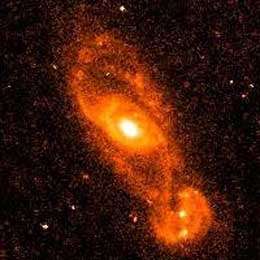
A set of 29 Hubble Space Telescope (HST) images of an exotic type of active galaxy known as a "post-starburst quasar" show that interactions and mergers drive both galaxy evolution and the growth of super-massive black holes at their centers.
Mike Brotherton, associate professor in the University of Wyoming Department of Physics and Astronomy, presented his team's findings today (Monday) at the American Astronomical Society meeting in St. Louis, Mo. Other team members are Sabrina Cales, Rajib Ganguly, and Zhaohui Shang of the University of Wyoming, Gabriella Canalizo of the University of California at Riverside, Aleks Diamond-Stanic of the University of Arizona, and Dan Vanden Berk of the Penn State University.
The images provide support for a leading theory of the evolution of massive galaxies, but also show that the situation is more complicated than previously thought. The images may provide a glimpse of the future of our own Milky Way galaxy, the researchers said.
Over the last decade, astronomers have discovered that essentially every galaxy harbors a supermassive black hole at its center. When the black holes are fueled and grow, the galaxy becomes active, with the most luminous manifestation being a quasar, which can outshine the galaxy and make it difficult to observe.
To explain the relationships between galaxies and their central black holes, theorists have proposed detailed models in which both grow together as the result of galaxy mergers. This suggests that large galaxies are built up over time through the assembly of smaller galaxies with corresponding bursts of star formation, and that this process also fuels the growth of the black holes which eventually ignite to shine as quasars. Supernova explosions and their dusty debris shroud the infant starburst until the activated quasar blows out the obscuration.
Starbursts fade as they age because the more massive and luminous stars have shorter lifetimes before exploding as supernovas. There should be a phase, however, during which the fading starburst and the quasar can be seen simultaneously.
In the late 1990s, Brotherton discovered a candidate for such a transition object, which possessed the spectral signatures of both a quasar and an older starburst. The actual burst of star formation, equivalent to a significant fraction of a Milky Way's worth of stars, was already 400 million years old, hence the label "post-starburst"quasar. Hubble images of this single extreme and distant object showed that it was the remnant of a galaxy merger.
To find more of these rare post-starburst quasars, Brotherton and his Wyoming-based team turned to the Sloan Digital Sky Survey, the world's largest catalog of quasar and galaxy spectra. Searching through a candidate list of 15,000 quasars, they identified the signatures of post-starbursts in some 600 objects. Through ground-based telescopes the objects just appear as smudges, without detail.
Brotherton and his team turned the sharp-eyed HST to observe a subset of these post-starburst quasars that had the strongest and most luminous stellar content.
"The images started coming in and we were blown away," said Brotherton. "We see not only merger remnants as in the prototype of the class, but also post-starburst quasars with interacting companion galaxies, double nuclei, starbursting rings and all sorts of messy structures."
Hubble snapped pictures of 29 post-starburst quasars in total, using a red-light filter that emphasized the starlight over the glare of the bluer quasar.
"These images provide us tremendous insight into the complexity of galaxy evolution," said Ganguly. "We see nuclear activity and post-starbursts simultaneously in systems from pre-merger to post-merger and in between."
More work remains to characterize the physics properties of each object, such as the masses and ages of the post-starbursts and the masses and fueling rates of the black holes powering the quasars. This task will require the combination of the Hubble images with high-quality spectra from the Keck Observatory on Mauna Kea, Hawaii.
Astronomers have determined that our own Milky Way galaxy and the great spiral galaxy of Andromeda will collide three billion years from now. This event will create massive bursts of star formation and most likely fuel nuclear activity a few hundred million years later. Hubble has imaged post-starburst quasars three and a half billion light-years away, corresponding to three and a half billion years ago, and three and a half billion years from now our own galaxy is probably going to be one of these systems, the researchers said.
Source: University of Wyoming


