Milky Way's infrared portrait gives new view of galaxy
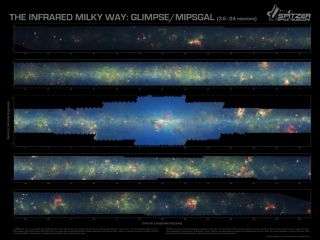
Humans have always had a ringside seat for viewing the Milky Way. Now, however, thanks to NASA's Spitzer Space Telescope, astronomers have obtained an entirely new perspective of our home galaxy: a complete mosaic portrait of the Milky Way in infrared light, a picture that when printed measures 180 feet long by 4 feet wide.
The portrait, known as GLIMPSE (Galactic Legacy Infrared Midplane Survey Extraordinaire) and five years in the making, was unveiled for the first time in St. Louis today at a meeting of the American Astronomical Society (AAS).
The image is available at www.nasa.gov/mission_pages/spi … imedia/20080603.html
"Looking in infrared light, we can see right across the galaxy," says Edward Churchwell, a University of Wisconsin-Madison astronomer and the leader of the team that produced the portrait. "It looks entirely different than what we've seen before."
Looking at the galaxy in infrared light, especially the innermost regions of the Milky Way, allows astronomers to cut through enormous obscuring clouds of interstellar dust to reveal millions of previously hidden stars, nascent planetary systems and protostars, baby stars yet to light up through the process of hydrogen fusion.
In the process of compiling their survey, Churchwell's group has catalogued nearly 100 million stars and has started to peel away some of the mystery of how stars evolve and, in particular, the process of star formation in vast, previously obscured stellar nurseries where millions of new stars are churned out to continuously seed the galaxy.
The GLIMPSE survey, Churchwell argues, may be especially important in illuminating the earliest stages of star formation and the dynamics of the dark, dense clouds of dust and gas molecules where stars are born.
"These dark clouds are the birthing grounds of stars," Churchwell explains, pointing to dark, willowy filaments between brighter, hotter stars. "Nobody understands how star formation is initiated, but we do know a lot about the properties of the clouds. They are fairly massive and the reason we can see them is they are opaque, even at infrared wavelengths. That means they are very dense, have a lot of dust and are cold because they are not radiating."
Forty years ago, Churchwell notes, astrophysicists were convinced dust couldn't survive the rigors imposed by the very hot stars found in the stellar nursery: "It turns out dust can survive for several million years. It is much hardier than we thought. We're beginning to get a lot deeper insight into the impact of dust and it's giving us a very different view of what's going on in these regions. It is changing our ideas of size, ages and temperatures."
The poster mosaic unfurled today will be one of only a few hard copies produced, says Churchwell. One poster will soon be on display at the Griffith Observatory and Planetarium in Los Angeles. However, a digital version will also be available for use by museums and researchers, according to the Wisconsin astronomer. "
Source: University of Wisconsin


