New study shows that transgenic plants don't hurt beneficial bugs
June 3, 2008 New study shows that transgenic plants don't hurt beneficial bugs

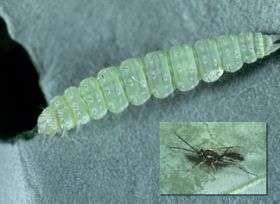
Larva of the diamondback moth, a devastating worldwide vegetable pest. Inset: The parasitic wasp Diadegma insulare, that kills the diamondback caterpillar, but was not injured by Bt or Bt plants in a Cornell study, showing that Bt does not harm beneficial organisms. Note: The two insects pictured here are not to scale. Credit: Joe Ogrodnick

Genetically modified (GM) plants that use Bt (Bacillus thuringiensis), a common soil bacterium, to kill pests won't harm the pests' natural enemies, according to new research by Cornell entomologists.

That is welcome news for ecologists and farmers in the debate over GM plants. Much of the debate surrounding the use of GM crops focuses on their effect on organisms that aren't pests.

The research showed that GM plants expressing Bt insecticidal proteins are not toxic to a parasite that lives inside the caterpillar of the diamondback moth, a devastating worldwide vegetable pest. It was published in the May 27 issue of the online scientific journal PLoS One.

"The conservation of parasites is important for enhancing natural biocontrol that will help suppress pest populations as well as reduce the potential for the pest insects to develop resistance to the Bt," explained Anthony Shelton, Cornell professor of entomology at the New York State Agricultural Experiment Station in Geneva, N.Y., who conducted the study with postdoctoral associate Mao Chen. "Our studies make it clear that Bt plants are a win-win situation to control pest insects and to enhance biocontrol and biodiversity."

The Bt bacterium, which is not harmful to humans, has been used for decades as a leaf spray and since 1996, in GM plants, a method that has proven much more effective and is now more widely used. Both uses are approved by the U.S. Environmental Protection Agency. In 2007, Bt corn and cotton plants were grown in 22 countries on 104 million acres, according to Shelton.

"Few studies have examined the effect of Bt plants on parasites of caterpillars, but some of them have reported negative impacts," said Chen, noting that the new research suggests that those negative findings were likely due to testing methods.

To separate out the effect of insecticides and Bt proteins on the caterpillar and parasite, the Cornell researchers isolated and bred strains of caterpillars that were resistant to Bt or a conventional or organic insecticide. Then the caterpillars were parasitized with a wasp that kills the caterpillar in nature.

The resistant caterpillars were then either fed GM plants expressing the Bt protein or non-GM plants sprayed with the Bt protein, conventional insecticides or organic insecticides.

The parasitized caterpillars that ate plants treated with conventional and organic insecticides to which they were resistant, survived and developed into moths because the parasite was killed by the insecticide the caterpillar ingested. However, when the caterpillar fed on the Bt-sprayed plants or Bt plants, the parasite was not affected and killed its host caterpillar when it emerged as an adult wasp, showing that Bt plants are not toxic to the parasite.

Other Cornell researchers involved in the study include Elizabeth Earle and Jun Cao from the Department of Plant Breeding and Genetics and Jian-Zhou Zhao and Hilda Collins from the Department of Entomology. The work was supported by a grant from the USAID Program for Biosafety Systems.

Source: Cornell University


print this article email this article download pdf blog this article bookmark this article     Stumble it Digg this share on Facebook retweet share on Reddit add to delicious
Rate this story - 4.5 /5 (10 votes)


June 3, 2008 all stories

Comments: 0

4.5 /5 (10 votes)
  • Stumble this up

  • Digg this

  • share this

  • hide
  • Related Stories

  • Gulf fritillary is back
    created Sep 24, 2009 | popularity not rated yet | comments 0
  • Conflict between plant and animal hormones in the insect gut?
    created Sep 14, 2009 | popularity not rated yet | comments 0
  • Climate change and species distributions
    created Aug 04, 2008 | popularity not rated yet | comments 0
  • Researcher shows evolution of milkweed defense system
    created Jul 22, 2008 | popularity not rated yet | comments 0
  • Milkweed's evolutionary approach to caterpillars: Counter appetite with fast repair
    created Jul 22, 2008 | popularity not rated yet | comments 0


Other News

The Monarchs' annual migration ritual has yet to be scientifically explained

Tree-eating bugs threaten Monarch butterfly in Mexico

Biology / Ecology

created 12 hours ago | popularity 4 / 5 (1) | comments 0

The mysterious Monarch butterfly, which migrates en masse annually between Canada and Mexico, is now facing a new peril: another insect thriving in Western Mexican forests.


Bigger not necessarily better, when it comes to brains

Bigger not necessarily better, when it comes to brains

Biology / Plants & Animals

created Nov 17, 2009 | popularity 4.5 / 5 (17) | comments 11

(PhysOrg.com) -- Tiny insects could be as intelligent as much bigger animals, despite only having a brain the size of a pinhead, say scientists at Queen Mary, University of London.


Extinct goat Myotragus balearicus

Extinct goat was cold-blooded

Biology / Plants & Animals

created Nov 18, 2009 | popularity 4.9 / 5 (33) | comments 10

(PhysOrg.com) -- An extinct goat that lived on a barren Mediterranean island survived for millions of years by reducing in size and by becoming cold-blooded, which has never before been discovered in mammals.


Right-handed chimpanzees provide clues to the origin of human language

Biology / Plants & Animals

created Nov 16, 2009 | popularity 3 / 5 (1) | comments 7

Most of the linguistic functions in humans are controlled by the left cerebral hemisphere. A study of captive chimpanzees at the Yerkes National Primate Research Center (Atlanta, Georgia), reported in the January 2010 issue ...


The creature was found at a depth of 161 metres

Japanese researchers film rare baby fish 'fossil'

Biology / Plants & Animals

created Nov 17, 2009 | popularity 4.7 / 5 (7) | comments 4

Japanese marine researchers said Tuesday they had found and successfully filmed a young coelacanth -- a rare type of fish known as "a living fossil" -- in deep water off Indonesia.