NASA Scientists Pioneer Method for Making Giant Lunar Telescopes
June 4, 2008 NASA Scientists Pioneer Method for Making Lunar Telescopes

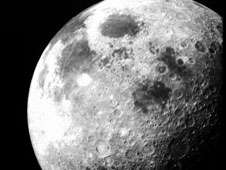
After Apollo 12 left lunar orbit this image of the Moon was taken from the command module on 11/24/69. Credit: NASA

Scientists working at NASA’s Goddard Space Flight Center in Greenbelt, Md., have concocted an innovative recipe for giant telescope mirrors on the Moon. To make a mirror that dwarfs anything on Earth, just take a little bit of carbon, throw in some epoxy, and add lots of lunar dust.

"We could make huge telescopes on the moon relatively easily, and avoid the large expense of transporting a large mirror from Earth," says Peter Chen of NASA Goddard and the Catholic University of America, which is located in Washington, D.C. "Since most of the materials are already there in the form of dust, you don’t have to bring very much stuff with you, and that saves a ton of money."

Chen and his Goddard colleagues Douglas Rabin, Michael Van Steenberg, and Ron Oliversen are presenting their mirror-making technique in a poster at the 212th meeting of the American Astronomical Society in St. Louis, Mo. They will also describe their results in a press conference on Wednesday, June 4.

For years, Chen had been working with carbon-fiber composite materials to produce high-quality telescope mirrors. But Chen and his colleagues decided to try an experiment. They substituted carbon nanotubes (tiny tubular structures made of pure carbon) for the carbon-fiber composites. When they mixed small amounts of carbon nanotubes and epoxies (glue-like materials) with crushed rock that has the same composition and grain size as lunar dust, they discovered to their surprise that they had created a very strong material with the consistency of concrete. This material can be used instead of glass to make mirrors.

They next applied additional layers of epoxy and spun the material at room temperature. The result was a 12-inch-wide mirror blank with the parabolic shape of a telescope mirror. All of this was achieved with minimal effort and cost.

"After that, all we needed to do was coat the mirror blank with a small amount of aluminum, and voilà, we had a highly reflective telescope mirror," says Rabin. "Our method could be scaled-up on the moon, using the ubiquitous lunar dust, to create giant telescope mirrors up to 50 meters in diameter." Such an observatory would dwarf the largest optical telescope in the world right now: the 10.4-meter Gran Telescopio Canarias in the Canary Islands.

The capabilities of a 50-meter telescope on the Moon boggle the imagination, according to NASA. With a stable platform, and no atmosphere to absorb or blur starlight, the monster scope could record the spectra of extra solar terrestrial planets and detect atmospheric biomarkers such as ozone and methane. Two or more such telescopes spanning the surface of the Moon can work together to take direct images of Earth-like planets around nearby stars and look for brightness variations that come from oceans and continents. Among many other projects, it could make detailed observations of galaxies at various distances, to see how the universe evolved.

"Constructing giant telescopes provides a strong rationale for doing astronomy from the moon," says Chen. "We could also use this on-site composite material to build habitats for the astronauts, and mirrors to collect sunlight for solar-power farms."

Chen notes that his group achieved this breakthrough with only the support of small NASA internal seed funds. The carbon nanotubes were contributed by Dan Powell, Lead Nanotechnologist for NASA Goddard. Several amateur astronomers made key contributions by advising and making special epoxy formulations, helping with polishing experiments, and vacuum coating the 12-inch mirror.

Source: NASA, by Robert Naeye


print this article email this article download pdf blog this article bookmark this article     Stumble it Digg this share on Facebook retweet share on Reddit add to delicious
Rate this story - 4.5 /5 (27 votes)

Rank Filter

Move the slider to adjust rank threshold, so that you can hide some of the comments.


Display comments: newest first

  • Mercury_01 - Jun 04, 2008
    • Rank: 5 / 5 (2)
    Its a cool Idea, with the added benefit of construction use, but how to transport all that heavy resin? Could not we find a way to make normal concrete on the moon for shelters, and use the good stuff for the mirrors?
  • ezezz - Jun 04, 2008
    • Rank: 5 / 5 (3)
    This seems like it could be a really worthy project. I don't know why else you'd want to go to the moon at the moment, but this would great. I even imagine you could get a good amount of public support behind this.

    Should we start writing senators? =D
  • Quantum_Conundrum - Jun 04, 2008
    • Rank: 4 / 5 (1)
    Theoretically this makes more sense than a space station or space telescope. A moonbase constrcuted mostly from native materials could allow astronauts to function in low gravity environment, far healthier than zero g. Most of the systems for the telescopes could be fully automated, but have maintenance once in a while.
  • thales - Jun 05, 2008
    • Rank: 4 / 5 (1)
    From wikipedia: "In terms of elements, the lunar crust is composed primarily of oxygen, silicon, magnesium, iron, calcium, and aluminium, but important minor and trace elements such as titanium, uranium, thorium, potassium, and hydrogen are present as well."

    I would think the hydrogen and oxygen could be used to produce water, which would allow us to ship powdered resin there. Seems like there's a lot we could do with that many elements.
  • Gregori - Jun 05, 2008
    • Rank: 4 / 5 (1)
    oh please oh please oh please do this!!!
  • Enthalpy - Jun 05, 2008
    • Rank: 3 / 5 (1)
    Cool down everybody!

    Parabolic concrete is not a telescope mirror.

    Concrete and epoxies are awful (=impossible) materials to make mirrors.

    0.2m and 50m mirrors share nothing.

    Epoxy contains no water, hence "powdered" is pointless.

    Normal concrete needs water which needs hydrogen, quite scarce there.

    The report fabulously exaggerates the usability of the discover, and you all swallow the bait.
  • 1bigschwantz - Jun 05, 2008
    • Rank: not rated yet
    Sounds like a pretty good plan, particularly the plan for two mirrors. I just hope there is some good protection from incoming meteors.
  • Mercury_01 - Jun 05, 2008
    • Rank: 4 / 5 (1)
    Well its a better idea than building the mirror out of wood! a concrete mirror base could be spun toa parabola, then ground smooth by a robot. The bowl could be filled with molten aluminum and spun. Then lapped by the same robot.

June 4, 2008 all stories

Comments: 8

4.5 /5 (27 votes)
  • Stumble this up

  • Digg this

  • share this

  • hide
  • Related Stories

  • Planet Imager will enable telescopes to image extrasolar planets directly
    created Sep 29, 2009 | popularity not rated yet | comments 0
  • Dark Energy From the Ground Up: Make Way for BigBOSS
    created Aug 07, 2009 | popularity not rated yet | comments 0
  • Herschel and Planck space telescopes lift off
    created May 14, 2009 | popularity not rated yet | comments 0
  • ESA to launch two large observatories to look deep into space and time
    created May 07, 2009 | popularity not rated yet | comments 0
  • Herschel and Planck Share Ride to Space
    created May 05, 2009 | popularity not rated yet | comments 0


  • hide
  • Relevant PhysicsForums posts

Other News

2 Earth-sized bodies with oxygen rich atmospheres found -- but they're stars not planets

Two Earth-sized bodies with oxygen rich atmospheres found -- but they're stars not planets

Space & Earth / Astronomy

created 9 hours ago | popularity 4.3 / 5 (12) | comments 1

(PhysOrg.com) -- Astrophysicists at the University of Warwick and Kiel University have discovered two earth sized bodies with oxygen rich atmospheres - however there is a bit of a disappointing snag for anyone ...


Greenland ice cap melting faster than ever

Greenland ice cap melting faster than ever

Space & Earth / Earth Sciences

created 9 hours ago | popularity 3.7 / 5 (17) | comments 10

Satellite observations and a state-of-the art regional atmospheric model have independently confirmed that the Greenland ice sheet is loosing mass at an accelerating rate, reports a new study in Science.


A faraway planet intrigues: Exoplanet with extremely tilted orbit raises new interest in stellar astronomy

A faraway planet intrigues: Exoplanet with extremely tilted orbit raises new interest in stellar astronomy

Space & Earth / Astronomy

created 16 hours ago | popularity 4.8 / 5 (9) | comments 5

(PhysOrg.com) -- Two teams of astronomers have found a planet outside the solar system that might be orbiting backwards compared to its star's rotation, a discovery that could shed light on how unique the ...


Research gives new insights into 4 billion year-old meteorites

Research gives new insights into 4 billion year-old meteorites

Space & Earth / Astronomy

created 7 hours ago | popularity not rated yet | comments 0

(PhysOrg.com) -- Scientists have gained new insight into the makeup of ancient meteorites called Carbonaceous Chondrites, in research published in the October edition of the journal Earth Science and Planetary Le ...


NASA to Begin Attempts to Free Sand-Trapped Mars Rover

NASA to Begin Attempts to Free Sand-Trapped Mars Rover

Space & Earth / Space Exploration

created 8 hours ago | popularity not rated yet | comments 0

(PhysOrg.com) -- NASA will begin transmitting commands to its Mars exploration rover Spirit on Monday as part of an escape plan to free the venerable robot from its Martian sand trap.