W28: A Mixed Bag of Supernova Remnant
June 4, 2008
Credit: Chandra X-ray: NASA/CXC/HSC/J. Keohane et al; ROSAT X-ray: NASA/ROSAT; Optical: NOAO/CTIO/P.F. Winkler et al; Radio: NSF/NRAO/VLA/G. Dubner et al.
When some stars die, they explode as supernovas and their debris fields (aka, "supernova remnants") expand into the surrounding environments. There are several different types, or categories, of supernova remnants. One of these is known as a mixed-morphology supernova remnant.
This type gets its name because it shares several characteristics from other types of supernova remnants. More specifically, particles that have been superheated are seen in X-rays in the center of the remnant. This inner region is enclosed by shell structure detected in radio emission.
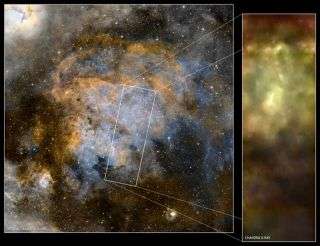
This composite shows a classic example of mixed-morphology supernova remnant known as W28. Each wavelength shows detailed structure of how the supernova shock wave is interacting, or has interacted, with the complex cloudy environment which surrounded its parent star.
In this image, the stars and fine structure in the background are seen in optical light (grey and white) by the Cerro Tololo Inter-American Observatory in Chile. The radio (orange) data was obtained by the Very Large Array in New Mexico, while the blue in the wide-field view comes from the ROSAT satellite (X-rays). Data from NASA’s Chandra X-ray Observatory give new detail into the heart of W28 as seen in the inset. In this close-up view of the center, low-energy X-rays are colored red, the medium are green, and the highest found by Chandra are blue.
The Chandra data show the shape and extent of the high-energy emission in the central region. By studying W28 and others like it, astronomers hope to better understand the complexities involved when a star explodes in a crowded neighborhood.
Involved in this W28 study were Jonathan Keohane (Hampden-Sydney College), Jeonghee Rho (Spitzer Science Center), Thomas Pannuti (Morehead State University), Kazik Borkowski (North Carolina State University) and Frank Winkler (Middlebury College).
Source: NASA
-
Engineers build first sub-10-nm carbon nanotube transistor
Feb 01, 2012 |
4.9 / 5 (31) |
30
-
Something old, something new: Evolution and the structural divergence of duplicate genes
Jan 31, 2012 |
4.6 / 5 (7) |
1
-
The hidden nanoworld of ice crystals: Revealing the dynamic behavior of quasi-liquid layers
Jan 30, 2012 |
5 / 5 (3) |
1
-
Stock market network reveals investor clustering
Jan 27, 2012 |
3.9 / 5 (23) |
8
-
Of microchemistry and molecules: Electronic microfluidic device synthesizes biocompatible probes
Jan 26, 2012 |
5 / 5 (1) |
0
-
Never ending outer space.....
12 hours ago
-
Neutron Star fragments?
14 hours ago
-
stationary or not?
18 hours ago
-
Scale of the Universe
Feb 10, 2012
-
Titan's lack of impact craters
Feb 09, 2012
-
Real pictures of black hole eating a star?
Feb 08, 2012
- More from Physics Forums - General Astronomy
More news stories
Latin America mining boom clashes with conservation
Latin America is experiencing a mining boom as prices rise fuelled by a hike in global demand, but the region is also being hit by a wave of violent protests, strikes and rallies by environmentalists.
5 hours ago |
not rated yet |
0
Political leaders play key role in how worried Americans are by climate change: study
More than extreme weather events and the work of scientists, it is national political leaders who influence how much Americans worry about the threat of climate change, new research finds.
Feb 06, 2012 |
5 / 5 (6) |
72
NASA budget will axe Mars deal with Europe: scientists
US President Barack Obama's budget proposal to be submitted next week for 2013 will cut NASA's budget by 20 percent and eliminate a major partnership with Europe on Mars exploration, scientists said Thursday.
Space & Earth / Space Exploration
Feb 10, 2012 |
5 / 5 (3) |
55
Humans may have helped the decline of African rainforests 3000 years ago
(PhysOrg.com) -- Large areas of rainforests in Central Africa mysteriously disappeared over three thousand years ago, to be replaced by savannas. The prevailing theory has been that the cause was a change ...
Study shows global glaciers, ice caps, shedding billions of tons of mass annually
Earth's glaciers and ice caps outside of the regions of Greenland and Antarctica are shedding roughly 150 billion tons of ice annually, according to a new study led by the University of Colorado Boulder.
Space & Earth / Earth Sciences
Feb 08, 2012 |
4.4 / 5 (9) |
14
|
Google might launch Drive for cloud storage soon
(PhysOrg.com) -- Google's next big move, according to the Wall Street Journal, is a cloud storage service called Drive. Hardly first to the plate, Google is simply catching up to introducing its cloud reposi ...
Love a click away in Indonesia's Twitter Republic
He was a geeky kid from Yogyakarta, she a glamorous city girl in Jakarta. In a country with one of the world's most vibrant social networking scenes they fell in love on Twitter.
Europeans protest controversial Internet pact
Tens of thousands of people marched in protests in more than a dozen European cities Saturday against a controversial anti-online piracy pact that critics say could curtail Internet freedom.
Walney offshore wind farm is world's biggest (for now)
(PhysOrg.com) -- The Walney wind farm on the Irish Sea--characterized by high tides, waves and windy weather--officially opened this week. The farm is treated in the press as a very big deal as the Walney ...
Navy to begin tests on electromagnetic railgun prototype launcher
The Office of Naval Research (ONR)'s Electromagnetic (EM) Railgun program will take an important step forward in the coming weeks when the first industry railgun prototype launcher is tested at a facility ...
Explained: Sigma
It's a question that arises with virtually every major new finding in science or medicine: What makes a result reliable enough to be taken seriously? The answer has to do with statistical significance -- but ...