Team hopes to use new technology to search for ETs
June 4, 2008 Team hopes to use new technology to search for ETs

A Johns Hopkins astronomer is a member of a team briefing fellow scientists about plans to use new technology to take advantage of recent, promising ideas on where to search for possible extraterrestrial intelligence in our galaxy.

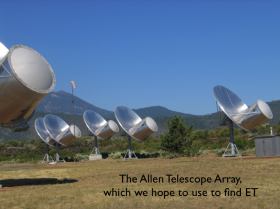
Richard Conn Henry, a professor in the Henry A. Rowland Department of Physics and Astronomy at Johns Hopkins' Zanvyl Krieger School of Arts and Sciences, is joining forces with Seth Shostak of the SETI Institute and Steven Kilston of the Henry Foundation Inc., a Silver Spring, Md., think tank, to search a swath of the sky known as the ecliptic plane. They propose to use new Allen Telescope Array, operated as a partnership between the SETI Institute in Mountain View, Calif., and the Radio Astronomy Laboratory at the University of California, Berkeley.

Comprising hundreds of specially produced small dishes that marry modern, miniaturized electronics and innovative technologies with computer processing, the ATA provides researchers with the capability to search for possible signals from technologically advanced civilizations elsewhere in our galaxy – if, in fact, such civilizations exist and are transmitting in this direction.

Employing this new equipment in a unique, targeted search for possible civilizations enhances the chances of finding one, in the same way that a search for a needle in a haystack is made easier if one knows at least approximately where the needle was dropped, said Henry, who is speaking about the proposal at the American Astronomical Society annual meeting in St. Louis.

According to the researchers, the critical place to look is in the ecliptic, a great circle around the sky that represents the plane of Earth's orbit. The sun, as viewed from Earth, appears annually to pass along this circle. Any civilization that lies within a fraction of a degree of the ecliptic could annually detect Earth passing in front of the sun. This ecliptic band comprises only about 3 percent of the sky.

"If those civilizations are out there – and we don't know that they are – those that inhabit star systems that lie close to the plane of the Earth's orbit around the sun will be the most motivated to send communications signals toward Earth," Henry said, "because those civilizations will surely have detected our annual transit across the face of the sun, telling them that Earth lies in a habitable zone, where liquid water is stable. Through spectroscopic analysis of our atmosphere, they will know that Earth likely bears life.

"Knowing where to look tremendously reduces the amount of radio telescope time we will need to conduct the search," he said.

Most of the 100 billion stars in our Milky Way galaxy are located in the galactic plane, forming another great circle around the sky. The two great circles intersect near Taurus and Sagittarius, two constellations opposite each other in the Earth's sky – areas where the search will initially concentrate.

"The crucial implication is that this targeted search in a favored part of the sky -- the ecliptic stripe, if you will – may provide us with significantly better prospects for detecting extraterrestrials than has any previous search effort," Kilston said.

Ray Villard of the Space Telescope Science Institute, who will join the team in its observations, said that in November 2001, STScI publicized Hubble Space Telescope observations of a transiting planet and "it occurred to me that alien civilizations along the ecliptic would likely be doing similar observations to Earth."

"Once they had determined Earth to be habitable, they might initiate sending signals," Villard said.

Shostak of SETI notes that the Allen Telescope Array is ideal for the team's plans to search the entire ecliptic over time, and not just the intersections of the ecliptic and galactic planes.

The team's presentation at the AAS meeting also explores possible scenarios for the appearance of civilizations in our galaxy.

"These models are nothing but pure speculation. But hey … it is educational to explore possibilities," Henry said. "We have no idea how many – if any – other civilizations there are in our galaxy. One critical factor is how long a civilization – for example, our own – remains in existence. If, as we dearly hope, the answer is many millions of years, then even if civilizations are fairly rare, those in our ecliptic plane will have learned of our existence. They will know that life exists on Earth and they will have the patience to beam easily detectable radio (or optical) signals in our direction, if necessary, for millions of years in the hope, now realized, that a technological civilization will appear on Earth."


Source: Johns Hopkins University


print this article email this article download pdf blog this article bookmark this article     Stumble it Digg this share on Facebook retweet share on Reddit add to delicious
Rate this story - 4.6 /5 (42 votes)

Rank Filter

Move the slider to adjust rank threshold, so that you can hide some of the comments.


Display comments: newest first

  • 1bigschwantz - Jun 04, 2008
    • Rank: 1.7 / 5 (3)
    If nothing else,, they'll do some pretty good astronomy.
  • zevkirsh - Jun 04, 2008
    • Rank: 3 / 5 (5)
    how fascinating that we impute our ownnewly formed astronomical capabilities of detecting extrasolar plantets to other foreign civilizations. perhaps they have a far greater power of observation than merely looking for shadow spots on far away starts.....or perhaps they are cavemen....still, the reasoning makes sense, we should impute to them at least as much as we know in order to maximize our chances of finding them.
  • Mercury_01 - Jun 04, 2008
    • Rank: 3.6 / 5 (5)
    I think we need to propigate a lossles virtual scalar potential wave on a bioligical frequency. Any advanced civilization probably has all but abandoned primitive radio waves.
  • Star_Gazer - Jun 04, 2008
    • Rank: 4 / 5 (4)
    "... they might initiate sending signals," Villard said..

    I think the biggest problem with SETI is the time. If the civilization detected habitable earth, they might have been sending signals for couple of hundreds of years if that, then, the "contact earth" project was canned due to the budget cuts and they stopped broadcasting, and dinosaurs didn't have radio telescope to receive those signals.
  • thales - Jun 05, 2008
    • Rank: 3 / 5 (2)
    Hm. It says you use the Roman alphabet and apparently wish to communicate. Good enough for me.
  • thales - Jun 05, 2008
    • Rank: 4 / 5 (2)
    Also, we've pretty much classified all cosmic background signals by this time. A computer program that looks for statistically unlikely noise would be able to pick an alien signal out of the background very quickly.
  • Alexa - Jun 05, 2008
    • Rank: 3 / 5 (2)
    Here's no advantage in contact with E.T., on contrary.
  • Bitflux - Jun 05, 2008
    • Rank: 4.4 / 5 (5)
    The human race can't even accept the basic differences between our own people. If i was watching earth from afar i wouldnt send any signals, because the first impression would be.. if they see me, they would probably kill me, because im not like them.
  • CreepyD - Jun 05, 2008
    • Rank: 4 / 5 (1)
    Tbh, I don't think it would matter whether we could communicate or even understand what we picked up.
    Just the fact it was detected at all would be enough to have pretty big consequences I think.
  • Quantum_Conundrum - Jun 05, 2008
    • Rank: 2.5 / 5 (2)
    Hm. It says you use the Roman alphabet and apparently wish to communicate. Good enough for me.
    ----
    The alphabet is just a consequence of the fact I had nothing else to put up there, I could have just as easily made a bunch of random ascii symbols, but I assure you this message is a coded english sentence with no punctuation or spacing. Basicly you missed my point.

    In the case of an alien signal, all you will get is binary, or some other number system used by a computer or transmitter. It will bear no resemblance whatsoever to any spoken or written earth language. If the aliens consider what I am talking about, they will only send a message that is related to mathematics or technology, because common words will not even have an equivalent. They will not have any of the animals we have, so their language will not translate to anything we are familliar with other than math or technology.

    It isn't like translating english to spanish. In earth languages it basicly amounts to different words or phrases for the same meaning.

    english -> spanish
    cat = gato
    dog = pero
    hello = hola

    english -> alien
    cat = does not exist
    dog = does not exist
    hello = ???
  • equsnarnd - Jun 05, 2008
    • Rank: 4.5 / 5 (2)
    Quantum Conundrum - I think you're missing the point of looking. We're not trying to have a conversation or order lunch. If we find something out there that is different than random noise or other known background radiation - if it has a hint of intelligence behind it - it allows us to focus on that part of the sky and gives us data to work with. How exciting would that be? Hopefully there won't be a lot of false positives.
  • Stanley - Jun 05, 2008
    • Rank: 3.5 / 5 (2)
    Unless we develop technology to jump to other universes in multiverse, we maynot be able to find advanced intelligent. If ET in other universe has the technology, they may find us..or maybe already interacting with some of us?
  • Mercury_01 - Jun 05, 2008
    • Rank: 3 / 5 (2)
    Why would we have to jump to another universe stan? So we can start the search all over again? Do you even know what a mutiverse is, or are you just quoting star trek?
  • deatopmg - Jun 05, 2008
    • Rank: 3 / 5 (2)
    more smoke and mirrors and wasted money. Astronomy - good, searching for ET using EM radiation - silly.

    What about getting the photos of the moon and mars that have obviously been airbrushed out de-classified and released. Then, if anything intelligently made becomes visible, we can try to contact them directly. Communication time will be seconds to minutes instead 10's of years.
  • neurogalactus - Jun 05, 2008
    • Rank: 4 / 5 (2)
    Quote:
    "They may have already created spintronic computers and transmitters, and would be using different forms of modulation or quantum entanglement to communicate, in which case you couldn't intercept a message anyway. "

    Here's the real point of this conversation. There is NO - I repeat: NO WHATSOEVER - indication that other technical civilizations that may be out there use radio waves for communication. It's a completely unjustified assumption, and very self-centric at that. I never really understood why almost every scientist would share this conviction, lending no critical thought to it. OK, let's say that at the dawn of SETI people didn't have enough imagination to even conceive different communication technologies, but today there is no excuse for that. What if those guys from Alpha-Centauri or Epsilon Eridani or wherever they may dwell, use neutrinos for telecom? What if they use quantum entanglement? What if hyperspace tech? What if their comms operate in superluminal modes, of which our science is not aware yet?

    Also, suddenly, SETI people suggest that those other civilizations will surely use mass spectroscopy and maybe sth similar to Terrestrial Planet Finder to get info about our world. Wow, how did they figure it out? Why didn't they suggest the same, say, 20 years ago? Because we didn't HAVE that technology, nor BELIEVED it could be feasible then? Could that be the reason? Hmm...

    Now, somehow I KNOW that when we develop superluminal communications, we will all of a sudden start assuming that this tech is so damn widely used across all the Universe. What a dramatically innovative thought...

    Instead of wasting tons of money for ridiculous EM-based SETI explorations, they'd do a much better choice by focusing on inventing some really useful ways of long-distance communication, to which 30 light years is not an issue.
    But then again, we all know such technologies are impossible, don't we?

  • Stanley - Jun 05, 2008
    • Rank: 3 / 5 (3)
    If ET lives in different dimension, i.e., different universe in multiverse (multiple universe, plz see wiki for detail), we cannot find them as ant in two dimension cannot find us in 3D. On the other hand, 3D us can find 2D ant easily, wondering whether the ant can figure out how to escape 2D. You may shout "look up"..
  • thales - Jun 09, 2008
    • Rank: not rated yet
    Quote:
    "Instead of wasting tons of money for ridiculous EM-based SETI explorations, they'd do a much better choice by focusing on inventing some really useful ways of long-distance communication, to which 30 light years is not an issue.
    But then again, we all know such technologies are impossible, don't we?


    This is such a ridiculous point of view, but it seems to turn up periodically. Why don't we look for superluminal or other signals? Because, as pointed out by neurogalactus, we don't HAVE that technology. So we should develop it right? Well, as it turns out, we are unable to develop technology for which there is NO underlying theory. Feel free to invent a neutrino or entanglement communication device yourself, but the rest of us will focus on more practical projects. Also, if we wanted to communicate with a more primitive intelligence -- say, monkeys -- I'm thinking we wouldn't rely on radio transmissions. So why would another intelligence send only signals that require advanced tech? Unless maybe they're not that intelligent. And please don't say that it might not be that advanced to them; entanglement/ neutrinos/hyperluminal anything requires more than basic tech, and certainly is more advanced than modulating light. Right?

    And why should we wait to attempt this project until we have such technologies? People want to discover things before they die, and the wait might be a very long time indeed.
  • PresstoDigitate - Jun 12, 2008
    • Rank: 4.5 / 5 (2)
    We may be being bombarded with ET communication signals right now and just too dim witted to notice. Patterns in the White Noise and television "snow" that we dismiss as 'just nothing' - a null signal. Scalar Waves, Quantum Entanglement, and probably a dozen things we've never thought of, probably DO make more sense than old fashioned RF.

    The arrogance of scientists who say "If those civilizations are out there...and we don't know that they are..." is astonishing. Its not a balanced argument as to whethere or not they exist; WE ARE the 'Existence Proof' that biological intelligence DOES exist in the cosmos. There is absolutely no reason to believe that we are alone, and never has been. This is like the old 'scientific' argument over whether or not water could be found elsewhere in the solar system, or whether or not other stars even had planets. Only fools ever doubted either, regardless of their credentials. Now that we have found more water even on tiny Jovian moons than exists on Earth, and planets around most every star we've looked at, perhaps it will give the skeptics pause when they attempt to deny the next incredibly obvious inevitability.

June 4, 2008 all stories

Comments: 18

4.6 /5 (42 votes)
  • Stumble this up

  • Digg this

  • share this

  • hide
  • Related Stories

  • Scientists predict greater longevity for planets with life
    created Jun 13, 2009 | popularity not rated yet | comments 0
  • A serious search for extraterrestrial life
    created May 26, 2009 | popularity not rated yet | comments 0
  • Life in the universe? Almost certainly. Intelligence? Maybe not
    created May 12, 2009 | popularity not rated yet | comments 0
  • Astronomers hit a telescopic jackpot
    created Jan 12, 2009 | popularity not rated yet | comments 0
  • New comet discovered in Canada
    created Oct 14, 2008 | popularity not rated yet | comments 0


  • hide
  • Relevant PhysicsForums posts

  • The shape of our solar system's orbits.
    created 15 hours ago
  • Above or Below the Line of Nodes
    created 19 hours ago
  • Supernova vs. Nova?
    created Nov 07, 2009
  • Supernova's Gamma Rays and Comets
    created Nov 06, 2009
  • Our Moon
    created Nov 06, 2009
  • Question about a Carl Zeiss lens
    created Nov 05, 2009
  • More from Physics Forums - General Astronomy

Other News

Deep creep means milder, more frequent earthquakes along Southern California's San Jacinto fault

Deep creep means milder, more frequent earthquakes along Southern California's San Jacinto fault

Space & Earth / Earth Sciences

created 32 minutes ago | popularity 4 / 5 (1) | comments 0

With an average of four mini-earthquakes per day, Southern California's San Jacinto fault constantly adjusts to make it a less likely candidate for a major earthquake than its quiet neighbor to the east, the ...


Success in 'space elevator' competition (AP)

Success in 'space elevator' competition (Update 3)

Space & Earth / Space Exploration

created Nov 05, 2009 | popularity 4.3 / 5 (33) | comments 50

(AP) -- A robot powered by a ground-based laser beam climbed a long cable dangling from a helicopter on Wednesday to qualify for prize money in a $2 million competition to test the potential reality of the ...


'Dropouts' pinpoint earliest galaxies

'Dropouts' pinpoint earliest galaxies

Space & Earth / Astronomy

created Nov 06, 2009 | popularity 4.1 / 5 (9) | comments 12

Astronomers, conducting the broadest survey to date of galaxies from about 800 million years after the Big Bang, have found 22 early galaxies and confirmed the age of one by its characteristic hydrogen signature ...


Space hotel taking bookings for 2012 opening

Space hotel taking bookings for 2012 opening

Space & Earth / Space Exploration

created Nov 05, 2009 | popularity 4.4 / 5 (20) | comments 11

(PhysOrg.com) -- The first orbiting space hotel is on track to open for its first customers in 2012, but hurry, as bookings are filling fast.


In a Galaxy Far, Far Away...

In a Galaxy Far, Far Away...

Space & Earth / Astronomy

created Nov 06, 2009 | popularity 4.8 / 5 (4) | comments 11

(PhysOrg.com) -- Astronomers have published the discovery of the farthest known object in the cosmos: a star that exploded when the universe was only 630 million years old -- only 4.6% of its current age. ...