IBM Cools 3-D Chips with Water
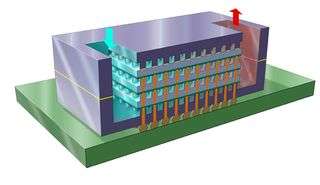
In IBM’s labs, tiny rivers of water are cooling computer chips that have circuits and components stacked on top of each other, a design that promises to advance Moore’s Law in the next decade and significantly reduce energy consumed by data centers.
IBM Researchers, in collaboration with the Fraunhofer Institute in Berlin, demonstrated a prototype that integrates the cooling system into the 3-D chips by piping water directly between each layer in the stack.
These so-called 3-D chip stacks – which take chips and memory devices that traditionally sit side-by-side on a silicon wafer and stacks them together on top of one another -- presents one of the most promising approaches to enhancing chip performance beyond its predicted limits.
This follows IBM’s leadership in advancing chip-stacking technology in a manufacturing environment a year ago, which shortens the distance information on a chip needs to travel by 1000 times, and allows for the addition of up to 100 times more channels, or pathways, for that information to flow compared to 2-D chips.
“As we package chips on top of each other to significantly speed a processor’s capability to process data, we have found that conventional coolers attached to the back of a chip don’t scale. In order to exploit the potential of high-performance 3-D chip stacking, we need interlayer cooling,” explains Thomas Brunschwiler, project leader at IBM’s Zurich Research Laboratory. “Until now, nobody has demonstrated viable solutions to this problem.”
3-D chip stacks would have an aggregated heat dissipation of close to 1 kilowatt—10 times greater than the heat generated by a hotplate—with an area of 4 square centimeters and a thickness of about 1 millimeter. Moreover, each layer poses an additional barrier to heat removal.
Brunschwiler and his team piped water into cooling structures as thin as a human hair (50 microns) between the individual chip layers in order to remove heat efficiently at the source. Using the superior thermophysical qualities of water, scientists were able to demonstrate a cooling performance of up to 180 W/cm2 per layer for a stack with a typical footprint of 4 cm2.
“This truly constitutes a breakthrough. With classic backside cooling, the stacking of two or more high-power density logic layers would be impossible,” said Bruno Michel, manager of the chip cooling research efforts at the IBM Zurich Lab.
Technological Specifications
In these experiments, scientists piped water through a 1 by 1 cm test vehicle, consisting of a cooling layer between two dies or heat sources. The cooling layer measures only about 100 microns in height and is packed with 10,000 vertical interconnects per cm2.
The team overcame key technical challenges in designing a system that maximizes the water flow through the layers, yet hermetically seals the interconnects to prevent water from causing electrical shorts. The complexity of such a system resembles that of a human brain, wherein millions of nerves and neurons for signal transmissions are intermixed but do not interfere with tens of thousands of blood vessels for cooling and energy supply, all within the same volume.
The fabrication of the individual layers was accomplished with existing fabrication methods, except those needed to etch or drill the holes for signal transmission from one layer to the next. To insulate these “nerves”, scientists left a silicon wall around each interconnect (also called through silicon vias) and added a fine layer of silicon oxide to insulate the electrical interconnects from the water. The structures had to be fabricated to an accuracy of 10 microns, 10 times more accurate than for interconnects and metallizations in current chips.
To assemble the individual layers, Brunschwiler with colleagues from the Fraunhofer Institute developed a sophisticated thin-film soldering technique. Using this technique, scientists achieved the high quality, precision and robustness needed to ensure excellent thermal contacts as well as electrical contacts without shorts. In the final setup, the assembled stack is placed in a silicon cooling container resembling a miniature basin. The water is pumped into the container from one side and flows between the individual chip layers before exiting at the other side.
Using simulations, scientists extrapolated the experimental results of their test vehicle to a 4-cm2 chip stack and achieved a cooling performance of 180 W/cm2.
In further research, Brunschwiler and his team are working to optimize cooling systems for even smaller chip dimensions and more interconnects. They are also investigating additional sophisticated structures for hotspot cooling.
Chip-cooling innovations at IBM Research
This most recent advancement is part of IBM’s ambitious research efforts focused on cooling technologies that allow the reuse of heat generated by data centers by capturing water at its hottest and piping it into the building’s water and heating systems. This announcement marks an important step toward that goal by succeeding in getting water to the hottest parts of the computer chip, where cooling is critical.
The results were presented in a paper entitled “Forced convective interlayer cooling in vertically integrated packages” at the IEEE ITherm conference in Orlando, Florida, where it received a Best Paper award. This makes the third consecutive year in which the IBM Zurich Lab’s Advanced Thermal Packaging team was awarded for their chip-cooling innovations at leading IT cooling conferences.
By borrowing efficient concepts from nature and combining these with their long-standing expertise in microscale heat and mass transfer in addition to micro-fabrication techniques, IBM researchers have developed a new breed of highly efficient chip-cooling technologies that have the potential to resolve the cooling issue for generations of high-performance, efficient chips to come.
Source: IBM


