A New Way to Think About Earth's First Cells
June 5, 2008 A New Way to Think About Earth's First Cells

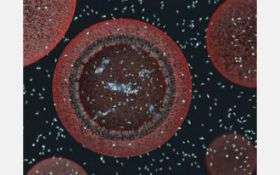
Above is a three-dimensional view of a model protocell approximately 100 nanometers in diameter. The protocell's fatty acid membrane allows nutrients and DNA building blocks to enter the cell and participate in non-enzymatic copying of the cell's DNA. The newly formed strands of DNA remain in the protocell. Credit: Janet Iwasa, Szostak Laboratory, Harvard Medical School and Massachusetts General Hospital

A team of researchers at Harvard University have modeled in the laboratory a primitive cell, or protocell, that is capable of building, copying and containing DNA.

Since there are no physical records of what the first primitive cells on Earth looked like, or how they grew and divided, the research team's protocell project offers a useful way to learn about how Earth's earliest cells may have interacted with their environment approximately 3.5 billion years ago.

The protocell's fatty acid membrane allows chemical compounds, including the building blocks of DNA, to enter into the cell without the assistance of the protein channels and pumps required by today's highly developed cell membranes. Also unlike modern cells, the protocell does not use enzymes for copying its DNA.

Supported with funding from the National Science Foundation and led by Jack W. Szostak of the Harvard Medical School, the research team published its findings in the June 4, 2008, edition of the journal Nature's advance online publication.

"Szostak's group took a creative approach to this research challenge and made a significant contribution to our understanding of small molecule transport through membranes," said Luis Echegoyen, director of the NSF Division of Chemistry. "This is a great outcome of NSF's support of basic research."

Some scientists have proposed that ancient hydrothermal vents may have been sites where prebiotic molecules--molecules made before the origin of life, such as fatty acids and amino acids--were formed. An animation (accessible at upper right) created by Janet Iwasa of the Szostak Laboratory shows a theoretical scenario in which fatty acids are formed on the surface of minerals deep underground, and then brought to the surface by the eruption of a geyser.

When fatty acids are in an aqueous environment, they spontaneously arrange so that their hydrophilic, or water-loving, "heads" interact with the surrounding water molecules and their hydrophobic, or water-fearing, "tails" are shielded from the water, resulting in the formation of tiny spheres of fatty acids called micelles.

Depending upon chemical concentrations and the pH of their environment, micelles can convert into layered membrane sheets or enclosed vesicles. Researchers commonly use vesicles to model the cellular membranes of protocells. A second animation created by Iwasa (accessible at lower right) shows how vesicles may have been formed.

When the team started its work, the researchers were not sure that the building blocks required for copying the protocell's genetic material would be able to enter the cell.

"By showing that this can happen, and indeed happen quite efficiently, we have come a little closer to our goal of making a functional protocell that, in the right environment, is able to grow and divide on its own," said Szostak.

Source: National Science Foundation


print this article email this article download pdf blog this article bookmark this article     Stumble it Digg this share on Facebook retweet share on Reddit add to delicious
Rate this story - 4.4 /5 (35 votes)

Rank Filter

Move the slider to adjust rank threshold, so that you can hide some of the comments.


Display comments: newest first

  • nano999 - Jun 05, 2008
    • Rank: 3.7 / 5 (3)
    Praise Science!
  • Lord_jag - Jun 05, 2008
    • Rank: 4.3 / 5 (4)
    Once science gets this pesky origin of life thing figured out, maybe we can finally give the ole God-bit a rest, eh?
  • zevkirsh - Jun 05, 2008
    • Rank: 1.2 / 5 (5)
    dna didn't exist until long after primitive rna type codes. so why theorize about dna containing cells?
    z
  • Quantum_Conundrum - Jun 05, 2008
    • Rank: 1 / 5 (9)
    Once science gets this pesky origin of life thing figured out, maybe we can finally give the ole God-bit a rest, eh?

    ----

    How does a man making a cell in a test tube disprove creationism?

    Wait a minute! that's right! If man MAKES a cell in a test tube it doesn't prove evolution or abiogenesis! It supports special creation, since it took an intelligent being producing a specific sequence of DNA and a specific sequence of finely controlled conditions to produce anything other than lifeless goo...


    Evolutionist:

    "We created life in a test tube, this PROVES creation isn't true..."

    idiocy...
  • Quantum_Conundrum - Jun 05, 2008
    • Rank: 1.2 / 5 (6)
    You cannot prove evolution or abiogenesis by experiment. Any experiment you can come up with involves INTELLIGENT DESIGN on the part of the person running the experiment.

  • ranfea - Jun 05, 2008
    • Rank: 3.8 / 5 (4)
    Unless that experiment consists of something like a tank filled with stuff that existed around when human life is thought to originate, and exposed to stuff that it was exposed to.
    Like a tank filled with water and various minerals or chemicals and probed with electricity (simulating lightning), or something.
    If complex proteins begin to develop while doing something like this, then it would indeed prove that life can originate independently.
  • D666 - Jun 05, 2008
    • Rank: 4.4 / 5 (7)
    Bzzzt! No, sorry. The essential argument of creationism is that there MUST have been a creator, because there is no way EVEN IN PRINCIPLE that the complexity we see around us could have arisen spontaneously, by 'natural' processes. Basically, Creationism is proof by process of elimination. If we show that there are natural processes that *could* have produced said complexity, then the creationist argument loses credibility. Now, we can't *prove* that creationism is wrong any more than we can *prove* that Santa Clause as a source of presents is wrong, but if we can show a legitimate, creditble path by which the complexity (or the presents) got there, without the requirement for the guy with the white beard (or the other guy with the white beard), then the onus is on creationism to come up with some other positive reason why we should take it seriously.
    And yes, scientists are creating these neat little thingies in a lab, but they are doing it by modelling natural processes. And every time they discover something new, the God Of The Gaps gets squeezed more and more.
  • Quantum_Conundrum - Jun 05, 2008
    • Rank: 1.2 / 5 (9)
    A team of researchers at Harvard University have modeled in the laboratory a primitive cell, or protocell, that is capable of building, copying and containing DNA.

    ---

    Key word here = "Modeled"

    Some interesting things about this word:

    1) Implies intelligent creation and/or design

    2) Implies a representation or simulation of another thing, and not the thing itself

    So the atheistic notion that you are "merely" throwing some things in a tank and turning on the juice is misleading.

    As I stated, creating a cell in a laboratory is, by definition, Intelligent Design. It is not at all proof of evolution or abiogenesis.
  • dcoder - Jun 06, 2008
    • Rank: 4 / 5 (1)
    It's funny how wise we all are - with our comments of man-made lexicon of "god" and "science"... if we honestly look at our placement in the universe, can any of us rule out over 13-14.5 (who knows) billion years that just by chance life exists? Same {an}anaxiom asks could we rule out god? - Why are we fighting about it... IMHO we trifle with knowledge, but we (both sides) deal so much mundane pedagogy that witnessing our universe becomes a chore to explain rather than sit back in amusement and love. Maybe *our future* intelligent design (intelligent computers) won't have this problem and they will explore the universe, leaving us in their wake to reside in our dirty doctrine.
  • out7x - Jun 06, 2008
    • Rank: 3.7 / 5 (3)
    Dont confuse intelligent design with chemistry. Cant wait till the first living cell is built from organic compounds.
  • CWFlink - Jun 06, 2008
    • Rank: 2.3 / 5 (3)
    If God exists, and wants us to "know" it (i.e. believe not out of faith, but out of proof), proof would be easy (in fact, pre-ordained); if he wanted it to be a secret (so that free will, faith, hope and love exists) He/She would have created a universe springing from a singularity and based upon evolution... or some other scheme which would assure that Faith is not Science.

    By definition, neither science nor religion can prove or disprove the existence of God, in spite of what lots of scientists and preachers say.

    Now drop the creationist/evolutionist foolishness before your ignorance of religion becomes embarrassingly obvious.
  • zevkirsh - Jun 06, 2008
    • Rank: 4 / 5 (4)
    the question is that of self organization. if naturally existing materials self organize into cells, then this explains how life could have developed from a certain state of things we theorize to have existed millions of years ago.
  • HenisDov - Jun 08, 2008
    • Rank: 2 / 5 (1)

    NOT A New Way to Think About Earth's First Cells
    Just Probing Small Molecule Transport Through Membranes

    http://www.physor...452.html

    This work report concludes with a strange deluded statement:

    "By showing that this can happen, and indeed happen quite efficiently, we have come a little closer to our goal of making a functional protocell that, in the right environment, is able to grow and divide on its own"

    This is another glaring case that demonstrates why science must be rescued from the guild(s) of "professional science (mostly) technicians and (very few) scientists".

    Unbelievable that in the 21st century "scientists" regard a cell as an organism. This is like regarding a future space station as an organism. Unbelievable!


    Dov Henis

    http://www.physfo...ic=14988&st=225&#entry347345

    http://blog.360.y...Q--?cq=1
  • thales - Jun 09, 2008
    • Rank: not rated yet
    Dov, I think the consensus is that the first true organism consisted of a single cell.

June 5, 2008 all stories

Comments: 14

4.4 /5 (35 votes)
  • Stumble this up

  • Digg this

  • share this

  • hide
  • Related Stories

  • Simple membranes could have allowed nutrients to pass into primitive cells
    created Jun 04, 2008 | popularity not rated yet | comments 0
  • Flaxseed oil and osteoporosis
    created 15 hours ago | popularity not rated yet | comments 0
  • Let them eat snail
    created Nov 19, 2009 | popularity not rated yet | comments 0
  • How fish is cooked affects heart-health benefits of omega-3 fatty acids
    created Nov 17, 2009 | popularity not rated yet | comments 0
  • Oil from biotech soybeans increases key omega-3 fatty acid in humans
    created Nov 16, 2009 | popularity not rated yet | comments 0


Other News

Computational microscope peers into the working ribosome

Computational microscope peers into the working ribosome (w/ Video)

Biology / Cell & Microbiology

created 16 hours ago | popularity 4.9 / 5 (7) | comments 0

Two new studies reveal in unprecedented detail how the ribosome interacts with other molecules to assemble new proteins and guide them toward their destination in biological cells. The studies used molecular ...


Spider secrets decoded in world-first database

Biology / Plants & Animals

created 10 hours ago | popularity not rated yet | comments 0

(PhysOrg.com) -- Queensland scientists have developed a world-first database that catalogues the venom components from hundreds of spiders.


New chameleon species discovered in East Africa

New chameleon species discovered in East Africa (w/ Podcast)

Biology / Plants & Animals

created 18 hours ago | popularity 5 / 5 (1) | comments 0

A new species of chameleon has been discovered in Tanzania by a team of scientists.


Indian engineer invents device to stop rampaging elephants

Biology / Plants & Animals

created 21 hours ago | popularity 4.3 / 5 (3) | comments 0

An Indian inventor has created a device to stop rampaging elephants in their tracks, amid concern about human injuries and deaths when they run amok, his company said Monday.


A year after discovery, Congo's 'mother lode' of gorillas remains vulnerable

A year after discovery, Congo's 'mother lode' of gorillas remains vulnerable

Biology / Plants & Animals

created 14 hours ago | popularity 5 / 5 (1) | comments 0

A new study by the Wildlife Conservation Society says that western lowland gorillas living in a large swamp in the Republic of Congo—part of the "mother lode" of more than 125,000 gorillas discovered last ...