Cassini sees collisions of moonlets on Saturn's ring
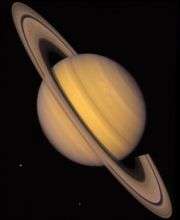
A team of scientists led from the UK has discovered that the rapid changes in Saturn's F ring can be attributed to small moonlets causing perturbations. Their results are reported in Nature. Saturn's F ring has long been of interest to scientists as its features change on timescales from hours to years and it is probably the only location in the solar system where large scale collisions happen on a daily basis. Understanding these processes helps scientists understand the early stages of planet formation.
Professor Carl Murray of Queen Mary, University of London and member of the Cassini Imaging Team led the analysis. He says "Saturn's F ring is perhaps the most unusual and dynamic ring in the solar system; it has multiple structures with features changing on a variety of timescales from hours to years."
The team used images gathered by the NASA-ESA Cassini Huygens mission. Images snapped by Cassini in 2006 and 2007 show the formation and evolution of a series of structures (called "jets" in the paper) that are the result of collisions between small nearby moonlets and the core of the F ring.
A ~5km object discovered by Cassini in 2004 (called S/2004 S 6) is the best candidate to explain some of the largest jets seen in the images.
Professor Murray adds "Previous research has noted the features in the F ring and concluded that either another moon of radius about 100km must be present and scattering the particles in the ring, or a much smaller moonlet was colliding with its constituent particles. We can now say that the moonlet is the most likely explanation and even confirm the identity of one culprit."
The F ring and all the nearby objects are being continually perturbed by encounters with the shepherding moon Prometheus and this allows the gravitational signature of the embedded objects to be detected, even when the objects themselves cannot be seen.
Dr Sébastien Charnoz of Université Paris 7 / CEA Saclay is a co-author on the paper. He says "Large scale collisions happen in Saturn's F ring almost daily – making it a unique place to study. We can now say that these collisions are responsible for the changing features we observe there."
The Cassini images also show new features (called "fans") which result from the gravitational effect of small (~1km) satellites orbiting close to the F ring core.
Professor Keith Mason, CEO of the Science and Technology Facilities Council which funds UK involvement in Cassini-Huygens said "This incredibly successful mission has taught us a great deal about the solar system and the processes at work in it. Understanding how small objects move within the dust rings around Saturn gives an insight into the processes that drive planetary formation, where the proto-planet collects material in its orbit through a dust plane and carves out similar grooves and tracks."
Source: Science and Technology Facilities Council


