A 'supra' new kind of froth
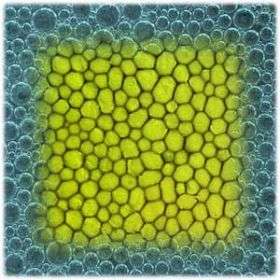
To see the latest science of type-I superconductors, look no further than the froth on a morning cup of cappuccino. A team of U.S. Department of Energy's Ames Laboratory physicists and collaborating students have found that the bubble-like arrangement of magnetic domains in superconducting lead exhibits patterns that are very similar to everyday froths like soap foam or frothed milk on a fancy coffee.
The similarities between the polygonal-shaped patterns in conventional foams and "suprafroths," the patterns created by a magnetic field in a superconductor, establish suprafroths as a model system for the study of froths.
"There are certain statistical laws that govern the behavior of froths, and we found that suprafroths satisfy these laws," said Ruslan Prozorov, Ames Laboratory physicist and primary investigator. "We can now apply what we know of suprafroths to all other froths and complex froth-like systems."
Prozorov discovered the suprafroth pattern last year, seeing an unexpected foam-like design when he applied a magnetic field to a lead sample in a magneto-optics system. Since the term "superfroth" was already in use for an unrelated product, Prozorov coined "suprafroths" in a nod to history: in the 1930s, superconductors were called "supraconductors."
To help characterize suprafroths, Prozorov pulled together a team including Ames Lab senior physicist Paul Canfield, summer laboratory assistant Andrew Fidler and graduate student Jacob Hoberg.
Canfield, who has an interest in pattern formation in nature, supplied the original idea to compare suprafroths' patterns to conventional froths.
"Last year, we were standing by Ruslan's poster on equilibrium patterns in Pb (lead), and I was discussing one of his figures during a break," said Canfield. "I recognized that the patterns he was showing for his Pb sample were exceptionally similar to that of a classical picture of bubbles.
"At first Ruslan was skeptical, but over the next few weeks we both realized just how profound the similarity between suprafroths and conventional froths was." Canfield continued.
The team's analysis revealed that suprafroths behave similarly to other commonplace froths, despite their very different microscopic origins: traditional froths' cell walls consist of material like detergent, water or plastic, while suprafroths' cell boundaries consist of superconducting phase lead.
One similarity between suprafroths and conventional froths is the process of coarsening, or when froth cells grow or shrink and eventually disappear. In everyday froths, this process is evident in a sink full of dish soap bubbles that pop and disappear over time. The process is similar in suprafroths when magnetic field is increased, illustrating that suprafroths adhere to John von Neumann's law, the widely accepted concept in froth physics that specifies the rate at which froth cells grow or shrink.
"Seeing von Neumann's law at work in suprafroths shows that the froth state is really an intrinsic property of this superconductor," said Prozorov.
"Suprafroths, like regular foams, adhere to the concept of area tiling that says that if you want to cover a plane with polygons with each having three vertices, the most probable polygon is a hexagon," he continued.
Physicists have long believed in a connection between the two statistical rules of froths. Common understanding has been that the most probable polygon—the hexagon—was related to the number of sides—six—that determines whether a froth cell shrinks or grows during coarsening. But the Ames Lab team's analysis has decoupled these two concepts in suprafroths.
"In our suprafroths, we found that the association between these two ideas is a coincidence, said Prozorov. "There is no strict correspondence between the most stable type of froth cell and the most common number of sides in a froth cell."
In suprafroths, cells of all observed numbers of sides grow with an increase in magnetic field, a discovery marking an important contribution to the general study of froths.
But the most significant contribution suprafroths make to the general physics of froth is as a model system that can be used to study all froths. Suprafroths offer reversibility, a significant benefit over conventional froths.
"In everyday froths, like soap foam, the agent of change is time," said Prozorov. "You have to wait for bubbles to simply dry out, and that takes days. And it's not reversible. You cannot reverse time."
"Once the bubbles pop, the problem is that the physical and chemical properties of the cells get modified, so that doesn't make for a clean experiment," Prozorov continued. "In an ideal situation, you want to only study the properties of the froth patterns and their complexity. You want to easily be able to change some parameter and change the structure of the froth."
Achieving an ideal froth experiment is possible in suprafroths because the agents that create the superconducting phase cells are magnetic field and temperature, both reversible parameters.
"Magnetic field and temperature can be tuned in the lab," said Prozorov. "They can be increased or decreased, and therefore we are able to study the pure statistical properties of froth without problems associated with the irreversibility of time or with chemical property changes."
Prozorov's comparison of suprafroths is also an important contribution is the study of superconductors.
"The statistical analysis shows suprafroths behave just like normal froth, which is also new for superconductivity," said Prozorov. "Just last year we found this new pattern in superconductors, and now we've proven that the froth state is really an intrinsic property of superconducting lead. It's a big deal for both the general physics of froth and the growing physics of superconductors.
"In physics, if you can find model systems, like suprafroths, that have similar patterns, then by studying these model systems you can actually get additional information about the behavior of very complex systems like galaxies, geophysics or biophysics" said Prozorov. "So, the bottom line is that studying physics of everyday soap froth, or, more reliably, suprafroths, can help us understand very complex, difficult questions about the world around us."
Canfield said that the suprafroth project is a case study for how collaboration should work at research laboratories.
"Fruitful collaboration like this happens frequently at Ames Lab," he said. "As part of our extensive collaboration and interaction, Ruslan and I discuss ideas, materials and results all the time."
Citation: "Suprafroth in Type-I Superconductors" by Ruslan Prozorov appears in Nature Physics' April issue: www.nature.com/nphys/journal/v … 4/full/nphys888.html
Source: Ames Laboratory


