Where mathematics and astrophysics meet
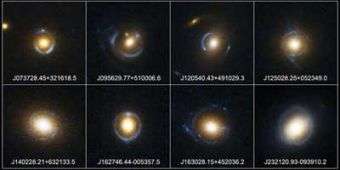
The mathematicians were trying to extend an illustrious result in their field, the Fundamental Theorem of Algebra. The astrophysicists were working on a fundamental problem in their field, the problem of gravitational lensing. That the two groups were in fact working on the same question is both expected and unexpected: The "unreasonable effectiveness of mathematics" is well known throughout the sciences, but every new instance produces welcome insights and sheer delight.
In their article "From the Fundamental Theorem of Algebra to Astrophysics: A `Harmonious' Path", which appears today in the Notices of the AMS, mathematicians Dmitry Khavinson (University of South Florida) and Genevra Neumann (University of Northern Iowa) describe the mathematical work that surprisingly led them to questions in astrophysics.
The Fundamental Theorem of Algebra (FTA), proofs of which go back to the 18th century, is a bedrock mathematical truth, elegant in its simplicity: Every complex polynomial of degree n has n roots in the complex numbers. In the 1990s, Terry Sheil-Small and Alan Wilmshurst explored the question of extending the FTA to harmonic polynomials. In a surprising twist in 2001, Khavinson, together with G. Swiatek, applied methods from complex dynamics to settle one of the cases of Wilmshurst's conjecture, showing that for a certain class of harmonic polynomials, the number of zeros is at most 3n - 2, where n is the degree of the polynomial.
When she was a postdoc at Kansas State University, Neumann mentioned the 3n-2 result in a talk, and Pietro Poggi-Corradini wondered whether Khavinson and Swiatek's complex dynamics approach could be extended to counting the zeros of rational harmonic functions. (A rational function is a quotient of polynomials, and a rational harmonic function is the sum of a rational function and the complex conjugate of a rational function.) She later asked Khavinson about this possibility. "We didn't have any idea what the answer would be," she said. And they certainly had no idea that an astrophysicist had already conjectured the answer.
"We were slightly surprised that the number came out different, 5n - 5 vs. 3n - 2," recalled Khavinson. They also wondered whether the bound of 5n - 5 was "sharp"---that is, whether it could be pushed any lower. "After checking and re-checking it, we posted a preprint on the arXiv and then returned to our respective business," Khavinson said. "Literally, a week later we received a congratulatory e-mail from Jeffrey Rabin of UCSD kindly telling us that our theorem resolves a conjecture of Sun Hong Rhie in astrophysics." Khavinson and Neumann had no idea that anyone outside of mathematics would be interested in this result.
Rhie has been studying the problem of gravitational lensing, a phenomenon in which light from a celestial source, such as a star or galaxy, is deflected by a massive object (or objects) between the light source and the observer. Because of the deflection, the observer sees multiple images of the same light source. The phenomenon was first predicted in the early 19th century, using Newtonian mechanics. A more accurate prediction was made by Einstein in 1915 using his theory of general relativity, and early observational support came in 1919 during a solar eclipse. The first gravitational lensing system was discovered in 1979.
It turns out that at least in some idealized situations one can count the number of images of the light source seen in a gravitational lensing system by counting the number of zeros of a rational harmonic function---exactly the kind of function Khavinson and Neumann had been studying. While investigating the possible number of images produced by a gravitational lens that has n point masses deflecting the light, Rhie had conjectured the bound of 5n - 5 that so surprised Khavinson and Neumann. Rhie also came up with an ingenious way of constructing an example of a rational harmonic function with exactly 5n - 5 zeros. Together with the result of Khavinson and Neumann, this example establishes that their 5n - 5 bound is sharp.
After hearing about Rhie's work, Khavinson and Neumann contacted other mathematicians and astrophysicists who worked on similar problems and received feedback they then used to revise their paper (it has since appeared in Proceedings of the AMS). These interactions led Khavinson into fruitful collaborations with astrophysicists on related questions. Some of the new results from this work are mentioned in the Notices article.
"I find this kind of interdisciplinary collaboration extremely exciting and stimulating," said Khavinson. "I just hope that I will be able to continue these collaborations. It is one of the most exciting experiences I have had in my life." Neumann is just as enthusiastic, and is grateful to Kansas State physicist Larry Weaver, who helped her to understand the physics of gravitational lensing, and to Rabin, who acted as the link between mathematics and astrophysics. "Professor Rabin's generous email introduced both Dmitry and me to an entirely new world," she said.
"From the Fundamental Theorem of Algebra to Astrophysics: A `Harmonious' Path" appears in the June/July 2008 issue of the AMS Notices, which will be posted today on the Notices web site, www.ams.org/notices .
Source: American Mathematical Society


