Researchers observe spontaneous 'ratcheting' of single ribosome molecules
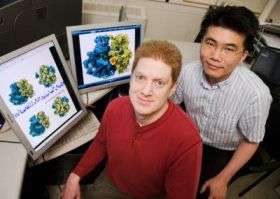
Researchers report this week that they are the first to observe the dynamic, ratchet-like movements of single ribosomal molecules in the act of building proteins from genetic blueprints. Their study, published in the journal Molecular Cell, reveals a key mechanism in the interplay of molecules that allows cells to build the proteins needed to sustain life.
Cells use a variety of tools to build proteins, beginning with messenger RNA, a ribbon-like molecule that codes for the sequence of amino acids in the protein. Another molecule, transfer RNA (tRNA) is uniquely qualified to read this code, but can do so only within the confines of the ribosome. Transfer RNAs bring individual amino acids into the ribosome where they are assembled into proteins. Various other proteins also participate in the process.
When protein translation occurs, single tRNAs enter specific sites in the ribosome, read the code and deliver their amino acids – one by one – to a growing protein chain. The ribsome transits along the messenger RNA as the protein is built, releasing the "deacylated" tRNA through an exit site.
A ribosome is made up of two subunits composed of ribonucleic acids (RNAs) and about 50 individual proteins.
The ribosome was once considered a static "workbench" for the assembly of new proteins. A recent study by researchers at the Wadsworth Center in Albany, N.Y., using cryo-electron microscopy, showed the ribosomal subunits in two distinct positions relative to one another, however. They proposed that the motion of the subunits depended on a protein catalyst, elongation factor G (EF-G).
In the new study, a team led by University of Illinois physics professor Taekjip Ha used fluorescence resonance energy transfer (FRET) to observe in real time the movement of the ribosomal subunits that is essential for protein synthesis. The team collaborated with Harry Noller, of the University of California at Santa Cruz, who provided expertise on the ribosome.
FRET makes use of fluorescent molecules whose signals vary in intensity depending on their proximity to one another. By labeling each of the two subunits of a single ribosomal molecule with these fluorescent markers, the researchers were able to watch the subunits move in relation to one another.
When Ha and postdoctoral fellow Peter Cornish observed the signal from the labeled ribosomes, they saw a spontaneous back-and-forth rotation between the subunits – even in the absence of the elongation factor, EF-G.
"Other researchers proposed that this rotation is induced by EF-G – that you have to have EF-G to cause this rotation," Ha said. "But we showed that no, that's not the case. Actually the ribosome can rock back and forth spontaneously, and can do it quite rapidly."
The researchers were able to view this motion even in the absence of tRNA. The ribosomal subunits were spontaneously switching back and forth between the classical (that is, non-rotated) state and a hybrid (rotated) state.
When they added a single tRNA with an amino acid permanently attached to it, the ribosome became "essentially stuck in the classical, non-rotated state," Cornish said. "And as soon as we removed that, it started to move spontaneously."
To better understand the role of EF-G, the researchers added a modified EF-G molecule that could not deliver its normal energy payload to the ribosome. The modified EF-G bound to the ribosome only in the rotated, hybrid state.
These findings led the researchers to propose that EF-G has a critical role in the process of protein translation: It stabilizes the rotated position of the ribosomal subunits relative to one another.
This allows the tRNA molecules to add amino acids to the growing protein and to exit, making room for the next tRNA specified in the messenger RNA code.
The researchers believe that EF-G acts as a linchpin, temporarily holding the ribosome in its rotated position until the deacylated tRNAs reposition themselves in the molecule as they move toward the exit. Once the tRNAs have accomplished this, the EF-G goes away, the ribosome ratchets back into its non-rotated position and the process begins again.
The researchers propose that this ratcheting motion allows the ribosome to advance along the messenger RNA as protein translation progresses. Without EF-G, the ribosomal subunits move in relation to one another, but are unable to progress along the messenger RNA as a protein is built.
"Many people would argue that the ribosome is one of the most important machines in our cells," Ha said. "What's really amazing is that it is such a massive complex that is still able to move spontaneously, to rock back and forth at a fairly rapid rate. And that movement is not just some random movement, but it's the most important movement of the ribosome for its locomotion."
Future studies will use FRET by labeling both the ribosomal subunits and the messenger RNA to see if the movement of the subunits and the ribosome's transit along the messenger RNA are synchronized, Ha said.
Source: University of Illinois at Urbana-Champaign


