Helicopters with Fuel Cells
June 6, 2008 Helicopters with Fuel Cells

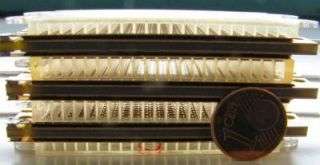
A stack of lightweight fuel cells: The individual cells are held apart by plastic spacers. Measuring 2 x 5 x 4 centimeters, the structure is not much bigger than a matchbox. Credit: © Fraunhofer IZM

The old saying that "there is strength in numbers" also applies to fuel cells. To deliver a high enough power output, a number of cells have to be connected in series. Manufacturers normally stack the fuel cells – a structure consisting of several metal plates, each containing one channel for air and one for hydrogen. This makes the fuel cell stack quite heavy.

Together with colleagues at the Technical University of Berlin, researchers from the Fraunhofer Institute for Reliability and Microintegration IZM in Berlin have developed a fuel cell that weighs only 30 grams and has an output of 12 watts. The high power density of 400 watts per kilogram has so far only been achieved in considerably larger systems weighing several hundred grams.

The fuel cell is light enough to power a twenty-centimeter helicopter. It is being developed by the participants in an EU project, and will be used in future for missions such as locating victims trapped in fallen buildings, monitoring traffic or investigating tracts of land that have been contaminated by chemical accidents.

How did the researchers manage to reduce the weight of the fuel cells so dramatically? "We use very thin, planar fuel cells," explains IZM team leader Dr. Robert Hahn. "We have replaced the metal plates by lightweight plastic spacers." The researchers have no need for an additional pump to provide an adequate air supply: The wind generated by the helicopter's rotor blades goes directly into the air vents.

The scientists had to devise a solution for the hydrogen supply, too, as a conventional pressure tank would be too heavy for the helicopter. "We have built a small reactor containing solid sodium borohydride. If we inject water, this produces hydrogen," declares Hahn. Since the helicopter always needs about the same amount of energy to stay in the air, the reactor always has to produce a consistent quantity of hydrogen.

The researchers have already built a prototype of the lightweight fuel cell. The helicopter is expected to take off, powered by this fuel cell, in just over a year's time. For the scientists, the next step is to adjust the hydrogen production to cater for fluctuating energy requirements. There are plenty of applications for such a fuel cell: It could be used as a charging point for laptop computers and cell phones, for instance.

Source: Fraunhofer-Gesellschaft


print this article email this article download pdf blog this article bookmark this article     Stumble it Digg this share on Facebook retweet share on Reddit add to delicious
Rate this story - 4.8 /5 (25 votes)

Rank Filter

Move the slider to adjust rank threshold, so that you can hide some of the comments.


Display comments: newest first

  • thales - Jun 06, 2008
    • Rank: not rated yet
    The power-to-weight ratio must be extraordinarily high. I imagine it could be used for a spaceship? Yes please.

June 6, 2008 all stories

Comments: 1

4.8 /5 (25 votes)
  • Stumble this up

  • Digg this

  • share this

  • hide
  • Related Stories

  • New rechargeable zinc-air batteries coming soon
    created Oct 29, 2009 | popularity not rated yet | comments 0
  • Like a hungry teen, life on Earth had big growth spurts
    created Oct 27, 2009 | popularity not rated yet | comments 0
  • Alternatively spliced tissue factor identified as promising new biomarker for aggressive cancers
    created Oct 26, 2009 | popularity not rated yet | comments 0
  • Japanese automakers rev up efforts in hydrogen cars
    created Oct 25, 2009 | popularity not rated yet | comments 0
  • Replacing Platinum in Fuel Cell Technology
    created Oct 20, 2009 | popularity not rated yet | comments 0


  • hide
  • Relevant PhysicsForums posts

  • CFP: ISNN2010 (June 6-10, 2010; Shanghai, China)
    created 3 hours ago
  • Secret Knock Detecting Lock
    created 12 hours ago
  • Gas engine running on Veggie oil - need help
    created 12 hours ago
  • Egg drop contest
    created 16 hours ago
  • More from Physics Forums - General Engineering

Other News

What computer science can teach economics

What computer science can teach economics

Technology / Computer Sciences

created 7 minutes ago | popularity not rated yet | comments 0

(PhysOrg.com) -- Computer scientists have spent decades developing techniques for answering a single question: How long does a given calculation take to perform? Constantinos Daskalakis, an assistant professor ...


Eco-friendly building techniques don't have to significantly raise construction costs

Technology / Energy

created 1hour ago | popularity 4.5 / 5 (2) | comments 1

Home builder Lance Schmidt hears it all the time: Green building costs more. But he and his colleagues are out to prove otherwise.


Framed for child porn -- by a PC virus

Framed for child porn -- by a PC virus

Technology / Internet

created 19 hours ago | popularity 5 / 5 (6) | comments 3

(AP) -- Of all the sinister things that Internet viruses do, this might be the worst: They can make you an unsuspecting collector of child pornography.


A system of space solar power system (SSPS)

Japan eyes solar station in space as new energy source

Technology / Energy

created Nov 08, 2009 | popularity 4.7 / 5 (15) | comments 21

It may sound like a sci-fi vision, but Japan's space agency is dead serious: by 2030 it wants to collect solar power in space and zap it down to Earth, using laser beams or microwaves.


Dartmouth professor finds that iconic Oswald photo was not faked

Professor finds that iconic Oswald photo was not faked (w/ Video)

Technology / Computer Sciences

created Nov 05, 2009 | popularity 3.8 / 5 (9) | comments 38

(PhysOrg.com) -- Dartmouth Computer Scientist Hany Farid has new evidence regarding a photograph of accused John F. Kennedy assassin Lee Harvey Oswald. Farid, a pioneer in the field of digital forensics, digitally ...