Crystal clear savings for drug giants
June 6, 2008 Crystal Polymorph

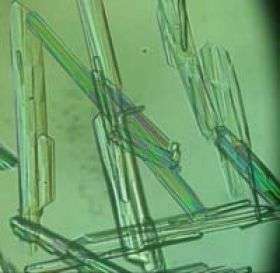
Beta version of L-Glutamic Acid as determined using on-line powder X-ray diffraction. Credit: University of Leeds

Drug companies could save millions thanks to a new technology to monitor crystals as they form. The technique, developed by University of Leeds engineers, is a potentially invaluable tool in drug manufacture, where controlling crystal forms is crucial both to cost and product safety.

Most drug compounds are crystalline and their structure can affect both their physical attributes and their performance. Changes to these structures are often caused by undetected fluctuations in the process.

"If you were to use a pencil to write on glass you wouldn't get very far, but use a diamond and you could write your name. Yet both are pure forms of carbon. It's the same with different solid forms of the same drug; they can have completely different properties," says Dr Robert Hammond of the University's Faculty of Engineering, who leads the research team.

"Drug molecules are becoming increasingly complex and the challenges involved in processing them means that it is not always possible to successfully produce the desired form reliably. That's why there's such enormous potential for our system. We're now able to look at crystals as they are forming in a reactor, something that has never been done before."

The new technology identifies and monitors changes in crystal structures on-line, providing a method of ensuring production of the desired drug compounds. The bespoke system has been developed by engineers at the University of Leeds in collaboration with Bede X-Ray Metrology as part of the EPSRC funded Chemicals Behaving Badly programme.

Called polymorphism, changes in crystal structure during processing can lead to huge delays in bringing drugs to market, costing drug companies many millions of pounds. It can also lead to challenges to intellectual property protection. There have been a number of high profile cases where patents have been challenged by companies making an established formulation using a different polymorph.

"It's an enormous problem for drug companies," explains Dr Hammond. "Their patents are extremely valuable – they are granted for 20 years, but it can take ten years to bring a new drug to market, which only leaves another ten to recoup the cost of its development."

The technology developed at Leeds is based on the 'gold standard' method for monitoring crystal structures - powder X-ray diffraction, the primary tool for studying polymorphs.

"There's enormous commercial potential for this technology, for example it could be developed to work at manufacturing plant scales and can be applied to speciality chemical industries as well," says Dr Hammond. "We're interested in talking to pharmaceutical and speciality chemical companies that can help us drive this forward."

Source: University of Leeds


print this article email this article download pdf blog this article bookmark this article     Stumble it Digg this share on Facebook retweet share on Reddit add to delicious
Rate this story - 3.3 /5 (3 votes)

Rank Filter

Move the slider to adjust rank threshold, so that you can hide some of the comments.


Display comments: newest first

  • TheRogue - Jun 06, 2008
    • Rank: not rated yet
    One can be fairly sure they will not pass along any savings to the public. Sad folks.

June 6, 2008 all stories

Comments: 1

3.3 /5 (3 votes)
  • Stumble this up

  • Digg this

  • share this

  • hide
  • Related Stories

  • Diamonds May Be the Ultimate MRI Probe, Say Quantum Physicists
    created Sep 22, 2009 | popularity not rated yet | comments 0
  • Stunning Finding: Compounds Protect Against Cerebral Palsy
    created Feb 25, 2009 | popularity not rated yet | comments 0
  • New tool for 'right first time' drug manufacture
    created Sep 22, 2008 | popularity not rated yet | comments 0
  • Researchers clarify function of glucose transport molecule
    created Jul 03, 2008 | popularity not rated yet | comments 0
  • NMR researchers unlock hydrogen’s secrets to spot polymorphism in pharmaceuticals
    created Oct 16, 2007 | popularity not rated yet | comments 0


Other News

Right first time: Pioneering new methods of drug manufacture

Chemistry / Materials Science

created 1hour ago | popularity not rated yet | comments 0

Engineers at the University of Leeds have developed a simple technology which can be used in existing chemical reactors to ensure "right first time" drug crystal formation.


H1N1 Virus Can Be Killed by Acidic Ozone Water

H1N1 Virus Can Be Killed by Acidic Ozone Water

Chemistry / Biochemistry

created Nov 09, 2009 | popularity 4.8 / 5 (23) | comments 10

(PhysOrg.com) -- Scientists have found that acidic ozone water can deactivate H1N1 viruses very effectively, offering a promising disinfectant for the millions of people trying to avoid the disease. Acidic ...


Telling an old book by its smell: Aroma hints at ways of preserving treasured documents

Telling an old book by its smell: Aroma hints at ways of preserving treasured documents

Chemistry / Analytical Chemistry

created 22 hours ago | popularity not rated yet | comments 0

Scientists may not be able to tell a good book by its cover, but they now can tell the condition of an old book by its odor. In a report published in the American Chemical Society's Analytical Chemistry they d ...


Toward home-brewed electricity with 'personalized solar energy'

Toward home-brewed electricity with 'personalized solar energy'

Chemistry / Materials Science

created Nov 04, 2009 | popularity 3.4 / 5 (9) | comments 5

New scientific discoveries are moving society toward the era of "personalized solar energy," in which the focus of electricity production shifts from huge central generating stations to individuals in their ...


New imagining technique could lead to better antibiotics and cancer drugs

Chemistry / Biochemistry

created Nov 09, 2009 | popularity 5 / 5 (4) | comments 0

A recently devised method of imaging the chemical communication and warfare between microorganisms could lead to new antibiotics, antifungal, antiviral and anti-cancer drugs, said a Texas AgriLife Research scientist.