Ocean life under threat from climate change
June 6, 2008 Detecting Ocean Change

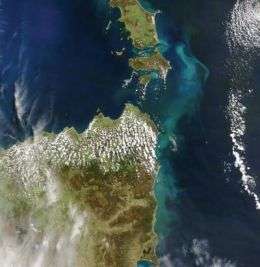
The extent of this algal bloom near Tasmania can only be seen using special sensors on ocean-observing satellites. Credit: CSIRO

The international science community must devote more resources to research into the effects climate change is having on ocean environments, according to a paper published today in the journal Science by researchers at CSIRO's Climate Adaptation National Research Flagship.

"Marine ecosystems are undoubtedly under-resourced, overlooked and under threat and our collective knowledge of impacts on marine life is a mere drop in the ocean," wrote Dr Anthony Richardson, from The University of Queensland and CSIRO, and his co-author, Dr Elvira Poloczanska from CSIRO in Hobart.

"There is an overwhelming bias toward land-surface studies which arise in part because investigating the ocean realm is generally difficult, resource-intensive and expensive," they said.

The disparity in focus on land-based compared to marine impacts was highlighted in the Intergovernmental Panel on Climate Change's (IPCC's) Fourth Assessment Report (2007), which included 28,500 significant biological changes in terrestrial systems but only 85 in marine systems.

The paper argues that the collection of marine environment data over 20 years or more – a requirement for inclusion in IPCC assessments – suffered in the mid-1980s due to government funding cutbacks for international marine science research, just as ocean warming began accelerating.

The authors advocate change in the existing IPCC process to better assess the impacts.

"Climate change is affecting ocean temperatures, the supply of nutrients from the land, ocean chemistry, food chains, shifts in wind systems, ocean currents and extreme events such as cyclones," Dr Poloczanska said. "All of these in turn affect the distribution, abundance, breeding cycles and migrations of marine plants and animals, which millions of people rely on for food and income. Development of the Integrated Marine Observing System, announced in 2006, is an important step forward but securing data over the time scales relevant for climate assessment will not occur until near 2030."

Dr Richardson said the situation is made more urgent as emerging evidence suggests marine organisms may be responding faster to climate change than land-based plants and animals. "As the climate is warming, marine plants and animals are shifting towards the poles and their timing of peak abundance is occurring earlier in the year," he said. "The slower dynamics of the ocean also means that some changes such as ocean acidification will be irreversible this century.

"While understanding impacts of climate change in the oceans is important, ultimately we need to develop adaptation options as the knowledge-base expands," Dr Richardson said.

Source: CSIRO Australia


print this article email this article download pdf blog this article bookmark this article     Stumble it Digg this share on Facebook retweet share on Reddit add to delicious
Rate this story - 3.4 /5 (9 votes)

Rank Filter

Move the slider to adjust rank threshold, so that you can hide some of the comments.


Display comments: newest first

  • Quantum_Conundrum - Jun 06, 2008
    • Rank: 2.9 / 5 (7)
    Good god people.

    GIVE IT A REST.

    MEDIEVAL WARM PERIOD.

    LITTLE ICE AGE.

    THE DAMN FISH, WHALES AND ALGAE ALL SURVIVED IT.
  • 1bigschwantz - Jun 06, 2008
    • Rank: 1.3 / 5 (3)
    Cant give it a rest dude! Way too much of an industry out there.

June 6, 2008 all stories

Comments: 2

3.4 /5 (9 votes)
  • Stumble this up

  • Digg this

  • share this

  • hide
  • Related Stories

  • Marine ecosystems get a climate form guide
    created 10 hours ago | popularity not rated yet | comments 0
  • From Greenhouse to Icehouse
    created Nov 24, 2009 | popularity not rated yet | comments 0
  • International expedition investigates climate change, alternative fuels in Arctic
    created Nov 20, 2009 | popularity not rated yet | comments 0
  • Oceans' uptake of manmade carbon may be slowing
    created Nov 18, 2009 | popularity not rated yet | comments 0
  • You're being followed: Scientists track movement of living things
    created Nov 13, 2009 | popularity not rated yet | comments 0


  • hide
  • Relevant PhysicsForums posts

  • Climate Science Update
    created 9 hours ago
  • The IPCC and the term "most"
    created Nov 23, 2009
  • Is global warming a fact?
    created Nov 23, 2009
  • Random variability of wind patterns
    created Nov 23, 2009
  • More from Physics Forums - Earth

Other News

The Energy Sources of Ultraluminous Galaxies

The Energy Sources of Ultraluminous Galaxies

Space & Earth / Astronomy

created 6 hours ago | popularity 4.2 / 5 (6) | comments 0

(PhysOrg.com) -- Ultraluminous infrared galaxies ((ULIRGs) are galaxies whose luminosity exceeds that of a trillion suns; for comparison, the Milky Way galaxy has a typical (and much more modest) luminosity ...


Space shuttle Atlantis, 7 astronauts back on Earth (AP)

Space shuttle Atlantis, 7 astronauts back on Earth

Space & Earth / Space Exploration

created 7 hours ago | popularity not rated yet | comments 0

(AP) -- Space shuttle Atlantis and its seven astronauts returned to Earth with a smooth touchdown Friday to end an 11-day flight that resupplied the International Space Station.


Fermi Telescope Peers Deep into Microquasar

Fermi Telescope Peers Deep into Microquasar (w/ Video)

Space & Earth / Astronomy

created 5 hours ago | popularity 4.5 / 5 (2) | comments 0

(PhysOrg.com) -- NASA's Fermi Gamma-ray Space Telescope has made the first unambiguous detection of high-energy gamma-rays from an enigmatic binary system known as Cygnus X-3. The system pairs a hot, massive ...


China is set to launch its second moon orbiter next October, state media have reported

China to launch second lunar probe: state media

Space & Earth / Space Exploration

created 11 hours ago | popularity 5 / 5 (3) | comments 0

China will launch its second moon orbiter next October, state media reported Friday, as it powers ahead with a space programme that has sparked concerns abroad.


In Greenland, warming fuels dream of hidden wealth (AP)

In Greenland, warming fuels dream of hidden wealth

Space & Earth / Environment

created 9 hours ago | popularity 3 / 5 (3) | comments 1

(AP) -- Gert Ignatiussen returns to this fjord-front Inuit town with the spoils of his hunting trip. Six seals, all killed with a single shot to the head.