New detector uses nanotubes to sense deadly gases
June 6th, 2008 New detector uses nanotubes to sense deadly gases

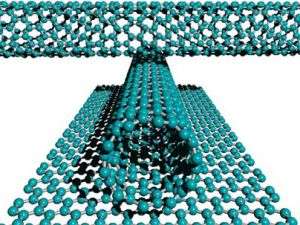
MIT researchers are designing sensors that use carbon nanotubes, shown here in middle and at top, to detect hazardous gases. Image: Chang Young Lee

Using carbon nanotubes, MIT chemical engineers have built the most sensitive electronic detector yet for sensing deadly gases such as the nerve agent sarin.

The technology, which could also detect mustard gas, ammonia and VX nerve agents, has potential to be used as a low-cost, low-energy device that could be carried in a pocket or deployed inside a building to monitor hazardous chemicals.

"We think this could be applied to a variety of environmental and security applications," said Michael Strano, the Charles and Hilda Roddey Associate Professor of Chemical Engineering and senior author of a paper describing the work published this week in the online edition of Angewandte Chemie.

Strano's sensor has exhibited record sensitivity to molecules mimicking organophosphate nerve toxins such as sarin: It can detect minute quantities as low as 1 femtomole (1 billion molecules), roughly equivalent to a concentration of 25 parts per trillion. "There's nothing that even comes close," he said.

Sarin, which killed 12 people in a 1995 terrorist attack on the Tokyo subway, can kill at very low concentrations (parts per million) after 10 minutes, so highly sensitive detection is imperative to save lives. The new detector is far more sensitive than needed to detect lethal doses.

To build their super-sensitive detector, Strano and his team used an array of carbon nanotubes aligned across microelectrodes. Each tube consists of a single-layer lattice of carbon atoms, rolled into a long cylinder with a diameter about 1/50,000 of the width of a human hair, which acts as a molecular wire.

The nanotube sensors require very little power--about 0.0003 watts. One sensor could run essentially forever on a regular battery. "It's something that could sit in the corner of a room and you could just forget about it," Strano said.

When a particular gas molecule binds to the carbon nanotube, the tube's electrical conductivity changes. Each gas affects conductivity differently, so gases can be identified by measuring the conductivity change after binding.

The researchers achieved new levels of sensitivity by coupling the nanotubes with a miniature gas-chromatography column etched onto a silicon chip smaller than a penny. The column rapidly separates different gases before feeding them into the nanotubes.

The new MIT sensor is also the first nanotube sensor that is passively reversible at this level of sensitivity. To achieve this, the team needed to decrease how strongly the nanotube sensor binds different gas molecules on its surface, allowing the sensor to detect a series of gas exposures in rapid succession.

Using a newly described chemistry outlined in a separate paper published in January in the Journal of the American Chemical Society, Strano and co-workers showed that this can be done by coating the nanotubes with amine-type molecules, which donate an extra pair of electrons to the nanotubes.

The coating allows gas molecules to bind to nanotubes but detach a few milliseconds later, allowing another molecule from the column to move in. With a network of these reversible sensors, a gas could be tracked as it spreads through a large area.

The lead author of the paper is Chang Young Lee, a graduate student in chemical engineering. Richa Sharma, another MIT graduate student in chemical engineering, is also an author of the paper. Adarsh Radadia and Richard Masel at the University of Illinois at Urbana-Champaign developed the microcolumn technology.

Source: MIT


print this article email this article download pdf blog this article bookmark this article     Digg this Stumble it share on Facebook share on Reddit add to delicious save to Yahoo! bookmarks
4.4/5 after 8 votes


June 6th, 2008 all stories
Nanotechnology / Nanomaterials

Comments: 0
Rank: 4.4/5 after 8 votes

  • Stumble this up

  • Digg this

  • Share it:
  • share on Facebook
  • share on MySpace
  • share on Slashdot
  • rss-newsfeed
  • share on Google
  • share on Reddit
  • add to delicious
  • save to Yahoo! bookmarks
  • share on Windows Live
  • Add to Mixx!
Rating: 4.4/5 after 8 votes

  • Related Stories

  • New Gas Sensor Based on Multiwalled Carbon Nanotubes
    created May 27, 2009 | popularity not rated yet | comments 0
  • Super Sensitive Gas Detector Goes Down the Nanotubes
    created Jan 13, 2009 | popularity not rated yet | comments 0
  • Carbon Nanotubes Detect Lung Cancer Markers in the Breath
    created Nov 20, 2008 | popularity not rated yet | comments 0
  • New gas sensor is tiny, quick
    created Jan 11, 2008 | popularity not rated yet | comments 0
  • Two Nanostructures Are Better Than One
    created Sep 04, 2007 | popularity not rated yet | comments 0

Tags


  • Physicists Demonstrate Quantum Memory with Matter Qubits
    Physicists Demonstrate Quantum Memory with Matter Qubits
    Physics / General Physics
    created Jul 03, 2009 | popularity 4.4 / 5 (16) | comments 1
  • 'Holey' Nanosheets for Wastewater Dye Removal
    Nanotechnology / Nanomaterials
    created Jul 01, 2009 | popularity 5 / 5 (5) | comments 1
  • Jellyfish Robot Swims Like its Biological Counterpart
    Jellyfish Robot Swims Like its Biological Counterpart
    Electronics / Robotics
    created Jun 26, 2009 | popularity 4.4 / 5 (7) | comments 1
  • Could Maxwell's Demon Exist in Nanoscale Systems?
    Could Maxwell's Demon Exist in Nanoscale Systems?
    Physics / General Physics
    created Jun 24, 2009 | popularity 4.4 / 5 (18) | comments 29
  • Living Safely with Robots, Beyond Asimov's Laws
    Living Safely with Robots, Beyond Asimov's Laws
    Electronics / Robotics
    created Jun 22, 2009 | popularity 4.6 / 5 (52) | comments 40
  • Other News

    A 'quantum of sol' -- how nanotechnology could hold the key to a solar-powered future

    A 'quantum of sol' -- how nanotechnology could hold the key to a solar-powered future

    Nanotechnology / Nanomaterials

    created Jun 30, 2009 | popularity 3.7 / 5 (12) | comments 16

    (PhysOrg.com) -- A new generation of 'nano-structured' millimetre-sized solar cells that could convert the sun's energy to electricity more than twice as efficiently as current technology, is the subject of ...


    Australian researchers are set to begin human trials of a tiny nano-cell that acts as a "Trojan horse" against cancer

    Hi-tech 'Trojan horse' can kill cancer cells: researchers

    Nanotechnology / Bio & Medicine

    created Jun 29, 2009 | popularity 4.6 / 5 (11) | comments 7

    Australian researchers are set to begin human trials of a tiny nano-cell that acts as a "Trojan horse" against cancer cells, a breakthrough they say may curb the need for debilitating chemotherapy.


    Harnessing Nanoparticles To Track Cancer Cell Changes

    Nanotechnology / Bio & Medicine

    created Jul 03, 2009 | popularity not rated yet | comments 1

    The more dots there are, the more accurate a picture you get when you connect them. Cancer researchers adopting that philosophy have developed a new imaging technology that could give scientists the ability to simultaneously ...


    'Holey' Nanosheets for Wastewater Dye Removal

    Nanotechnology / Nanomaterials

    created Jul 01, 2009 | popularity 5 / 5 (5) | comments 1

    (PhysOrg.com) -- Researchers have discovered that extremely thin sheets of nickel oxide with hexagonally shaped holes can absorb hazardous dyes from wastewater nearly as well as the best traditional methods, but are recyclable. ...


    New statistical technique improves precision of nanotechnology data

    New statistical technique improves precision of nanotechnology data

    Nanotechnology / Nanophysics

    created Jul 01, 2009 | popularity 3 / 5 (2) | comments 0

    A new statistical analysis technique that identifies and removes systematic bias, noise and equipment-based artifacts from experimental data could lead to more precise and reliable measurement of nanomaterials ...