Circadian math: 1 plus 1 doesn't always equal 2
June 7th, 2008 Circadian math: 1 plus 1 doesn't always equal 2

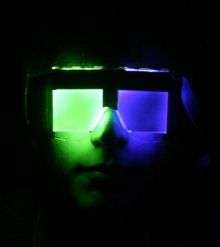
Researchers have found that the circadian system may be able to distinguish between lights of different colors. Credit: Rensselaer/Lighting Research Center

Like a wristwatch that needs to be wound daily for accurate time-telling, the human circadian system — the biological cycles that repeat approximately every 24 hours — requires daily light exposure to the eye's retina to remain synchronized with the solar day. In a new study published in the June issue of Neuroscience Letters, researchers have demonstrated that when it comes to the circadian system, not all light exposure is created equal.

The findings have profound implications for exploring how lighting can be used to adjust our bodies' clocks, and they could redefine the way lighting is manufactured, according to Mariana Figueiro, lead author of the paper and assistant professor in the Lighting Research Center (LRC) at Rensselaer Polytechnic Institute.

Short-wavelength light, including natural light from the blue sky, is highly effective at stimulating the circadian system. Exposure to other wavelengths — and thus colors — of light may necessitate longer exposure times or require higher exposure levels to be as effective at "winding the watch."

In some instances, exposure to multiple wavelengths (colors) of light simultaneously can result in less total stimulation to the circadian system than would result if either color were viewed separately, a phenomenon known as "spectral opponency." The LRC scientists have shown that the circadian system shares neurons in the retina — which exhibit spectral opponency and form the foundation for our perception of color — with the visual system. Thus, in principle, the circadian system may be able to distinguish between lights of different colors.

More than meets the eye

To demonstrate that the circadian system exhibited spectral opponency formed in the retina, the researchers exposed 10 subjects to three experimental conditions: one unit of blue light to the left eye plus one unit of green light to the right eye; one unit of blue light to the right eye plus one unit of green light to the left eye; and half a unit of blue light plus half a unit of green light to both eyes and then measured each individual's melatonin levels, a natural indicator of the circadian clock.

"The first two conditions — exposure to a single color in each eye — did not result in a significant difference in melatonin suppression, while the third condition — exposure to both colors in both eyes — resulted in significantly less melatonin suppression," said Figueiro. "Even though the amount of light at the eye was the same in all three conditions, when the two colors of light were combined in the same eye, the response of the system was reduced due to spectral opponent mechanisms formed in the retina."

This indicates that spectral opponency is a fundamental characteristic of how the human retina converts light into neural signals in the human circadian system, according to Figueiro.

The findings also verify the accuracy of a new quantification system LRC researchers developed in 2006 to calculate the "circadian efficacy" of different light sources. Called the model of human circadian phototransduction,
the tool correctly predicted the circadian system response demonstrated under each of the three experimental conditions.

The model appears to correctly predict the circadian response to any light source, and can be used as the foundation for a new system of circadian photometry, much like the current system of photometry based on human vision.

Quantification of light as a stimulus for the circadian system provide new scientific insights into how the human body processes light for the circadian system, according to Figueiro.

Nocturnal melatonin, a hormone produced at night and under conditions of darkness, is used as a marker for the circadian clock. Scientific evidence suggests that disruption of the circadian system — and thus the melatonin cycle — may result in increased malignant tumor growth, as well as poor sleep quality, lack of alertness, seasonal depression, and immune deficiencies.

Now that the model can predict circadian efficacy for any light source, Figueiro and her research partners have begun studying the way time of night affects the potency of light exposure. Once complete, the comprehensive model will allow manufacturers to develop light sources that most effectively stimulate and, importantly, do not stimulate the circadian system.

Source: Rensselaer Polytechnic Institute


print this article email this article download pdf blog this article bookmark this article     Digg this Stumble it share on Facebook share on Reddit add to delicious save to Yahoo! bookmarks
4.5/5 after 24 votes

Rank Filter

Move the slider to adjust rank threshold, so that you can hide some of the comments.


Display comments: newest first

  • superhuman - Jun 07, 2008
    • Rank: not rated yet
    So exposure to blue light resembling the sky should suppress sleepiness while white light does not. I'm going to test it If I can get a proper blue light somewhere.
  • HenisDov - Jun 08, 2008
    • Rank: 4 / 5 (1)
    Origin Of Circadian Rhythm

    For Archaic Genes Sunlight Was The Only Source Of Energy

    A. Posted Nov 25 2007 in physorg forum
    and e-mailed to Editor-in-Chief, Journal of Circadian Rhythms 28 Nov 2007

    Circadian Rhythm and Plant Genes Fuel-Up

    (1) One of the routes, of the mechanisms of energy absorption, by which some archaegenes became and function as active energy packages, i.e. became living organisms:

    http://www.physor...032.html

    (2) My elsewhere note on the Origin of Circadian Rhythm applies neatly in Plant Genes Fuel-Up, too. Both these processes fit in with comprehension that genes-genomes are living organisms.

    (3) Genome observed "Oscillating" in coordination with circadian rhythm:

    http://www.physor...572.html

    But circadian rhythm may be innate gene-genome characteristic, inborn/brought-about at the energetic conditions during the genesis of genes in the process of phasing from chemical olygomer to replicating life, to genes, to base life energy packages .....

    See

    http://blog.360.y...Q--?cq=1&p=372

    Chapter I, G. Life's Drive and Purpose

    "1. If one accepts, intuitively and logically, Pasteur's observation that all life must come from previously existing life, then the answer to "what makes a mono- and poly-cell life-form a Life" is the answer to "what makes some molecular associations in cells LIVES", and vice versa. It is the "lifehood" of genes that makes us and all other forms of life on Earth living organisms, and evolution has been the route of Life's ever more complexing progress since the first replication of the first gene."

    B. Posted 12 Jan 2008 in physorg forum

    It occurs to me that the point of the above post has not been duly obvious, i.e. that it has not clearly explained the source of Earth's organism's Circadian Rhythm.

    I therefore wish to add this to the original post, the emphasis that for the archaic genes, parents of all Earth's Life, direct sunlight was the ONLY source of energy. Hence circadian rhythm is most certainly an innate gene-genome characteristic.

    Dov Henis

  • x646d63 - Jun 08, 2008
    • Rank: 3 / 5 (2)
    I remember reading that a yogi once went 300 days without food and claimed that he got his energy from staring at the sun for 45 minutes as it rose in the morning...maybe we still have the ability to generate energy from sunlight...
  • AgentMarty - Jun 09, 2008
    • Rank: not rated yet
    I bet it was a blind yogi.
  • nilbud - Aug 05, 2008
    • Rank: not rated yet
    Phew, I thought for a second someone was having a go at the Canadians again.

June 7th, 2008 all stories
Medicine & Health / Research

Comments: 5
Rank: 4.5/5 after 24 votes

  • Stumble this up

  • Digg this

  • Share it:
  • share on Facebook
  • share on MySpace
  • share on Slashdot
  • rss-newsfeed
  • share on Google
  • share on Reddit
  • add to delicious
  • save to Yahoo! bookmarks
  • share on Windows Live
  • Add to Mixx!
Rating: 4.5/5 after 24 votes


Tags


  • Physicists Demonstrate Quantum Memory with Matter Qubits
    Physicists Demonstrate Quantum Memory with Matter Qubits
    Physics / General Physics
    created Jul 03, 2009 | popularity 4.4 / 5 (17) | comments 1
  • 'Holey' Nanosheets for Wastewater Dye Removal
    Nanotechnology / Nanomaterials
    created Jul 01, 2009 | popularity 5 / 5 (5) | comments 1
  • Jellyfish Robot Swims Like its Biological Counterpart
    Jellyfish Robot Swims Like its Biological Counterpart
    Electronics / Robotics
    created Jun 26, 2009 | popularity 4.4 / 5 (8) | comments 1
  • Could Maxwell's Demon Exist in Nanoscale Systems?
    Could Maxwell's Demon Exist in Nanoscale Systems?
    Physics / General Physics
    created Jun 24, 2009 | popularity 4.4 / 5 (18) | comments 29
  • Living Safely with Robots, Beyond Asimov's Laws
    Living Safely with Robots, Beyond Asimov's Laws
    Electronics / Robotics
    created Jun 22, 2009 | popularity 4.6 / 5 (54) | comments 40
  • Other News

    One step closer to an artificial nerve cell

    Medicine & Health / Research

    created 29 minutes ago | popularity not rated yet | comments 0

    (PhysOrg.com) -- Scientists at Karolinska Institutet and Linköping University (Sweden) are well on the way to creating the first artificial nerve cell that can communicate specifically with nerve cells in the body using neurotransmitters. ...


    Chemicals in common consumer products may play a role in pre-term births

    Medicine & Health / Health

    created 26 minutes ago | popularity not rated yet | comments 0

    (PhysOrg.com) -- A new study of expectant mothers suggests that a group of common environmental contaminants called phthalates, which are present in many industrial and consumer products including everyday personal care items, ...


    Students with depression twice as likely to drop out of college (w/ Podcast)

    Medicine & Health / Psychology & Psychiatry

    created 7 minutes ago | popularity not rated yet | comments 0

    (PhysOrg.com) -- College students with depression are twice as likely as their classmates to drop out of school, new research shows.


    New study pinpoints difference in the way children with autism learn new behaviors

    Medicine & Health / Neuroscience

    created 3 hours ago | popularity not rated yet | comments 0

    Researchers from the Kennedy Krieger Institute and Johns Hopkins University School of Medicine have collaborated to uncover important new insights into the neurological basis of autism.


    Dogs, humans, put heads together to find cure for brain cancer

    Medicine & Health / Genetics

    created 1hour ago | popularity not rated yet | comments 0

    Pinpointing the genes involved in human brain cancer can be like looking for a needle in a haystack, and sometimes the needle you find may not be the right one. By comparing human and canine genomes, researchers at North ...