Scientists find 245 million-year-old burrows of land vertebrates in Antarctica
June 8, 2008 Burrow Excavation

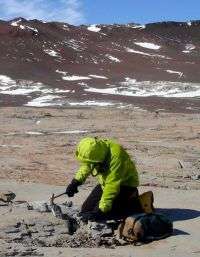
Christian Sidor of the University of Washington digs for tetrapod fossils in Allan Hills, part of the southern Victoria Land area of Antarctica, during field work in January 2006. Credit: Cara Fritz/Oregon State University

For the first time paleontologists have found fossilized burrows of tetrapods – any land vertebrates with four legs or leglike appendages – in Antarctica dating from the Early Triassic epoch, about 245 million years ago.

The fossils were created when fine sand from an overflowing river poured into the animals' burrows and hardened into casts of the open spaces. The largest preserved piece is about 14 inches long, 6 inches wide and 3 inches deep. No animal remains were found inside the burrow casts, but the hardened sediment in each burrow preserved a track made as the animals entered and exited.

In addition, scratch marks from the animals' initial excavation were apparent in some places, said Christian Sidor, a University of Washington assistant professor of biology and curator of vertebrate paleontology at the Burke Museum of Natural History and Culture at the UW.

"We've got good evidence that these burrows were made by land-dwelling animals rather than crayfish," said Sidor, who is lead author of a paper describing the find, which is being published in the June edition of The Journal of Vertebrate Paleontology.

Co-authors are Molly Miller, a geology professor at Vanderbilt University, and John Isbell, a geosciences professor at the University of Wisconsin-Milwaukee. The work was funded by the National Science Foundation.

Fossils of tetrapod bones from later in the Triassic period have been found in a section of Antarctica called Victoria Land, but the fossil burrows predate those bone fossils by at least 15 million years, Sidor said.

The fossilized burrows were collected in 2003 and 2005-06 from the Fremouw Formation at Wahl Glacier and from the Lashly Formation at Allan Hills, both toward the outer edges of Antarctica.

Despite the absence of fossil bones, the burrows' relatively small size prompted Sidor to speculate that their owners might have been small lizardlike reptiles called Procolophonids or an early mammal relative called Thrinaxodon.

Burrows, some containing tetrapod bones, have previously been excavated in South Africa, which is considered to be perhaps the world's richest fossil depository, and those burrows are nearly identical to the fossils unearthed in Antarctica. During the Triassic period, Antarctica and South Africa were connected as part of a supercontinent called Pangea.

Because even at that time Antarctica was substantially colder than South Africa, and because sea levels likely were higher than today, it is much rarer to find fossils there that date from as far back as the Early Triassic.

"Everywhere has a spotty fossil record, but Antarctica has an extremely spotty fossil record because it is difficult finding exposed rocks amid all the ice," Sidor said.

At the time the burrows were dug, Antarctica would have been ice free. However temperatures still would have been quite cold, since both areas where the burrows were found are within the Antarctic Circle and so experience at least one day a year of complete darkness.

"We have documented that tetrapods were burrowing, making dens in Antarctica, back in the Triassic," Sidor said. "There are lots of good reasons for burrowing at high latitudes, not the least of which is protection from the elements."

Source: University of Washington


print this article email this article download pdf blog this article bookmark this article     Stumble it Digg this share on Facebook retweet share on Reddit add to delicious
Rate this story - 4 /5 (25 votes)

Rank Filter

Move the slider to adjust rank threshold, so that you can hide some of the comments.


Display comments: newest first

  • agg - Jun 09, 2008
    • Rank: 1 / 5 (1)
    so true. Also anthropogenic global warming must be the cause of the ice receeding and by that logic no other causes exist. So this means future generations are sending greenhouse gas back in time.
  • rubberman - Jun 12, 2008
    • Rank: 5 / 5 (1)
    This article has nothing to do with current climate change issues....thanks for the input though.

June 8, 2008 all stories

Comments: 2

4 /5 (25 votes)
  • Stumble this up

  • Digg this

  • share this

  • hide
  • Related Stories


  • hide
  • Relevant PhysicsForums posts

  • Selenocysteine in pH=7
    created 21 hours ago
  • What is the formula for calculating the speed of thought?
    created Nov 26, 2009
  • What does word "absorption" mean in the intestine?
    created Nov 26, 2009
  • What is transpulmonary pressure?
    created Nov 24, 2009
  • More from Physics Forums - Biology

Other News

Living buildings could mop up carbon dioxide

Living buildings could mop up carbon dioxide

Other Sciences / Other

created 58 minutes ago | popularity not rated yet | comments 0

(PhysOrg.com) -- Architecture could help us tackle climate change, if we start to design our buildings with 'living' materials, according to Dr Rachel Armstrong, UCL Bartlett School of Architecture.


Message gone viral? Blame it on altruistic, yet image-conscious Internet  'e-mavens'

Message gone viral? Blame it on altruistic, yet image-conscious Internet 'e-mavens'

Other Sciences / Economics

created 22 hours ago | popularity 3.5 / 5 (2) | comments 0

(PhysOrg.com) -- Why do some online ad campaigns go viral while other online marketing messages gather "cyber-dust" on the information superhighway? The key may lie in the motivation of Internet users to email ...


The skyline of Tokyo in Japan, where scientists have criticised the new government for plans to slash research budgets

Japan scientists attack govt research cut plans

Other Sciences / Other

created 15 hours ago | popularity 5 / 5 (2) | comments 0

Top Japanese scientists, including four Nobel laureates, have criticised the new government for plans to slash research budgets, warning the country will loose its high-tech edge.


Researcher: Faint writing seen on Shroud of Turin (AP)

Researcher: Faint writing seen on Shroud of Turin (Update)

Other Sciences / Archaeology & Fossils

created Nov 20, 2009 | popularity 2.3 / 5 (31) | comments 45

(AP) -- A Vatican researcher has rekindled the age-old debate over the Shroud of Turin, saying that faint writing on the linen proves it was the burial cloth of Jesus. Experts say the historian may be reading ...


Explained: The Discrete Fourier Transform

Explained: The Discrete Fourier Transform

Other Sciences / Mathematics

created Nov 25, 2009 | popularity 4.3 / 5 (26) | comments 8

(PhysOrg.com) -- In 1811, Joseph Fourier, the 43-year-old prefect of the French district of Isčre, entered a competition in heat research sponsored by the French Academy of Sciences. The paper he submitted ...