'Super paper:' New nanopaper more break-resistant than cast iron
June 9, 2008 Nanopaper

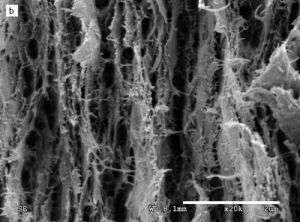
Scientists report development of cellulose nanopaper, a superstrong material that could be used in the construction industry. Above is a cross-section of a fracture surface of a cellulose nanofibril film. Credit: Courtesy of American Chemical Society

Researchers in Sweden and Japan report development of a new type of paper that resists breaking when pulled almost as well as cast iron. The new material, called "cellulose nanopaper," is made of sub-microscopic particles of cellulose and may open the way for expanded use of paper as a construction material and in other applications, they suggest. Their study is scheduled for the June 9 issue of ACS' Biomacromolecules.

In the new study, Lars A. Berglund and colleagues note that cellulose — a tough, widely available substance obtained from plants — has potential as a strong, lightweight ingredient in composites and other materials in a wide range of products.

Although cellulose-based composites have high strength, existing materials are brittle and snap easily when pulled.

The study described a solution to this problem. It involves exposing wood pulp to certain chemicals to produce cellulose nanopaper. Their study found that its tensile strength — a material's ability to resist pull before snapping — exceeded that of cast iron.

They also were able to adjust the paper's strength by changing its internal structure.

Source: ACS


print this article email this article download pdf blog this article bookmark this article     Stumble it Digg this share on Facebook retweet share on Reddit add to delicious
Rate this story - 4.2 /5 (46 votes)

Rank Filter

Move the slider to adjust rank threshold, so that you can hide some of the comments.


Display comments: newest first

  • zevkirsh - Jun 09, 2008
    • Rank: 4.5 / 5 (2)
    i read about this before , and i somehow could see this as the revival of some ancient recipe for paper that ancient warriors used as for armor.
    it almost sounds like such a simple technique that an alchemist could have simply found it many hudnreds of years ago and been forgotten. go chemists!
  • Mercury_01 - Jun 09, 2008
    • Rank: 3 / 5 (1)
    yeah, but can you make roat beef hash on it?
  • Glis - Jun 09, 2008
    • Rank: 4 / 5 (1)
    But what about tearing? Serious question. Does tensile strength really mean anything if it still tears like paper?
  • SongDog - Jun 09, 2008
    • Rank: 3 / 5 (1)
    Original article is at pubs.acs.org/cgi-bin/sample.cgi/bomaf6/2008/9/i06/pdf/bm800038n.pdf
  • superhuman - Jun 09, 2008
    • Rank: 2 / 5 (2)
    Why is this a 'nano' paper?
  • NeilFarbstein - Jun 09, 2008
    • Rank: 1.3 / 5 (4)
    That's nothing we vulvox is working on a nanopaper that's 100 times stronger than steel.
  • weewilly - Jun 09, 2008
    • Rank: 4.3 / 5 (3)
    How will our shredders work now?
  • Glis - Jun 09, 2008
    • Rank: 4 / 5 (2)
    That's nothing we vulvox is working on a nanopaper that's 100 times stronger than steel.


    Doesn't vulvox send e-mails asking if you want to 'UPpGRADE yOu're P3n1s'?

June 9, 2008 all stories

Comments: 8

4.2 /5 (46 votes)
  • Stumble this up

  • Digg this

  • share this

  • hide
  • Related Stories


  • hide
  • Relevant PhysicsForums posts

  • photoconductivity of polymers
    created Nov 25, 2009
  • Heat pipe for high temperature
    created Nov 24, 2009
  • Robot built out of acrylic
    created Nov 24, 2009
  • Thickness or Ga. of Stainless steel water tank?
    created Nov 24, 2009
  • More from Physics Forums - Materials & Chemical Engineering

Other News

Nanowire Formation

Nanowires key to future transistors, electronics

Nanotechnology / Nanophysics

created 50 minutes ago | popularity 5 / 5 (1) | comments 0

(PhysOrg.com) -- A new generation of ultrasmall transistors and more powerful computer chips using tiny structures called semiconducting nanowires are closer to reality after a key discovery by researchers ...


Nanotube defects equal better energy and storage systems

Nanotube defects equal better energy and storage systems

Nanotechnology / Nanomaterials

created Nov 19, 2009 | popularity 4.4 / 5 (10) | comments 2

(PhysOrg.com) -- Most people would like to be able to charge their cell phones and other personal electronics quickly and not too often. A recent discovery made by UC San Diego engineers could lead to carbon ...


Water droplets direct self-assembly process in thin-film materials

Nanotechnology / Nanomaterials

created Nov 23, 2009 | popularity 5 / 5 (4) | comments 2

You can think of it as origami - very high-tech origami. Researchers at the University of Illinois have developed a technique for fabricating three-dimensional, single-crystalline silicon structures from thin films by coupling ...


Fast, easy, and highly sensitive arsenic detection with gold nanoparticles

Nanotechnology / Nanomaterials

created Nov 25, 2009 | popularity 5 / 5 (1) | comments 0

(PhysOrg.com) -- Mention of arsenic poisoning usually brings to mind underhanded murder. However, the danger of arsenic poisoning from contaminated drinking water is far greater. Low concentrations of arsenic are found in ...


Using superconducting probes to get a picture of what it's like inside CNTs

Nanotechnology / Nanophysics

created Nov 20, 2009 | popularity 4.4 / 5 (9) | comments 0

(PhysOrg.com) -- "Carbon nanotubes are exciting for fundamental physics, and for potential technological applications," Nadya Mason tells PhysOrg.com. "However, we are generally limited in the way that we can study them. ...