Stripes key to nanoparticle drug delivery
June 9th, 2008 Stripes key to nanoparticle drug delivery

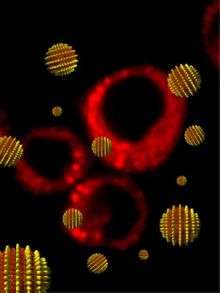
MIT researchers have created 'striped' nanoparticles capable of entering a cell without rupturing it. In the background of this cartoon are cells that have taken up nanoparticles carrying fluorescent imaging agents. Image courtesy: Francesco Stellacci, Darrell Irvine and colleagues, MIT

In work that could at the same time impact the delivery of drugs and explain a biological mystery, MIT engineers have created the first synthetic nanoparticles that can penetrate a cell without poking a hole in its protective membrane and killing it. The key to their approach? Stripes.

The team found that gold nanoparticles coated with alternating bands of two different kinds of molecules can quickly pass into cells without harming them, while those randomly coated with the same materials cannot. The research was reported in a recent advance online publication of Nature Materials.

"We've created the first fully synthetic material that can pass through a cell membrane without rupturing it, and we've found that order on the nanometer scale is necessary to provide this property," said Francesco Stellacci, an associate professor in the Department of Materials Science and Engineering and co-leader of the work with Darrell Irvine, the Eugene Bell Career Development Associate Professor of Tissue Engineering.

In addition to the practical applications of such nanoparticles for drug delivery and more-the MIT team used them to deliver fluorescent imaging agents to cells-the tiny spheres could help explain how some biological materials such as peptides are able to enter cells.

"No one understands how these biologically derived cell-penetrating materials work," said Irvine. "So we could use the new particles to learn more about their biological counterparts. Could they be analogues of the biological system?"

When a cell membrane recognizes a foreign object such as a nanoparticle, it normally wraps around or "eats" it, encasing the object in a smaller bubble inside the cell that can eventually be excreted. Any drugs or other agents attached to the nanoparticle therefore never reach the main fluid section of the cell, or cytosol, where they could have an effect.

Such nanoparticles can also be "chaperoned" by biological molecules into the cytosol, but this too has drawbacks. Chaperones can work in some cells but not others, and carry one cargo but not another.

Hence the importance of the MIT work in developing nanoparticles that can directly penetrate the cell membrane, deliver their cargo to the cytosol, and do so without killing the cell.

Irvine compares the feat to a phenomenon kids can discover. "If you have a soap film and you poke it with a bubble wand, you'll pop it," he said. "But if you coat the bubble wand with soap before poking the film, it will pass through the film without popping it because it's coated with the same material." Stellacci notes that the coated nanoparticles have properties similar to the cell membrane-not identical-but the analogy is still apt.

Stellacci first reported the creation of the striped nanoparticles in a 2004 Nature Materials paper. At the time, "we noticed that they interacted with proteins in an interesting way," he said. "Could they also have interesting interactions with cells?" Four years later, he and his colleagues report a resounding "yes."

Source: Massachusetts Institute of Technology


print this article email this article download pdf blog this article bookmark this article     Digg this Stumble it share on Facebook share on Reddit add to delicious save to Yahoo! bookmarks
4.4/5 after 14 votes


June 9th, 2008 all stories
Nanotechnology / Bio & Medicine

Comments: 0
Rank: 4.4/5 after 14 votes

  • Stumble this up

  • Digg this

  • Share it:
  • share on Facebook
  • share on MySpace
  • share on Slashdot
  • rss-newsfeed
  • share on Google
  • share on Reddit
  • add to delicious
  • save to Yahoo! bookmarks
  • share on Windows Live
  • Add to Mixx!
Rating: 4.4/5 after 14 votes

  • Related Stories

  • Research explores interactions between nanomaterials, biological systems
    created Jun 19, 2009 | popularity not rated yet | comments 0
  • Gene therapy technique thwarts cancer by cutting off tumor blood supply
    created Jun 12, 2009 | popularity not rated yet | comments 0
  • Scientists advance safety of nanotechnology
    created Jun 11, 2009 | popularity not rated yet | comments 0
  • New tool for next-generation cancer treatments using nanodiamonds
    created May 18, 2009 | popularity not rated yet | comments 0
  • Nanotechnology holds promise for STD drug delivery
    created May 03, 2009 | popularity not rated yet | comments 0

Tags


  • Physicists Demonstrate Quantum Memory with Matter Qubits
    Physicists Demonstrate Quantum Memory with Matter Qubits
    Physics / General Physics
    created Jul 03, 2009 | popularity 4.4 / 5 (17) | comments 1
  • 'Holey' Nanosheets for Wastewater Dye Removal
    Nanotechnology / Nanomaterials
    created Jul 01, 2009 | popularity 5 / 5 (5) | comments 1
  • Jellyfish Robot Swims Like its Biological Counterpart
    Jellyfish Robot Swims Like its Biological Counterpart
    Electronics / Robotics
    created Jun 26, 2009 | popularity 4.4 / 5 (8) | comments 1
  • Could Maxwell's Demon Exist in Nanoscale Systems?
    Could Maxwell's Demon Exist in Nanoscale Systems?
    Physics / General Physics
    created Jun 24, 2009 | popularity 4.4 / 5 (18) | comments 29
  • Living Safely with Robots, Beyond Asimov's Laws
    Living Safely with Robots, Beyond Asimov's Laws
    Electronics / Robotics
    created Jun 22, 2009 | popularity 4.6 / 5 (54) | comments 40
  • Other News

    Physics research with atomic force microscope could lead to better health care

    Atomic force microscope research could lead to better health care

    Nanotechnology / Nanophysics

    created 5 hours ago | popularity 5 / 5 (1) | comments 0

    Where biology, chemistry and physics intersect, a Kansas State University professor expects to find applications to improve human health.


    Canadian researchers set to study impact of nanomaterials on aquatic ecosystems

    Nanotechnology / Bio & Medicine

    created 7 hours ago | popularity 5 / 5 (1) | comments 0

    A team of Canadian scientists and engineers, led by the University of Alberta and the National Research Council of Canada, will collaborate on a $3.39 million, three-year study to assess the potential effects of nanoparticles ...


    Nano Measurement in the 3rd Dimension

    Nano Measurement in the 3rd Dimension

    Nanotechnology / Nanophysics

    created 8 hours ago | popularity 3 / 5 (1) | comments 0

    From the motion sensor to the computer chip - in many products of daily life components are used whose functioning is based on smallest structures of the size of thousandths - or even millionths - of millimetres. ...


    A 'quantum of sol' -- how nanotechnology could hold the key to a solar-powered future

    A 'quantum of sol' -- how nanotechnology could hold the key to a solar-powered future

    Nanotechnology / Nanomaterials

    created Jun 30, 2009 | popularity 3.9 / 5 (16) | comments 17

    (PhysOrg.com) -- A new generation of 'nano-structured' millimetre-sized solar cells that could convert the sun's energy to electricity more than twice as efficiently as current technology, is the subject of ...


    Australian researchers are set to begin human trials of a tiny nano-cell that acts as a "Trojan horse" against cancer

    Hi-tech 'Trojan horse' can kill cancer cells: researchers

    Nanotechnology / Bio & Medicine

    created Jun 29, 2009 | popularity 4.7 / 5 (12) | comments 7

    Australian researchers are set to begin human trials of a tiny nano-cell that acts as a "Trojan horse" against cancer cells, a breakthrough they say may curb the need for debilitating chemotherapy.