Phoenix Vibrates Soil on Oven Door
June 9, 2008 Phoenix Vibrates Soil on Oven Door

Enlarge

Image NASA/JPL-Caltech/University of Arizona/Max Planck Institute

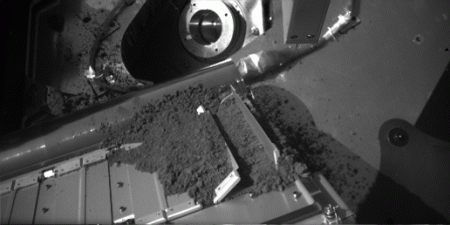
This animation shows a sample of Martian soil resting on a screen over the opening to one of the eight ovens of the Thermal and Evolved-Gas Analyzer instrument on Phoenix. After vibration, the soil slumped almost imperceptibly downhill.

In both images of this before-and-after sequence, a sample of Martian soil rests on a screen over the opening to one of the eight ovens of the Thermal and Evolved-Gas Analyzer instrument (TEGA) on NASA's Phoenix Mars Lander. Between the times at which the lander's Robotic Arm Camera took these images during the mission's 14th Martian day after landing (June 8, 2008), TEGA vibrated the screen for about seven minutes.

The TEGA oven doors are on a surface sloping at about 45 degrees, with the top of the doors near the lower edge of these images. The downhill direction on this part of the instrument appears upwards in the image. The screen-covered opening for the oven intended to analyze this soil sample is between the vertically positioned door at the right end of the series of doors and the partially opened door to the left of that one.

The screen is covered with soil in this pair of images, but visible in a view from about the same angle taken before the soil was delivered, at http://photojournal.jpl.nasa.gov/catalog/PIA10769 . For scale, the doors are about 10 centimeters (4 inches) long.

The "before" image here is the one in which the circular feature near the top of the image is more brightly lit. In the image taken after about seven minutes of shaking, the soil resting on the screen has slumped almost imperceptibly downhill. A dark gap about 3 millimeters (one-tenth of an inch) wide opened at the top edge of the screen.

The Phoenix Mission is led by the University of Arizona, Tucson, on behalf of NASA. Project management of the mission is by NASA's Jet Propulsion Laboratory, Pasadena, Calif. Spacecraft development is by Lockheed Martin Space Systems, Denver.

Source: NASA


print this article email this article download pdf blog this article bookmark this article     Stumble it Digg this share on Facebook retweet share on Reddit add to delicious
Rate this story - 3.6 /5 (7 votes)

Rank Filter

Move the slider to adjust rank threshold, so that you can hide some of the comments.


Display comments: newest first

  • superhuman - Jun 09, 2008
    • Rank: not rated yet
    So...? Did the soil get into the instrument or not? Is the oven working or not?
  • weewilly - Jun 09, 2008
    • Rank: not rated yet
    Someone needs to give that thing a kick or use the digger arm to give it a shot or nudge. Damn this suspense is killing me.

June 9, 2008 all stories

Comments: 2

3.6 /5 (7 votes)
  • Stumble this up

  • Digg this

  • share this

  • hide
  • Related Stories

  • Phoenix Lander Digs and Analyzes Soil as Darkness Gathers
    created Oct 09, 2008 | popularity not rated yet | comments 0
  • Mid-Depth Soil Collected for Lab Test On NASA's Mars Lander
    created Aug 22, 2008 | popularity not rated yet | comments 0
  • Soil Studies Continue at Site of Phoenix Mars Lander
    created Aug 11, 2008 | popularity not rated yet | comments 0
  • Phoenix Lander Has An Oven Full Of Martian Soil
    created Jun 11, 2008 | popularity not rated yet | comments 0
  • Phoenix Mars Lander Will Sprinkle Martian Soil for Microscope to View
    created Jun 10, 2008 | popularity not rated yet | comments 0


  • hide
  • Relevant PhysicsForums posts

  • Question about 2-body gravity
    created 46 minutes ago
  • life on Mars
    created 3 hours ago
  • Semi-major axis from cartesian co-ordinates
    created 15 hours ago
  • Primary Mirror grinding
    created 18 hours ago
  • More from Physics Forums - General Astronomy

Other News

From Greenhouse to Icehouse

From Greenhouse to Icehouse

Space & Earth / Earth Sciences

created 2 hours ago | popularity 4 / 5 (2) | comments 1

A new study that reconstructed ocean temperatures from millions of years ago could provide new insight into how the Earth responds to climate change.


'Cosmic fruit machine' matches collisions

'Cosmic fruit machine' matches collisions

Space & Earth / Astronomy

created 4 hours ago | popularity 5 / 5 (1) | comments 1

(PhysOrg.com) -- A new website will give everyone the chance to contribute to science by playing a 'cosmic fruit machine' and compare images of colliding galaxies with millions of simulated images of galactic ...


Humanity would need five Earths to create the resources needed if everyone lived as like Americans, a report has stated

Mankind using Earth's resources at alarming rate

Space & Earth / Environment

created 1hour ago | popularity 3.3 / 5 (3) | comments 5

Humanity would need five Earths to produce the resources needed if everyone lived as profligately as Americans, according to a report issued Tuesday.


Supervolcano eruption -- in Sumatra -- deforested India 73,000 years ago

Supervolcano eruption -- in Sumatra -- deforested India 73,000 years ago

Space & Earth / Earth Sciences

created 19 hours ago | popularity 4.4 / 5 (11) | comments 2

A new study provides "incontrovertible evidence" that the volcanic super-eruption of Toba on the island of Sumatra about 73,000 years ago deforested much of central India, some 3,000 miles from the epicenter, ...


New computer-developed map shows more extensive valley network on Mars

New computer-developed map shows more extensive valley network on Mars

Space & Earth / Space Exploration

created 17 hours ago | popularity 4.5 / 5 (8) | comments 0

New research adds to the growing body of evidence suggesting the Red Planet once had an ocean.