Liquid Crystals Slow Light Pulses to a Snail's Pace
June 10th, 2008 By Lisa Zyga Liquid Crystals Slow Light Pulses to a Snail's Pace

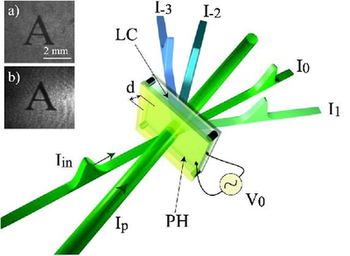
When a weak intensity and high intensity beam are aimed at a liquid crystal valve, the output pulse is split into different diffracted pulses, each showing a different group velocity. The images at left demonstrate image delay: image (a) is an original image imposed on the input pulse, and image (b) is the image from an output pulse delayed by several milliseconds. Credit: S. Residori, et al.

In a vacuum, the speed of a light pulse is always a constant at 186,000 miles (300,000 km) per second. But by changing the medium through which light travels, physicists can slow down light pulses, and possibly create highly sensitive light interferometers, among other devices.

Over the past decade, researchers have demonstrated several methods that can slow light, such as using ultracold atoms, silicon waveguides, or the quantum coherence effect. But now, for the first time, researchers have shown that liquid crystals can also slow light, and can provide group velocities of less than 0.2 millimeters per second – the slowest so far achieved.

The study, performed by physicists Stefania Residori and Umberto Bortolozzo of the Institut Non Lineaire de Nice, and Jean-Pierre Huignard of Thales Research and Technology, both in France, appears in a recent issue of Physical Review Letters.

The key to liquid crystals’ ability to slow light is the large dispersion properties associated with two-photon wave mixing. When the researchers aimed two beams – one with weak intensity and one with higher intensity – at a liquid crystal valve, the liquid crystal acted like a hologram and split the beam into several beams that went off in different directions. Each of these diffracted beams had a different delay or no delay at all, depending on the direction of their path within the liquid crystal.

“The main point is that slowing down optical pulses is equivalent to making the pulses travel inside a medium that has a very large refractive group index,” Residori explained to PhysOrg.com. “Thus, even though the light pulse travels over a small distance, its effective path becomes very large. Since the precision of an interferometer is given by the difference of the optical path between the two arms, then by inserting the slow light device on one arm, it will be possible to reach unprecedented sensitivity.”

The researchers also used the technique to demonstrate image delay. They imposed a 1-cm2 image on the low-intensity beam for a pulse duration of 180 milliseconds, and illuminated the image with the high-intensity beam. The output beams showed that the image was delayed by 82 milliseconds as it traveled through the liquid crystal. The image, which had a spatial resolution of 15 micrometers, appeared without any significant distortion due to the crystal’s homogeneity.

The ability to achieve both fast and slow light in a single device could have many optical uses. As the researchers explained, there is an optimum trade-off between amplifying the slow light pulses and reducing the intensity of the fast light pulses to achieve a good balance. In addition to optical communication networks, ultraslow group velocities could be useful for greatly increasing the sensitivity of light interferometers, testing fundamental laws of physics, and for precision metrology measurements.

“Liquid crystal technology is very well developed and liquid crystal devices could be easily commercialized,” Residori explained as some advantages of the technique. “Moreover, the device is very compact and of small size (20x20x1 mm), and the experimental apparatus is relatively simple compared to other techniques.”

More information: Residori, S.; Bortolozzo, U.; and Huignard, J. P. “Slow and Fast Light in Liquid Crystal Light Valves.” Physical Review Letters 100, 203603 (2008).

Copyright 2008 PhysOrg.com.
All rights reserved. This material may not be published, broadcast, rewritten or redistributed in whole or part without the express written permission of PhysOrg.com.


print this article email this article download pdf blog this article bookmark this article     Digg this Stumble it share on Facebook share on Reddit add to delicious save to Yahoo! bookmarks
4.6/5 after 100 votes

Rank Filter

Move the slider to adjust rank threshold, so that you can hide some of the comments.


Display comments: newest first

  • adam81 - Jun 10, 2008
    • Rank: 3 / 5 (1)
    "The main point is that slowing down optical pulses is equivalent to making the pulses travel inside a medium that has a very large refractive group index"

    so really the light pulses aren't slowing down at all, just bouncing around and taking longer to emerge!

    WOW!!!!
  • Mercury_01 - Jun 10, 2008
    • Rank: 5 / 5 (1)
    Pretty cool considering that it takes at least 82 ms for my internet signal to travel all the way from oregon to washington DC.
  • Bonkers - Jun 10, 2008
    • Rank: 5 / 5 (1)
    nope, they're slowing down, there is image storage in there, 82ms of it. look at ahttp://www.rp-pho...ity.html

    the applications look huge, steerable beams, data storage, elastic buffering, event capture. presumably you can wind the delay up and down?

  • thales - Jun 10, 2008
    • Rank: 5 / 5 (1)
    So this is like a pattern buffer?

    NICE
  • adam81 - Jun 11, 2008
    • Rank: not rated yet
    nope, they're slowing down, there is image storage in there, 82ms of it. look at ahttp://www.rp-pho...ity.html

    the applications look huge, steerable beams, data storage, elastic buffering, event capture. presumably you can wind the delay up and down?


    No, they're really not, they are just bouncing around for a bit before re-emerging, it even says so in this article
  • Bonkers - Jun 11, 2008
    • Rank: 5 / 5 (1)
    No, they're really not, they are just bouncing around for a bit before re-emerging, it even says so in this article

    I still can't see this in the article???

    point is it must be FIFO otherwise interferometry wouldn't work.
    And there is an undistorted image at 15um resolution - 360k pixels.

    given you can modulate easily at 20Gbit/s

    and the time of flight is 80ms

    i make that 5 x 10^14 bits of storage, call it 65 petabytes.
  • adam81 - Jun 11, 2008
    • Rank: not rated yet
    "The main point is that slowing down optical pulses is equivalent to making the pulses travel inside a medium that has a very large refractive group index,%u201D Residori explained to PhysOrg.com. %u201CThus, even though the light pulse travels over a small distance, its effective path becomes very large"

    Seems pretty straight forward to me, the light pulse takes longer to emerge because of the massive refraction and reflection properties of the crystal
  • snwboardn - Jun 11, 2008
    • Rank: not rated yet
    That's what I gathered from it too adam... It didn't sound to me at all that the light was traveling slower after it left the liquid crystal. It just had different latency times depending on how much bouncing around on the inside that it did.
  • adam81 - Jun 11, 2008
    • Rank: not rated yet
    phew, not just me then! lol
  • Bonkers - Jun 11, 2008
    • Rank: not rated yet
    No, No! i never suggested that light passing through the LCD then goes slower - a new form of light perhaps?!
    Nor do i read any evidence of different scattering/latency times times, its FIFO - first photon in first photon out, otherwise interferometry dont work.

    I can't see that scattering could be involved, it would mess up the spatial or temporal coherence.

    my point is just that this thing stores 65 petabytes, does it not?
  • adam81 - Jun 11, 2008
    • Rank: not rated yet
    That's not what the article was about though, I was merely stating that the article's focus is all wrong and complete rubbish.
  • snwboardn - Jun 11, 2008
    • Rank: not rated yet
    The image, which had a spatial resolution of 15 micrometers, appeared without any significant distortion due to the crystal%u2019s homogeneity.


    To me this is the only part that is significant. I didn't see any mention in this article if they were able to change the exit speed on the fly.
  • superhuman - Jun 14, 2008
    • Rank: 5 / 5 (2)
    Its not storage cause you cant decide when you want the data out, its just delay line.

    As for bouncing around, the refractive index is a macroscopic property which arises from atomic and electronic properties of matter. When light (which is an electromagnetic wave) is traveling through a piece of transparent matter its electromagnetic field stimulates electrons of atoms in the material to oscillate. Each oscillating electron is in turn a source of a new electromagnetic wave which interferes (overlaps) with the original electromagnetic wave and also has an effect on all the other electrons of the material. Electromagnetic fields in the sample are propagating with the speed c (speed of light in the vacuum) but the macroscopic effect of all that interference is such that it looks like the light of the original wave is traveling more slowly (its effective speed is c/n where n is the refractive index).
    So the light after the transparent block of matter is a sum of the original light and the light generated by electrons of the block. The higher the n the larger the contribution of light generated by electrons and lower the contribution of original light.
    In materials with very high n practically all the light after the sample is the effect of block electron's oscillations as the original is completely canceled out (scattered).

    It can be viewed as the light bouncing back and forth among the electrons of atoms of the block but it is important that light travels along all the possible paths at once and what emerges on the other side is the sum of the light bounced of all the atoms on all possible paths. The other important thing is that due to limited speed of light if we detect the light at a given time t only those paths whose length from source to detector is equal to l=c*t contribute.

    So when in the above article they detect light delayed by some time t it is true that the reason is the light had to travel on c*t longer path (compared to straight line) before it was able to reach the detector due to all the bouncing back and forth (although it would be more precise to say that its due to interference with the light induced in the sample).

June 10th, 2008 all stories
Physics / General Physics

Comments: 13
Rank: 4.6/5 after 100 votes

  • Stumble this up

  • Digg this

  • Share it:
  • share on Facebook
  • share on MySpace
  • share on Slashdot
  • rss-newsfeed
  • share on Google
  • share on Reddit
  • add to delicious
  • save to Yahoo! bookmarks
  • share on Windows Live
  • Add to Mixx!
Rating: 4.6/5 after 100 votes

  • Related Stories

  • Jets on Saturn's moon Enceladus not geysers from underground ocean
    created Jun 24, 2009 | popularity not rated yet | comments 0
  • New Catalyst Paves the Path for Ethanol-Powered Fuel Cells
    created Jan 26, 2009 | popularity not rated yet | comments 0
  • Light-driven plasmonic nanoswitch may pave way for new computers, tech
    created Jan 16, 2009 | popularity not rated yet | comments 0
  • Moon geology could solve three mysteries of early Earth
    created Dec 08, 2008 | popularity not rated yet | comments 0
  • Skipping Atomic-scale Stones to Study Some Chemistry Basics
    created Aug 06, 2008 | popularity not rated yet | comments 0

Tags


  • Physicists Demonstrate Quantum Memory with Matter Qubits
    Physicists Demonstrate Quantum Memory with Matter Qubits
    Physics / General Physics
    created Jul 03, 2009 | popularity 4.4 / 5 (17) | comments 1
  • 'Holey' Nanosheets for Wastewater Dye Removal
    Nanotechnology / Nanomaterials
    created Jul 01, 2009 | popularity 5 / 5 (5) | comments 1
  • Jellyfish Robot Swims Like its Biological Counterpart
    Jellyfish Robot Swims Like its Biological Counterpart
    Electronics / Robotics
    created Jun 26, 2009 | popularity 4.4 / 5 (8) | comments 1
  • Could Maxwell's Demon Exist in Nanoscale Systems?
    Could Maxwell's Demon Exist in Nanoscale Systems?
    Physics / General Physics
    created Jun 24, 2009 | popularity 4.4 / 5 (18) | comments 29
  • Living Safely with Robots, Beyond Asimov's Laws
    Living Safely with Robots, Beyond Asimov's Laws
    Electronics / Robotics
    created Jun 22, 2009 | popularity 4.6 / 5 (52) | comments 40
  • Other News

    Science journals

    How to Spot an Influential Paper Based on its Citations

    Physics / General Physics

    created 23 hours ago | popularity 4 / 5 (9) | comments 5

    (PhysOrg.com) -- At first it may seem that the number of citations received by a published scientific paper is directly related to that paper's quality of content. The higher the quality, the more people read ...


    Scientists create first electronic quantum processor

    Scientists create first electronic quantum processor

    Physics / General Physics

    created Jun 28, 2009 | popularity 4.8 / 5 (52) | comments 39

    A team led by Yale University researchers has created the first rudimentary solid-state quantum processor, taking another step toward the ultimate dream of building a quantum computer.


    Fermilab's CDF observes Omega-sub-b baryon

    Fermilab's CDF observes Omega-sub-b baryon

    Physics / General Physics

    created Jun 29, 2009 | popularity 4.7 / 5 (16) | comments 7

    (PhysOrg.com) -- At a recent physics seminar at the Department of Energy’s Fermi National Accelerator Laboratory, Fermilab physicist Pat Lukens of the CDF experiment announced the observation of a new particle, ...


    New insights, and a new angle, on high-temperature superconductivity

    New insights, and a new angle, on high-temperature superconductivity

    Physics / Superconductivity

    created Jun 29, 2009 | popularity 4.8 / 5 (13) | comments 6

    (PhysOrg.com) -- A Princeton-led research team has revealed surprising information about how electron behavior influences the conduction of electricity in a class of high-temperature superconductors. An increased ...


    The art of invisibility and the perfect cat's eye

    The art of invisibility and the perfect cat's eye

    Physics / Optics & Photonics

    created Jun 30, 2009 | popularity 4 / 5 (8) | comments 6

    (PhysOrg.com) -- In recent years scientists have explored the impossible by developing invisibility or 'cloaking' devices, but can the same technology also help make things more visible?