GLAST Set to Launch Wednesday to Study Cosmic Mysteries
June 10, 2008
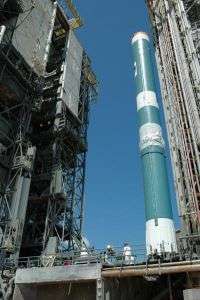
On Pad 17-B on Cape Canaveral Air Force Station, the mobile service tower (left) approaches the Delta II rocket that will carry the GLAST spacecraft. Credit: NASA/Jim Grossmann
In a final meeting of scientists, engineers, technicians and officials, NASA's Gamma-ray Large Area Space Telescope (GLAST) received the final "Ready to Go!" from all teams. GLAST is scheduled to launch on a United Launch Alliance's Delta II Heavy rocket with a launch window from 11:45 a.m. - 1:40 p.m. EDT on Wednesday, June 11.
During the "Launch Readiness Review," a two hour meeting at NASA's Kennedy Space Center, Fla., held on June 9, the U.S. Air Force, NASA and United Launch Alliance reported on various aspects of the GLAST spacecraft, the Delta II Heavy rocket that will carry it, clearances, weather and the final remaining issues, which are now all closed.
The Launch Readiness Review (LRR) ended with an all-around approval for GLAST to launch on Wednesday, June 11, pending the weather. Joel Tumbiolo, U.S. Air Force Delta II Launch Weather Officer, 45th Weather Squadron, of Cape Canaveral Air Force Station noted that there is a 40% chance that weather issues will delay the launch. "The clouds are the concern," he told the LRR group. Typically, the sea breeze on Florida's east coast develops around noontime from June through September, and that can create clouds over land. There's a "Cumulus Cloud Rule" which states that if a cumulus cloud is a certain height, it must be a certain distance from the launch vehicle. There are no issues with winds, which are expected to be light.
Tumbiolo repeated his forecast during the GLAST pre-launch press conference held at 1 p.m. on June 9 at Kennedy Space Center, carried live on NASA-TV. He was part of a panel of six that included Dr. Jon Morse, Director, Astrophysics Division, NASA Headquarters; Omar Baez, NASA Launch Director/Launch Manager, Kennedy Space Center; Kris Walsh, Director of Delta NASA and Commercial Programs, United Launch Alliance; Kevin Grady, GLAST Project Manager, Goddard Space Flight Center; and Dr. Steven Ritz, GLAST Project Scientist/Astrophysicist, Goddard Space Flight Center. The Large Area Telescope (LAT) Principal Investigator, Peter Michelson, and others also attended the briefing and answered questions.
At the press briefing, Omar Baez explained that the tower rollback will occur just after midnight on Wed. June 11, on Launch pad 17-B, at Cape Canaveral Air Force Station.
Kris Walsh talked about the launch and what happens during and after ignition. She said that by about 10 minutes after launch, the Delta II carrying GLAST will be over the island of Antigua in the Caribbean. By around 75 minutes after launch, GLAST will be put into orbit approximately 300 nautical miles high over the Earth's surface. GLAST's orbit will be at an inclination of approximately 25.6 degrees to the equator.
Steve Ritz spoke about the exciting science that GLAST will reveal. He said that the GLAST LAT will survey the Universe over an energy range from 20 million electron volts to over 300 billion electron volts, the upper end of which is a relatively unexplored area of the electromagnetic spectrum. "GLAST enables scientists to look under the hood and see how the universe works," Ritz said.
Kevin Grady, GLAST Program Manager, explained how the Large Area Telescope, or LAT, doesn't have a lens like a regular telescope. In fact, it converts gamma rays to electrons and positrons to infer the direction from which the gamma-ray came.
"It took a lot of people in many countries to make this sixteen-year journey come to fruition," said Michelson. NASA partnered with the U.S. Department of Energy, and many institutions and agencies in the U.S, France, Germany, Italy, Japan and Sweden.
Right now, however, before all eyes turn to the gamma-ray sky that GLAST will show scientists around the world, all eyes at the launch site in Florida are on the weather.
Source: Goddard Space Flight Center
-
Engineers build first sub-10-nm carbon nanotube transistor
Feb 01, 2012 |
4.9 / 5 (31) |
30
-
Something old, something new: Evolution and the structural divergence of duplicate genes
Jan 31, 2012 |
4.6 / 5 (7) |
1
-
The hidden nanoworld of ice crystals: Revealing the dynamic behavior of quasi-liquid layers
Jan 30, 2012 |
5 / 5 (3) |
1
-
Stock market network reveals investor clustering
Jan 27, 2012 |
3.9 / 5 (23) |
8
-
Of microchemistry and molecules: Electronic microfluidic device synthesizes biocompatible probes
Jan 26, 2012 |
5 / 5 (1) |
0
-
Never ending outer space.....
11 hours ago
-
Neutron Star fragments?
13 hours ago
-
stationary or not?
17 hours ago
-
Scale of the Universe
Feb 10, 2012
-
Titan's lack of impact craters
Feb 09, 2012
-
Real pictures of black hole eating a star?
Feb 08, 2012
- More from Physics Forums - General Astronomy
More news stories
Latin America mining boom clashes with conservation
Latin America is experiencing a mining boom as prices rise fuelled by a hike in global demand, but the region is also being hit by a wave of violent protests, strikes and rallies by environmentalists.
4 hours ago |
not rated yet |
0
Europe stakes billion-dollar bet on new rocket
A pencil-slim rocket is scheduled to lift into space from South America on Monday, carrying a billion-dollar bet that Europe can grab a juicy slice of the market to place satellites in low orbit.
Space & Earth / Space Exploration
23 hours ago |
4 / 5 (3) |
0
Political leaders play key role in how worried Americans are by climate change: study
More than extreme weather events and the work of scientists, it is national political leaders who influence how much Americans worry about the threat of climate change, new research finds.
Feb 06, 2012 |
5 / 5 (6) |
72
NASA budget will axe Mars deal with Europe: scientists
US President Barack Obama's budget proposal to be submitted next week for 2013 will cut NASA's budget by 20 percent and eliminate a major partnership with Europe on Mars exploration, scientists said Thursday.
Space & Earth / Space Exploration
Feb 10, 2012 |
5 / 5 (3) |
55
Humans may have helped the decline of African rainforests 3000 years ago
(PhysOrg.com) -- Large areas of rainforests in Central Africa mysteriously disappeared over three thousand years ago, to be replaced by savannas. The prevailing theory has been that the cause was a change ...
Google might launch Drive for cloud storage soon
(PhysOrg.com) -- Google's next big move, according to the Wall Street Journal, is a cloud storage service called Drive. Hardly first to the plate, Google is simply catching up to introducing its cloud reposi ...
Walney offshore wind farm is world's biggest (for now)
(PhysOrg.com) -- The Walney wind farm on the Irish Sea--characterized by high tides, waves and windy weather--officially opened this week. The farm is treated in the press as a very big deal as the Walney ...
Love a click away in Indonesia's Twitter Republic
He was a geeky kid from Yogyakarta, she a glamorous city girl in Jakarta. In a country with one of the world's most vibrant social networking scenes they fell in love on Twitter.
GPS court ruling leaves US phone tracking unclear
A US Supreme Court decision requiring a warrant to place a GPS device on the car of a criminal suspect leaves unresolved the bigger issue of police tracking using mobile phones, legal experts say.
Europeans protest controversial Internet pact
Tens of thousands of people marched in protests in more than a dozen European cities Saturday against a controversial anti-online piracy pact that critics say could curtail Internet freedom.
Study finds that anti-diabetic medication can prevent the long-term effects of maternal obesity
In a study to be presented today at the Society for Maternal-Fetal Medicine's annual meeting, The Pregnancy Meeting, in Dallas, Texas, researchers will report findings that show that short therapy with the anti-diabetic medication ...