Detective astronomers unearth hidden celestial gem
June 10, 2008 Detective astronomers unearth hidden celestial gem

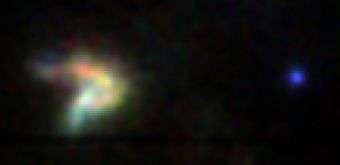
XMM-Newton image of the young, luminous supernova remnant G350.1-0.3 (to the left) and its neutron star companion (to the right). The image was taken by the spacecraft’s European Photon Imaging Cameras (EPIC), in the energy range of 0.5–10 keV. Credits: ESA/ XMM-Newton/ EPIC (Gaensler et al.)

ESA’s orbiting X-ray observatory XMM-Newton has re-discovered an ignored celestial gem. The object in question is one of the youngest and brightest supernova remnants in the Milky Way, the corpse of a star that exploded around 1000 years ago.

Its shape, age and chemical composition will allow astronomers to better understand the violent ways in which stars end their lives.

Exploding stars seed the Universe with heavy chemical elements necessary to build planets and create life. The expanding cloud of debris that each explosion leaves behind, known as a supernova remnant (SNR), is a bright source of X-rays and radio waves. Generally, the debris is thought to appear as an expanding bubble or ring.

When astronomers took the first high-resolution radio images of a celestial object known as ‘G350.1-0.3’ in the 1980s, they saw an irregular knot of gases that did not seem to meet these expectations. So it was classified as a probable background galaxy and was quietly forgotten.

Now Bryan Gaensler and Anant Tanna, both at the University of Sydney, have used the X-ray capabilities of XMM-Newton with their colleagues to prove that appearances can be deceptive. G350.1-0.3 is indeed the debris of an exploded star despite its misshapen configuration.

In fact, it turns out to be one of the youngest and brightest supernova remnants in the Milky Way.

To explain its shape, the team looked at radio surveys and discovered that G350.1-0.3 had exploded next to a dense cloud of gas about 15 000 light-years from Earth. The cloud prevented the blast from expanding evenly in all directions, resulting in an example of a rare kind of misshapen supernova remnant.

G350.1-0.3 is incredibly small and young in astronomical terms, only eight light years across and about 1000 years old. “Only a handful of such young supernova remnants are known. So even having one more is important,” says Tanna. That is because young supernova remnants are highly luminous, with the newly-formed chemical elements glowing brightly, making them easier to study.

“We're seeing these heavy elements fresh out of the oven,” says Gaensler. Young supernova remnants exhibit the newly created elements and also contain clues about the way the original star exploded. Such information is lost in most supernova remnants because, as they expand and age, they lose their initial characteristics. “After 20 000 years, all sorts of explosions look more or less the same,” says Gaensler.

Astronomers now recognise that stars explode in many different ways. Some might be just big enough for an explosion to occur, others might be much more massive. There are differences in the chemical composition of the exploding stars and some may have a companion star in orbit around them.

Gaensler and Tanna hope that further investigations of G350.1-0.3 will yield clues as to exactly what kind of star exploded. “It may turn out that many of the youngest supernova remnants have these strange shapes,” says Tanna, “The hunt to find more is now on.”


Despite the light from the supernova having reached Earth during the time of William the Conqueror, Gaensler thinks humans would not have seen it. “The X-ray data tell us that there's a lot of dust lying between it and Earth. Even if you'd been looking straight at it when it exploded, it would've been invisible to the naked eye,” he says.

Thankfully, XMM-Newton’s sensitivity and the detective work by Gaensler and Tanna mean that this important celestial object will never again be forgotten.

These findings will be published today in ‘The (re-)discovery of G350.1–0.3: A young, luminous supernova remnant and its neutron star’ by B. Gaensler, A. Tanna, P. Slane, C. Brogan, J. Gelfand, N. McClure-Griffiths, F. Camilo, C. Ng and J. Miller in The Astrophysical Journal Letters.

Source: ESA


print this article email this article download pdf blog this article bookmark this article     Stumble it Digg this share on Facebook retweet share on Reddit add to delicious
Rate this story - 4.4 /5 (10 votes)

Rank Filter

Move the slider to adjust rank threshold, so that you can hide some of the comments.


Display comments: newest first

  • Mercury_01 - Jun 10, 2008
    • Rank: 2.5 / 5 (2)
    So it exploded about 1,000 years ago, about 15,000 lightyears away? Or was the dust cloud that it exploded "next to" 15,000 lightyears away? I guess 500 lightyears is close enough to the star to cause the irregular shape, even though the supernova is only 8 lightyears across. hmmm...Good enough for me, I guess!
  • bearly - Jun 11, 2008
    • Rank: not rated yet
    If it exploded 1000 years ago how is it possible for the light from it to have traveled 15,000 light years to reach us?
  • jeffsaunders - Jul 25, 2008
    • Rank: not rated yet
    good question bearly. My math skills can't work it out - I am sure it is my fault.

    and if the gas cloud is 15,000 LY away but the star is only 1,000 then it is closer to us than to the dust by a good amount.

June 10, 2008 all stories

Comments: 3

4.4 /5 (10 votes)
  • Stumble this up

  • Digg this

  • share this

  • hide
  • Related Stories

  • Distant ball of dust not dusty enough
    created Jun 06, 2006 | popularity not rated yet | comments 0
  • Two Earth-sized bodies with oxygen rich atmospheres found -- but they're stars not planets
    created Nov 12, 2009 | popularity not rated yet | comments 0
  • Rapid supernova could be new class of exploding star
    created Nov 05, 2009 | popularity not rated yet | comments 0
  • Hubble Image Showcases Star Birth in M83, the Southern Pinwheel
    created Nov 05, 2009 | popularity not rated yet | comments 0
  • Heart of a galaxy emits gamma rays
    created Oct 02, 2009 | popularity not rated yet | comments 0


  • hide
  • Relevant PhysicsForums posts

  • Some help with a X-Ray astronomy question please!
    created 23 hours ago
  • Help with Images and Optical Instrument Question..
    created Nov 26, 2009
  • Redshift as a distance indicator
    created Nov 26, 2009
  • Question about 2-body gravity
    created Nov 24, 2009
  • More from Physics Forums - General Astronomy

Other News

Fermi Telescope Peers Deep into Microquasar

Fermi Telescope Peers Deep into Microquasar (w/ Video)

Space & Earth / Astronomy

created 17 hours ago | popularity 4.7 / 5 (10) | comments 0

(PhysOrg.com) -- NASA's Fermi Gamma-ray Space Telescope has made the first unambiguous detection of high-energy gamma-rays from an enigmatic binary system known as Cygnus X-3. The system pairs a hot, massive ...


The Energy Sources of Ultraluminous Galaxies

The Energy Sources of Ultraluminous Galaxies

Space & Earth / Astronomy

created 17 hours ago | popularity 4.5 / 5 (13) | comments 1

(PhysOrg.com) -- Ultraluminous infrared galaxies ((ULIRGs) are galaxies whose luminosity exceeds that of a trillion suns; for comparison, the Milky Way galaxy has a typical (and much more modest) luminosity ...


New climate targets may not change daily life much (AP)

New climate targets may not change daily life much

Space & Earth / Environment

created 22 hours ago | popularity 3.8 / 5 (13) | comments 7

(AP) -- Americans' day-to-day lives won't change noticeably if President Barack Obama achieves his newly announced goal of slashing carbon dioxide pollution by one-sixth in the next decade, experts say.


Space shuttle Atlantis, 7 astronauts back on Earth (AP)

Space shuttle Atlantis, 7 astronauts back on Earth

Space & Earth / Space Exploration

created 18 hours ago | popularity not rated yet | comments 0

(AP) -- Space shuttle Atlantis and its seven astronauts returned to Earth with a smooth touchdown Friday to end an 11-day flight that resupplied the International Space Station.


China is set to launch its second moon orbiter next October, state media have reported

China to launch second lunar probe: state media

Space & Earth / Space Exploration

created 22 hours ago | popularity 5 / 5 (5) | comments 0

China will launch its second moon orbiter next October, state media reported Friday, as it powers ahead with a space programme that has sparked concerns abroad.