'Cursus' is older than Stonehenge
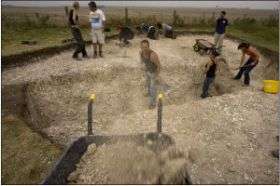
June 10, 2008 'Cursus' is older than Stonehenge

Archeologists have come a step closer to solving the 285-year-old riddle of an ancient monument thought to be a precursor to Stonehenge.

A team led by University of Manchester archaeologist Professor Julian Thomas has dated the Greater Stonehenge Cursus at about 3,500 years BC - 500 years older than the circle itself.

They were able to pinpoint its age after discovering an antler pick used to dig the Cursus – the most significant find since it was discovered in 1723 by antiquarian William Stukeley.

When the pick was carbon dated the results pointed to an age which was much older than previously thought - between 3600 and 3300 BC – and has caused a sensation among archeologists.

The dig took place last summer in a collaborative project run by five British universities and funded by the Arts and Histories Research Council and the National Geographic Society.

Professor Thomas said: “The Stonehenge Cursus is a 100 metre wide mile long area which runs about 500 metres north of Stonehenge.

“We don’t know what it was used for – but we do know it encloses a pathway which has been made inaccessible.

“And that suggests it was either a sanctified area or for some reason was cursed.”

Professor Thomas believes that the Cursus was part of complex of monuments, within which Stonehenge was later constructed.

Other elements include the ‘Lesser Stonehenge Cursus’ and a series of long barrows - all built within a mile of Henge.

He added: “Our colleagues led by a team from Sheffield University have also dated some of the cremated human remains from Stonehenge itself.

“That’s caused another sensational discovery and proves that burial cremation had been taking place at Stonehenge as early as 2900 BC – soon after the monument was first built.

“But what is still so intriguing about the Cursus is that it’s about 500 years older than Henge – that strongly suggests there was a link and was very possibly a precursor.

“We hope more discoveries lie in store when we work on the Eastern end of the Cursus this summer.

“It will be a big step forward in our understanding of this enigmatic monument.”

Source: University of Manchester


print this article email this article download pdf blog this article bookmark this article     Stumble it Digg this share on Facebook retweet share on Reddit add to delicious
Rate this story - 4.4 /5 (29 votes)

Rank Filter

Move the slider to adjust rank threshold, so that you can hide some of the comments.


Display comments: newest first

  • thales - Jun 10, 2008
    • Rank: 5 / 5 (1)
    I'd bet the Cursus set the land apart as a burial ground or cremation scattering ground. They should examine the layer of soil corresponding with 3,500 BC, see if there's excess carbon and whatnot.

    "Stonehenge was a place of burial from its beginning to its zenith in the mid third millennium B.C. The cremation burial dating to Stonehenge's sarsen stones phase is likely just one of many from this later period of the monument's use and demonstrates that it was still very much a domain of the dead." -Professor Michael Parker Pearson, head of Stonehenge Riverside Archaeological Project, May 2008

June 10, 2008 all stories

Comments: 1

4.4 /5 (29 votes)
  • Stumble this up

  • Digg this

  • share this


  • hide
  • Relevant PhysicsForums posts

Other News

Study: Credit crisis, debt load a double whammy for investment

Other Sciences / Economics

created 4 hours ago | popularity not rated yet | comments 0

Firms with heavy long-term debt that came due amid the nation's recent credit crisis slashed investment more than three times as much as companies whose paybacks ducked the meltdown, a new University of Illinois study found.


Failing the sniff test: Researchers find new way to spot fraud

Other Sciences / Economics

created 13 hours ago | popularity not rated yet | comments 1

Companies that commit fraud can find innovative ways to fudge the numbers, making it hard to tell something is wrong by just looking at their financial statements. But research from North Carolina State University unveils ...


Remains of Minoan-style painting discovered during excavations of Canaanite palace

Other Sciences / Archaeology & Fossils

created 10 hours ago | popularity 4.5 / 5 (2) | comments 0

The remains of a Minoan-style wall painting, recognizable by a blue background, the first of its kind to be found in Israel, was discovered in the course of the recent excavation season at Tel Kabri. This fresco joins others ...


National anti-gun violence program largely successful, study finds

Other Sciences / Social Sciences

created 7 hours ago | popularity 5 / 5 (3) | comments 0

Project Safe Neighborhoods - a community-based policing effort launched in 2001 - has been largely successful in its goal of reducing violent crime, according to an analysis by Michigan State University, the national research ...


RIT scholars explore the impact of imaging on our reality

Other Sciences / Social Sciences

created 8 hours ago | popularity not rated yet | comments 0

Imaging is the use of machines to enhance humans' ability to perceive things, often by producing visible phenomena that cannot be seen with the naked eye. But, can imaging technology distort reality and even change what humans ...