Phoenix Mars Lander Will Sprinkle Martian Soil for Microscope to View
June 10, 2008 Phoenix Mars Lander Will Sprinkle Martian Soil for Microscope to View

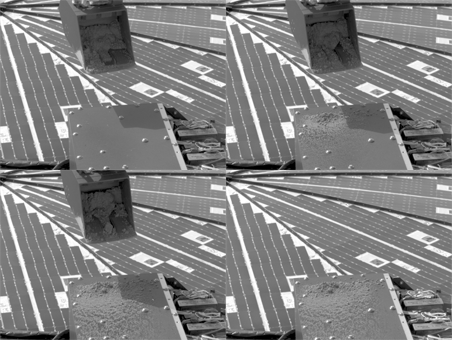
NASA's Phoenix Mars Lander used its Robotic Arm during the mission's 15th Martian day since landing (June 9, 2008) to test a "sprinkle" method for delivering small samples of soil to instruments on the lander deck. Image credit: NASA/JPL-Caltech/University of Arizona/Texas A&M

The team operating NASA's Phoenix Mars Lander plans to instruct the spacecraft in the next few days to use its Robotic Arm to sprinkle a spoonful of Martian soil onto a wheel that will rotate the sample into place for viewing by the spacecraft's Optical Microscope.

Meanwhile, commands for Phoenix's activities today are to continue a set of atmosphere observations begun during the Martian evening earlier Tuesday in coordination with overhead passes of NASA's Mars Reconnaissance Orbiter. These take advantage of opportunities for instruments on Phoenix and on the orbiter to examine the same column of atmosphere simultaneously from above and below.

"It allows us to put the Phoenix measurements into global perspective and gives a ground level calibration for the orbiter's measurements," said Phoenix Project Scientist Leslie Tamppari of NASA's Jet Propulsion Laboratory, Pasadena, Calif.

On Monday, Phoenix tested delivering Martian soil by sprinkling it rather than dumping it. The positive result prompted researchers not only to proceed with plans for delivery to the microscope, but also to plan on sprinkling a sample in the near future into one of the eight ovens of an instrument that bakes and sniffs samples, the Thermal and Evolved-Gas Analyzer, or TEGA.

A sample of clumpy soil dumped onto one TEGA oven on June 6 has yielded only a few particles passing through a mesh screen over the opening to the oven, even after additional vibration of the screen on Monday.

The sprinkling method developed a few months ago by members of Phoenix's arm and microscope teams uses vibration of the tilted scoop by a motorized rasp to gently jostle some material out, instead of turning the scoop over to empty it. The rasp is located on the back of the scoop and will be used later in the mission to scrape up samples of subsurface ice.

The first test of the sprinkling method Monday produced a layer of fine particles extending from a pile of about a tablespoon of soil. The practice placed the material on the top surface of the instrument suite that includes the microscope, the Microscopy, Electrochemistry and Conductivity Analyzer, or MECA.

"This is good news," said Ray Arvidson of Washington University in St. Louis, lead scientist for the Robotic Arm. He said that the clumping tendency of Martian soil at the Phoenix site and some earlier landing sites comes from extremely fine particles filling in gaps between coarser, sand-size particles, perhaps together with an ingredient acting to cement particles together. Future soil samples may be prepared prior to delivery by chopping and scraping them with blades on the scoop.

Source: NASA


print this article email this article download pdf blog this article bookmark this article     Stumble it Digg this share on Facebook retweet share on Reddit add to delicious
Rate this story - 3.3 /5 (3 votes)


June 10, 2008 all stories

Comments: 0

3.3 /5 (3 votes)
  • Stumble this up

  • Digg this

  • share this

  • hide
  • Related Stories

  • Phoenix Site on Mars May be in Dry Climate Cycle Phase
    created Dec 15, 2008 | popularity not rated yet | comments 0
  • Mars Lander Sees Falling Snow, Soil Data Suggest Liquid Past
    created Sep 29, 2008 | popularity not rated yet | comments 0
  • Spiky Probe on NASA Mars Lander Raises Vapor Quandary
    created Sep 05, 2008 | popularity not rated yet | comments 0
  • Phoenix Microscope Takes First Image of Martian Dust Particle
    created Aug 14, 2008 | popularity not rated yet | comments 0
  • Soil Studies Continue at Site of Phoenix Mars Lander
    created Aug 11, 2008 | popularity not rated yet | comments 0


  • hide
  • Relevant PhysicsForums posts

  • Question about 2-body gravity
    created Nov 24, 2009
  • life on Mars
    created Nov 24, 2009
  • Semi-major axis from cartesian co-ordinates
    created Nov 23, 2009
  • Primary Mirror grinding
    created Nov 23, 2009
  • More from Physics Forums - General Astronomy

Other News

Monster Waves on the Sun are Real

Monster Waves on the Sun are Real (w/ Video)

Space & Earth / Astronomy

created 7 hours ago | popularity 5 / 5 (9) | comments 1

Sometimes you really can believe your eyes. That's what NASA's STEREO (Solar Terrestrial Relations Observatory) spacecraft are telling researchers about a controversial phenomenon on the sun known as the "solar ...


Cosmic 'dig' reveals vestiges of the Milky Way's building blocks

Cosmic 'Dig' Reveals Vestiges of the Milky Way's Building Blocks

Space & Earth / Astronomy

created 12 hours ago | popularity 4.9 / 5 (14) | comments 1

(PhysOrg.com) -- Peering through the thick dust clouds of our galaxy's "bulge" (the myriads of stars surrounding its center), a team of astronomers has unveiled an unusual mix of stars in the stellar grouping ...


No Wheel Stall in Diagnostic Drive

Spirit Mars Rover: No Wheel Stall in Diagnostic Drive

Space & Earth / Space Exploration

created 8 hours ago | popularity 4.5 / 5 (2) | comments 0

(PhysOrg.com) -- On Sol 2095 (Tuesday, Nov. 24), Spirit performed a set of diagnostic actions related to a stall of the right-rear wheel on the previous drive, three days earlier.


Climate experts debate strategies for reducing atmospheric carbon and future warming

Climate experts debate strategies for reducing atmospheric carbon and future warming

Space & Earth / Environment

created 8 hours ago | popularity 2.8 / 5 (6) | comments 7

(PhysOrg.com) -- Reducing carbon dioxide to safe levels may require extracting carbon from the air, says Cornell climate researcher.


Oceanic crust formation is dynamic after all

Oceanic crust formation is dynamic after all

Space & Earth / Earth Sciences

created 11 hours ago | popularity 4.6 / 5 (5) | comments 0

Imagine the Earth's crust as the planet's skin: Some areas are old and wrinkled while others have a fresher, more youthful sheen, as if they had been regularly lathered with lotion.