Researchers find an Australian dinosaur with South American heritage
June 11, 2008
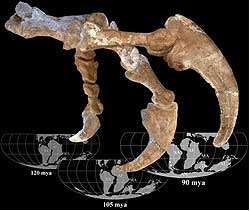
Articulated hand of the predatory dinosaur Megaraptor namunhuaiquii.
Australia's links to South America have just gotten a bit closer, but not due to economic forces, rather fossil forces.
University of Queensland palaeontologist Dr Steve Salisbury was part of an international team of palaeontologists from the US, Argentina and Australia that discovered a fossil that had previously only been found in South America.
Dr Salisbury, from UQ's School of Integrative Biology, said an upper arm bone found at Dinosaur Cove in southern Victoria, shares a suite of unique features with a medium-sized predatory dinosaur from Argentina called megaraptor.
He said it was the first time a dinosaur with unquestionable affinities to animals from other Southern Hemisphere continents had been recognised in Australia.
“Throughout much of the Age of Dinosaurs, Australia formed part of the southern super-continent of Gondwana,” Dr Salisbury said.
“As a result, there has long been an expectation that our dinosaur fauna would show similarities to similarly aged faunas from adjoining Gondwanan landmasses, in particular Antarctica, New Zealand and South America.
“Of the Australian dinosaurs that have been recognised so far, the consensus has been that some are relics of groups that went extinct much earlier in other parts of the world, while others have been seen as early representatives of groups that are more typical of the Northern Hemisphere.
“Partly as a result, it has been proposed that Australia was somehow isolated from the rest of Gondwana, either through geographic or climatic barriers.”
Dr Federico Angolin, from the Argentinean Museum of Natural Sciences, said when the six palaeontologists on the research team independently recognised the close similarity between the Dinosaur Cove fossil and the remains of megaraptor from Argentina, they knew they had an important discovery on their hands.
“Megaraptor is a unusual type medium-sized theropod, best known for its enormous clawed hands,” Dr Federico Angolin said.
“The proportionately large hand means that megaraptor has a very distinctive forearm, which is how we were able to identify the Australian fossil.”
Project leader Nate Smith, from The Field Museum in Chicago, said fossils of Megaraptor have previously only been found in central and southern Patagonia, in rocks at least 15 million years younger than those in southern Victoria.
He said it was first thought to be a member of Dromaeosauridae, the group of predatory dinosaurs that includes the velociraptor, but the Australian material has helped show megaraptor actually belongs to the same group of dinosaurs as Africa's “crocodile mimic” dinosaur suchomimus and the sail-backed spinosaurus – the Spinosauroidea.
“The recognition of Megaraptor in Victoria provides the first definitive evidence for interchange between the dinosaur faunas of South America and Australia during the Cretaceous,” Mr Smith said.
“Our results are consistent with several geological models for rifting between the southern continents during the time that these dinosaurs existed.
“This discovery indicates that we might need to rethink the longstanding claims of the Northern Hemisphere affinities for many Australian dinosaurs, and of geographic and/or climatic isolation of Australian dinosaur faunas.”
The results of the study are published online through the Proceedings of the Royal Society of London.
Source: University of Queensland
-
Archaeopteryx was first bird after all
Oct 26, 2011 |
4.1 / 5 (7) |
6
-
New research sheds light on South Pole dinosaurs
Aug 05, 2011 |
4.7 / 5 (6) |
7
-
Holes in fossil bones reveal dinosaur activity
Jul 08, 2011 |
5 / 5 (3) |
1
-
First Australian spinosaur dinosaur had global distribution
Jun 15, 2011 |
4.3 / 5 (3) |
0
-
Tyrannosaurs sent back to the Northern Hemisphere
Aug 26, 2010 |
5 / 5 (4) |
0
-
Engineers build first sub-10-nm carbon nanotube transistor
Feb 01, 2012 |
4.9 / 5 (31) |
30
-
Something old, something new: Evolution and the structural divergence of duplicate genes
Jan 31, 2012 |
4.6 / 5 (7) |
1
-
The hidden nanoworld of ice crystals: Revealing the dynamic behavior of quasi-liquid layers
Jan 30, 2012 |
5 / 5 (3) |
1
-
Stock market network reveals investor clustering
Jan 27, 2012 |
3.9 / 5 (23) |
8
-
Of microchemistry and molecules: Electronic microfluidic device synthesizes biocompatible probes
Jan 26, 2012 |
5 / 5 (1) |
0
-
Stem cell question.
Feb 10, 2012
-
Protease cleavage
Feb 10, 2012
-
Pertubance in a model
Feb 10, 2012
-
Cancer drugs and Alzheimer's, Oh my!
Feb 09, 2012
-
Squishing cells
Feb 09, 2012
-
Any books/articles for evolutionary stable strategy models in humans?
Feb 09, 2012
- More from Physics Forums - Biology
More news stories
A frank discussion of the power law and linking correlation to causation
(PhysOrg.com) -- Michael Stumpf a mathematics professor at Imperial College in London, and Mason Porter a lecturer at Oxford have teamed together to write and publish a perspective piece in Science regarding the in ...
Employers feel no love for unscrupulous practice of 'service sweethearting'
A new study led by two Florida State University marketing professors finds that some frontline service employees who are rewarded for hikes in customer loyalty and satisfaction also may engage in "service ...
Other Sciences / Economics & Business
Feb 10, 2012 |
3.3 / 5 (3) |
11
US workers are 'giving away the store,' costing firms billions
Nearly 70 percent of the nation's service employees give away free goods and services from hamburgers to cable TV costing companies billions of dollars a year, according to a groundbreaking study.
Other Sciences / Economics & Business
Feb 09, 2012 |
3.5 / 5 (4) |
10
New insights into how to correct false knowledge
The abundance of false information available on the Internet, in movies and on TV has created a big challenge for educators.
Other Sciences / Social Sciences
Feb 07, 2012 |
4.9 / 5 (7) |
9
|
Neanderthal demise due to many influences, including cultural changes: study
As an ice age crept upon them thousands of years ago, Neanderthals and modern human ancestors expanded their territory ranges across Asia and Europe to adapt to the changing environment.
Other Sciences / Archaeology & Fossils
Feb 07, 2012 |
4.4 / 5 (5) |
8
|
Google might launch Drive for cloud storage soon
(PhysOrg.com) -- Google's next big move, according to the Wall Street Journal, is a cloud storage service called Drive. Hardly first to the plate, Google is simply catching up to introducing its cloud reposi ...
Latin America mining boom clashes with conservation
Latin America is experiencing a mining boom as prices rise fuelled by a hike in global demand, but the region is also being hit by a wave of violent protests, strikes and rallies by environmentalists.
Walney offshore wind farm is world's biggest (for now)
(PhysOrg.com) -- The Walney wind farm on the Irish Sea--characterized by high tides, waves and windy weather--officially opened this week. The farm is treated in the press as a very big deal as the Walney ...
Love a click away in Indonesia's Twitter Republic
He was a geeky kid from Yogyakarta, she a glamorous city girl in Jakarta. In a country with one of the world's most vibrant social networking scenes they fell in love on Twitter.
GPS court ruling leaves US phone tracking unclear
A US Supreme Court decision requiring a warrant to place a GPS device on the car of a criminal suspect leaves unresolved the bigger issue of police tracking using mobile phones, legal experts say.
Europeans protest controversial Internet pact
Tens of thousands of people marched in protests in more than a dozen European cities Saturday against a controversial anti-online piracy pact that critics say could curtail Internet freedom.