Plutoid chosen as name for solar system objects like Pluto
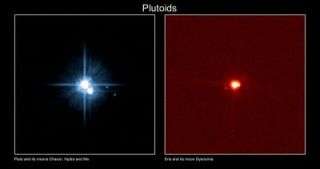
June 11, 2008 Plutoids

The two known and named plutoids are Pluto and Eris. Plutoids are celestial bodies in orbit around the Sun at a distance greater than that of Neptune that have sufficient mass for their self-gravity to overcome rigid body forces so that they assume a hydrostatic equilibrium (near-spherical) shape, and that have not cleared the neighbourhood around their orbit. Credit: IAU, NASA/ESA Hubble Space Telescope, H. Weaver (JHU/APL), A. Stern (SwRI), the HST Pluto Companion Search Team and M. Brown

Almost two years after the International Astronomical Union (IAU) General Assembly introduced the category of dwarf planets, the IAU, as promised, has decided on a name for transneptunian dwarf planets similar to Pluto. The name plutoid was proposed by the members of the IAU Committee on Small Body Nomenclature (CSBN), accepted by the Board of Division III, by the IAU Working Group for Planetary System Nomenclature (WGPSN) and approved by the IAU Executive Committee at its recent meeting in Oslo, Norway.

Plutoids are celestial bodies in orbit around the Sun at a distance greater than that of Neptune that have sufficient mass for their self-gravity to overcome rigid body forces so that they assume a hydrostatic equilibrium (near-spherical) shape, and that have not cleared the neighbourhood around their orbit. The two known and named plutoids are Pluto and Eris. It is expected that more plutoids will be named as science progresses and new discoveries are made.

The dwarf planet Ceres is not a plutoid as it is located in the asteroid belt between Mars and Jupiter. Current scientific knowledge lends credence to the belief that Ceres is the only object of its kind. Therefore, a separate category of Ceres-like dwarf planets will not be proposed at this time.

The IAU has been responsible for naming planetary bodies and their satellites since the early 1900s. The IAU CSBN, who originally proposed the term plutoid, is responsible for naming small bodies (except satellites of the major planets) in the Solar System. The CSBN will be working with the IAU WGPSN to determine the names of new plutoids to ensure that no dwarf planet shares the name of another small Solar System body. The WGPSN oversees the assignment of names to surface features on bodies in the Solar System. These two committees have previously worked together to accept the names of dwarf planet Eris and its satellite Dysnomia.

In Oslo, members of the IAU also discussed the timing involved with the naming of new plutoids. Again, following the advice of the Division III Board and the two Working Groups, it was decided that, for naming purposes, any Solar System body having (a) a semimajor axis greater than that of Neptune, and (b) an absolute magnitude brighter than H = +1 magnitude will be considered to be a plutoid, and be named by the WGPSN and the CSBN. Name(s) proposed by the discovery team(s) will be given deference. If further investigations show that the object is not massive enough and does not qualify as a plutoid, it will keep its name but change category.

In French plutoid is plutoïde, in Spanish plutoide.

Source: International Astronomical Union


print this article email this article download pdf blog this article bookmark this article     Stumble it Digg this share on Facebook retweet share on Reddit add to delicious
Rate this story - 3.9 /5 (9 votes)


June 11, 2008 all stories

Comments: 0

3.9 /5 (9 votes)
  • Stumble this up

  • Digg this

  • share this

  • hide
  • Related Stories

  • The violent youth of solar proxies steer course of genesis of life
    created Aug 10, 2009 | popularity not rated yet | comments 0
  • COROT's exoplanet hunt update
    created May 22, 2008 | popularity not rated yet | comments 0
  • The star, the dwarf and the planet
    created Oct 19, 2006 | popularity not rated yet | comments 0
  • IAU names dwarf planet Eris
    created Sep 14, 2006 | popularity not rated yet | comments 0
  • Astronomers React to Pluto's Planetary 'Demotion'
    created Aug 25, 2006 | popularity not rated yet | comments 0


  • hide
  • Relevant PhysicsForums posts

  • Sideral question
    created 11 hours ago
  • Doppler shifted blackbody spectrum
    created 14 hours ago
  • Earth v. Moon
    created 16 hours ago
  • help me with coordinates and orbits
    created 16 hours ago
  • More from Physics Forums - General Astronomy

Other News

Astronauts finish another spacewalk, still no baby (AP)

Astronauts finish another spacewalk, still no baby

Space & Earth / Space Exploration

created 3 hours ago | popularity 5 / 5 (1) | comments 0

(AP) -- A spacewalking astronaut put aside the impending birth of his daughter and blazed through his first-ever venture outside the International Space Station on Saturday.


Unseasonably hot and dry weather combined with strong winds to fan scores of blazes in the country's southeastern states

Australia issues 'catastrophic' alerts as fires rage

Space & Earth / Environment

created 9 hours ago | popularity 4 / 5 (1) | comments 0

Australia has issued "catastrophic" alerts after record-breaking temperatures and wild lightning storms sparked more than 100 fires across the country, officials said Saturday.


Commuters wait on the platform shrouded by fog in London

Climate change not man-made, say majority of Britons: poll

Space & Earth / Environment

created Nov 15, 2009 | popularity 3.3 / 5 (15) | comments 45

Less than half of Britons believes that human activity is to blame for global warming, according to a poll carried out for The Times newspaper and published on Saturday.


Mysteriously warm times in Antarctica

Mysteriously warm times in Antarctica

Space & Earth / Earth Sciences

created Nov 18, 2009 | popularity 4.3 / 5 (20) | comments 28

(PhysOrg.com) -- A new study of Antarctica's past climate reveals that temperatures during the warm periods between ice ages (interglacials) may have been higher than previously thought. The latest analysis ...


UN: Fight climate change with free condoms (AP)

UN: Fight climate change with free condoms

Space & Earth / Environment

created Nov 18, 2009 | popularity 3.1 / 5 (11) | comments 22

(AP) -- The battle against global warming could be helped if the world slowed population growth by making free condoms and family planning advice more widely available, the U.N. Population Fund said Wednesday.