Perfect Vision But Blind To Light
June 11, 2008
Perfect Vision But Blind To Light

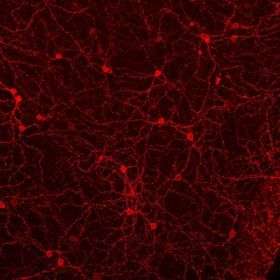
When light activates melanopsin (red), a light receptor found in rare, specialized cells in the retina, they send a signal to different areas in the brain. It allows the body to tell day from night and adjust accordingly. Credit: Image: Courtesy of Dr. Megumi Hatori, Salk Institute for Biological Studies

Mammals have two types of light-sensitive detectors in the retina. Known as rod and cone cells, they are both necessary to picture their environment. However, researchers at the Salk Institute for Biological Studies have found that eliminating a third sensor — cells expressing a photopigment called melanopsin that measures the intensity of incoming light —makes the circadian clock blind to light, yet leaves normal vision intact.

"It is entirely possible that in many older people a loss of this light sensor is not associated with a loss of vision, but instead may lead to difficulty falling asleep at the right time," says Satchidananda Panda, Ph.D., an assistant professor in the Regulatory Biology Laboratory, who led the study.

Understanding how melanopsin does its job may one day allow scientists to reset the body's biological clock with a pill to alleviate symptoms associated with jet lag, shifts in work schedules, seasonal changes in day lengths and disorders such as insomnia and depression, the researchers say. Their findings are published in the June 11, 2008 issue of the PLoS ONE.

Visual processing begins when photons entering the eye strike one or more of the 125 million light-sensitive nerve cells in the retina at the back of each eye. Rod cells use rhodopsin to pick up dim light, while cone cells rely on related photopigments to discriminate color. This first and outermost layer of cells converts the information into electrical signals and sends them to an intermediate layer, which in turn relays signals to the optic nerve. Melanopsin is different from the classical rod and cone opsins, which help us see.

"It functions like a light meter in a camera, but does more than set our biological clock," explains Panda. "The incoming information about light intensity is also used to adjust the aperture or pupil size, regulate melatonin synthesis and physical activity."

Unlike the millions of rod and cone cells imparting vision, melanopsin is only present in roughly 2,000 cells, which are known as melanopsin-expressing retinal ganglion cells or mRGCs. Embedded in the inner retina, these spidery cells signal directly to the human circadian clock, a cluster of cells less than half the size of a pencil eraser, which sits just above the point where the optic nerves cross.

Through these signals, the clock synchronizes the body's daily rhythms with the rising and setting of the sun. It tells the body when it's time to go to sleep, when to be hungry, when to wake up and makes us feel completely out of sync when we cross several time zones.

While it had been known that blind mice without functional rods and cones can still use mRGCs to adjust their biological clock, the aperture of their pupils and light-dependent activity ¬— collectively known as non-image forming visual responses — mice without melanopsin were not completely blind to light.

Since mice developing without melanopsin might compensate during their development for the lack of incoming information about light intensity, resulting in muddled results, postdoctoral researcher and first author Megumi Hatori, Ph.D., developed a system that allowed her to specifically and efficiently shut down all melanopsin-expressing cells while leaving the retina intact.

She genetically engineered mice to render their mRGCs susceptible to diptheria toxin, which she exploited to kill melanopsin-expressing cells at eight weeks of age. "We found that killing the melanopsin-expressing cells makes the mouse circadian clock completely blind to light," says Hatori, "but these mice can still perform normal image-forming visual tasks perfectly fine."

The mammalian time keeping system relies on information from melanopsin -- and to a lesser extent from rods and cones -- to collect information about light intensity. The Salk researchers experiments pinpointed mRGCs as the location where all the incoming information about the brightness of ambient light is integrated and forwarded to the circadian clock.

"Since all the information passes through mRGCs, these cells have emerged as a unique cellular target for therapeutic intervention in circadian clock related disorders," says Panda, who has started screening small molecules for their ability to tweak melanopsin's light sensing properties and thereby slowing down or enhancing the resetting of our biological clock.

Source: Salk Institute

4.7 /5 (20 votes)  

Filter


Move the slider to adjust rank threshold, so that you can hide some of the comments.


Display comments: newest first

Mercury_01
Jun 11, 2008

Rank: 3 / 5 (1)
Now let's figure out what faculty of the eye or visual cortex is responsible for the ability to see the subtle effects of the etherial counterpart of physical objects and biological entities. no, Im not crazy, I just see auric fields.
earls
Jun 11, 2008

Rank: 4 / 5 (1)
You and Wilhelm Reich.
dbren
Jun 11, 2008

Rank: 4 / 5 (1)
Isn't that called astigmatism?
Oderfla
Jun 12, 2008

Rank: not rated yet
I've studied this phenomona myself.
I once encountered a mystic who heeled a scar in a bone by looking at my energy. He's quite talented. I worked with the guy.
If you would like to know more about that, you can message me. I would like to talk about this.
gmurphy
Jun 12, 2008

Rank: 5 / 5 (1)
Mercury_01, this is the cause of your visual sense of auras around people: http://en.wikiped...esthesia

It's a perfectly normal neurological phenomenon. A wiring mutation in your brain has created an extra dimension to your perception of people, read the article in wikipedia
Mercury_01
Jun 12, 2008

Rank: not rated yet
its good to see that some still have scientific minds, objective and open to possibility. Im not sure whether or not it is a form of synesthesia, since I had to teach myself to do this. Once I saw for the first time though, I realized that I have always ben able to do this, but had previously written the images off without any thought. I simply thought I was seeing afterimages and had poor focus. Once I saw, there was a very obvious difference between this phenomenon and an afterimage. Anybody who would like to ask me about it can message me, and maybe I can tell you how to do it. I was able to teach my father at 47 years old, and he has never had any special abilities, but was able to see the full rainbow spectrum around his own hand. I can also tell you that this is definitely not just a product of the brain, and occurs "externaly". I know this by watching the light around other people and plants change as thier energy is exchanged between them, or as thier mood varies.
gmurphy
Jun 12, 2008

Rank: not rated yet
Mercury, synesthesia is genetic, this may explain why your father was able to pick up on this latent perceptual ability. Do you have a good memory or do you work in a field which requires creativity?, these are both observed in people with synesthesia. Your visual interpretation of the world is a product of your brain, I suspect (but cannot prove) that your visual and emotional(limbic) areas of the brain are interconnected in some way. Humans have an incredibly holistic perceptual abilities and you may be consciously perceiving dynamics which exist in most people subconsciously only, talk to a neurologist, they'll tell you the same thing i'm telling you. If you still disagree, devise an experiment to demonstrate otherwise.
Rank 4.7 /5 (20 votes)
Tags

Relevant PhysicsForums posts

More news stories

Plants use circadian rhythms to prepare for battle with insects

In a study of the molecular underpinnings of plants' pest resistance, Rice University biologists have shown that plants both anticipate daytime raids by hungry insects and make sophisticated preparations to ...

Biology / Cell & Microbiology

created 1 hour ago | popularity 5 / 5 (2) | comments 0 | with audio podcast

Study finds fish of Antarctica threatened by climate change

A Yale-led study of the evolutionary history of Antarctic fish and their "anti-freeze" proteins illustrates how tens of millions of years ago a lineage of fish adapted to newly formed polar conditions – ...

Biology / Ecology

created 3 hours ago | popularity 5 / 5 (2) | comments 0 | with audio podcast

Explosive evolution need not follow mass extinctions, says study of ancient zooplankton

Following one of Earth's five greatest mass extinctions, tiny marine organisms called graptoloids did not begin to rapidly develop new physical traits until about 2 million years after competing species became ...

Biology / Evolution

created 3 hours ago | popularity 5 / 5 (1) | comments 1 | with audio podcast

Writing a new code for life?

On "Star Trek, the aliens often look so human that crew members fall in love with them. But in real life, scientists in the field known as astrobiology can't be sure alien life would even be carbon-based like us, or use DNA ...

Biology / Biotechnology

created 6 hours ago | popularity 5 / 5 (5) | comments 1

Lens produces hours of scientific work in seconds

A new form of microscope which can produce results in seconds rather than hours – dramatically speeding up the process of drug development - is being developed by researchers at the University of Strathclyde ...

Biology / Other

created 7 hours ago | popularity 4.3 / 5 (6) | comments 1 | with audio podcast


First-of-its-kind stem cell study re-grows healthy heart muscle in heart attack patients

Results from a Cedars-Sinai Heart Institute clinical trial show that treating heart attack patients with an infusion of their own heart-derived cells helps damaged hearts re-grow healthy muscle.

Sensing self and non-self: New research into immune tolerance

At the most basic level, the immune system must distinguish self from non-self, that is, it must discriminate between the molecular signatures of invading pathogens (non-self antigens) and cellular constituents that usually ...

Missing dark matter located: Intergalactic space is filled with dark matter

Researchers at the University of Tokyo’s Institute for the Physics and Mathematics of the Universe (IPMU) and Nagoya University used large-scale computer simulations and recent observational data of gravitational ...

Scientists discover reason for Mt. Hood's non-explosive nature

(PhysOrg.com) -- For a half-million years, Mount Hood has towered over the landscape, but unlike some of its cousins in Oregon’s Cascade Mountains and many other volcanoes around the Pacific “Rim ...

Smoking bans lead to less, not more, smoking at home: study

Smoking bans in public/workplaces don't drive smokers to light up more at home, suggests a study of four European countries with smoke free legislation, published online in Tobacco Control.

Radiation treatment transforms breast cancer cells into cancer stem cells

Breast cancer stem cells are thought to be the sole source of tumor recurrence and are known to be resistant to radiation therapy and don't respond well to chemotherapy.