Rising Diesel Prices Renew Interest in Fuel Saving Technologies
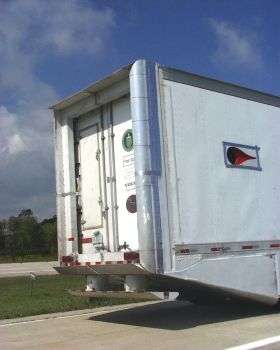
Diesel fuel prices approaching $5 a gallon – and the resulting economic impact on products transported by truck – have created renewed interest in fuel-saving technologies developed during the past decade at the Georgia Tech Research Institute (GTRI).
Use of pressurized air “active flow control” techniques combined with conventional aerodynamic streamlining could improve fuel efficiency by 8 to 12 percent in the heavy trucks used to transport a broad range of products. If installed throughout the U.S. trucking fleet, these technologies for reducing aerodynamic drag could save between 1.6 and 2.4 billion gallons of fuel per year.
“The dramatic increase in diesel prices has led the trucking industry to reconsider aerodynamic fuel efficiency improvements that might not have been cost effective only a few years ago,” said Robert Englar, a GTRI principal research engineer and principal investigator for the project. “Though there are technical challenges ahead, we believe our techniques for improving fuel efficiency offer significant potential to reduce the impact of these fuel cost increases. Beyond the trucking industry, that would help consumers who see the effects of fuel costs in everything they buy.”
Since diesel prices began their rapid increase, Englar has seen growing interest in the GTRI low-drag active flow control aerodynamic technologies, which were developed with support from the U.S. Department of Energy starting in the late 1990s. He has received numerous inquiries for information from both large and small trucking companies, and also from railroads – whose higher-speed western track runs could also benefit from aerodynamic drag reduction.
Aerodynamic drag is the major component of heavy vehicle resistance at typical highway speeds, and overcoming that resistance requires increased energy use. Truck designers have reduced drag on the tractor portion of the vehicles by applying such aerodynamic streamlining approaches as roof fairings, but those have done little to address drag on the aft portion of the trailers.
Because only limited streamlining can be done for trailers due to their length, the GTRI researchers added the active flow control techniques, which use patented pneumatic devices to blow air from slots over small curved aerodynamic surfaces at the rear of the trailers. These air jets smooth the flow of air over the boxy trailers to eliminate air-flow separation, vorticity and suction on the aft doors, which reduces aerodynamic drag at highway speeds.
The researchers also evaluated aerodynamic improvements that involved rounding aft trailer corners, installing fairings around wheels and making other changes designed to better streamline the trailers.
These active flow control techniques are based on aerodynamic research done during the 1980s for applications on U.S. military aircraft. Beyond the fuel savings, they have also been shown to enhance braking and directional control for the heavy trucks without using any moving external parts, potentially improving safety.
“Aerodynamically, we have resolved unknowns raised in earlier testing, and the next step is to get this into a fleet of trucks for more extensive testing,” Englar said. “At highway speeds, each one percent improvement in fuel economy would result in saving about 200 million gallons of fuel for the U.S. heavy truck fleet. We believe that is worth pursuing.”
The fuel efficiency project began in the late 1990s with tests of simple scale model tractor-trailers in GTRI’s low-speed wind tunnel. The researchers then applied those principles to a full-sized test truck, working with Volvo Trucks of North America and Great Dane Trailers, manufacturers of the basic test tractor and trailer respectively.
A series of Interstate-speed test runs at the Transportation Research Center’s Ohio fuel-economy test track have demonstrated substantial fuel savings. The tests involved operating a test tractor-trailer for several different 45-mile runs around a 7.5-mile oval track at highway speeds of 65 and 75 miles per hour. A control truck that did not have either the aerodynamic improvements or pneumatic flow control system was operated under the same conditions to provide a comparison. For additional comparisons, the test truck was also run without the experimental blowing equipment.
The tests showed that the techniques could provide drag coefficient reductions of up to 31 percent, which translates to a fuel efficiency increase of 11 to 12 percent. When the energy required by the air compressor installed on the truck to provide the compressed air for these prototype tests was subtracted from those savings, those tests showed that the low-drag techniques could produce an overall fuel efficiency increase of 8 to 9 percent.
Before the pneumatic control system can be widely used in trucks, however, researchers will have to choose the best source of compressed air for the blowing system, Englar notes. An air compressor more efficient than the one used in the testing would provide higher overall fuel efficiency. Options include a small diesel-powered compressor installed on or under the trailer like current refrigeration units; bleeding pressurized air from the truck’s supercharger/turbocharger, or a simple chain drive from the trailer’s wheels to turn air blowers.
Other practical issues – such as protecting the pneumatic surfaces from damage during docking – still must be resolved. A simple solution, Englar noted, could be to use stiff rubber surfaces.
Beyond boosting fuel efficiency, the pneumatic system can also provide a form of aerodynamic braking to assist the mechanical brakes. “The pneumatic systems can turn a low-drag configuration into a high-drag configuration very rapidly, providing a lot more braking power,” Englar said. “By turning the trailer into a non-moving pneumatic rudder, blowing can also restore directional stability should the truck be operating in destabilizing high side winds.”
Further energy savings could come using a pulsed pneumatic system, which preliminary wind-tunnel studies show could produce the same aerodynamic efficiency with 40 to 50 percent less energy consumed by the blowing system. Englar hopes to receive additional funding to study how this might affect the truck aerodynamics – as well as fuel consumption.
“The ultimate proof would be to apply this overall aerodynamic system to a small fleet of heavy trucks and run them on their normal cross-country routes for a month or so to measure the operational increases in fuel efficiency and safety,” Englar said.
Source: Georgia Tech Research Institute


