Diamonds reveal deep source of platinum deposits
June 11, 2008
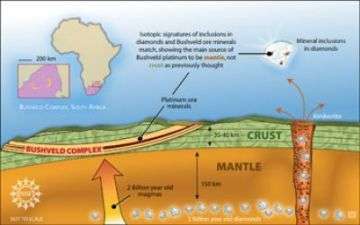
Researchers studied platinum group elements inclusions in about 20 diamonds collected near the Bushveld Complex in South Africa. The complex is vast, measuring hundreds of kilometers in length, and it is one of the few places in the world where PGEs are found in large enough quantities to be mined. The Bushveld Complex is also very old -- geologists put its age at just over 2 billion years -- and formed by crystallization of the Bushveld magmas in a massive crustal magma chamber. The researchers looked at the PGEs in the diamonds, sometimes analyzing grains as small as a few micrograms. They found that the isotopic signatures of the PGEs in the diamonds and Bushveld ore minerals match, showing the main source of Bushveld platinum to be mantle, not crust falling into the magma chamber as previously thought. Credit: Zina Deretsky, National Science Foundation
The world's richest source of platinum and related metals is an enigmatic geological structure in South Africa known as the Bushveld Complex. This complex of ancient magmas is known to have formed some two billion years ago, but the source of its metallic riches has been a matter of scientific dispute. Now researchers from the Carnegie Institution and the University of Cape Town have traced the origin of the unique ore deposits by using another of South Africa's treasures—diamonds.
The study, published in the June 12 issue of Nature, suggests that the source of these valuable ores may be ancient parts of the mantle beneath the African continent.
Platinum group elements (PGEs), which include platinum, palladium, rhodium, ruthenium, osmium and iridium, are extremely rare in the Earth's crust. Platinum, the most abundant, is 30 times rarer than gold. Mined only in a few places in the world, these elements are becoming increasingly important in applications ranging from pollution control (they are key components of catalytic converters in automobiles) to microelectronics.
Previous isotopic studies of rocks from the Bushveld Complex had suggested that a significant fraction of the magma that formed the complex and deposited the ores came from shallow parts of the crust, despite the rarity of PGEs there compared to the Earth's mantle. "But the ore layers are extremely homogeneous over hundreds of kilometers," says Steven Shirey of the Carnegie Institution's Department of Terrestrial Magnetism. "The crust is very heterogeneous. That suggests a deeper source for the platinum."
To test this idea, Shirey and Stephen H. Richardson of the University of Cape Town studied minute mineral inclusions in about 20 diamonds mined from areas surrounding the Bushveld Complex. The diamonds formed at depths of 150-200 kilometers within the Earth's mantle. By measuring the ratios of certain isotopes of strontium, osmium, and neodymium in the mineral inclusions, the researchers were able to determine the isotopic "signatures" of the different regions of the mantle where the diamonds grew. They then compared these signatures with those of ore rocks in the Bushveld Complex.
Richardson and Shirey found that the isotopic signatures of the ores could be matched by varying mixtures of source rocks in the mantle beneath the continental crust. That these parts of the mantle were involved in producing the magmas is also suggested by seismic studies, which reveal anomalies beneath the complex. The anomalies were likely the result of magmas rising through these parts of the mantle.
"This helps explain the richness of these deposits," says Richardson. "The old subcontinental mantle has a higher PGE content than the crust and there is more of it for the Bushveld magmas to traverse and pick up the PGEs found in the ores."
Source: Carnegie Institution
-
Beam-line science to take us on a virtual journey to the center of the Earth
Nov 22, 2011 |
not rated yet |
0
-
Visualizing the flow of molten rock through seabed mantle
Jul 29, 2011 |
4 / 5 (2) |
0
-
New scenery at Earth's core-mantle boundary found
Sep 02, 2010 |
5 / 5 (4) |
4
-
Scientists locate apparent hydrothermal vents off Antarctica
Mar 03, 2010 |
4.5 / 5 (11) |
20
-
As the World Churns
Dec 28, 2009 |
4.4 / 5 (19) |
29
-
Fast photon control brings quantum photonic technologies closer
1 hour ago |
5 / 5 (2) |
0
-
Engineers build first sub-10-nm carbon nanotube transistor
Feb 01, 2012 |
4.9 / 5 (33) |
30
-
Something old, something new: Evolution and the structural divergence of duplicate genes
Jan 31, 2012 |
4.6 / 5 (7) |
1
-
The hidden nanoworld of ice crystals: Revealing the dynamic behavior of quasi-liquid layers
Jan 30, 2012 |
5 / 5 (5) |
1
-
Stock market network reveals investor clustering
Jan 27, 2012 |
3.9 / 5 (23) |
8
-
Do some geologists actually act a lot like Randy Marsh?
Feb 11, 2012
-
Discrepancy between oxygen and carbon-dioxide levels
Feb 09, 2012
-
where gems are found in the world
Feb 09, 2012
-
Wind Waves in Reservoir ~ Wind run-up and Wind set-up
Feb 08, 2012
-
Balance of oxygen in the atmosphere
Feb 01, 2012
-
The case for a methanol-based economy
Jan 30, 2012
- More from Physics Forums - Earth
More news stories
Planck mission steps closer to the cosmic blueprint
(PhysOrg.com) -- ESA's Planck mission has revealed that our Galaxy contains previously undiscovered islands of cold gas and a mysterious haze of microwaves. These results give scientists new treasure to mine ...
1 hour ago |
5 / 5 (3) |
0
|
Slowing ocean current caused Earth to spin faster
(PhysOrg.com) -- Most people probably didn’t notice it, but back in 2009, the Earth spun around on its axis a tiny bit faster than usual, making for some slightly shorter days. It only happened for a ...
New European rocket lifts off on maiden flight
Europe on Monday successfully launched a new lightweight rocket carrying a test payload, culminating a more than 12-year quest to master the entire range of space launchers.
Space & Earth / Space Exploration
4 hours ago |
5 / 5 (5) |
2
Transforming galaxies
(PhysOrg.com) -- Many of the Universe's galaxies are like our own, displaying beautiful spiral arms wrapping around a bright nucleus. Examples in this stunning image, taken with the Wide Field Camera 3 on ...
2 hours ago |
5 / 5 (1) |
0
|
Alien matter in the solar system: A galactic mismatch
This just in: The Solar System is different from the space just outside it.
Space & Earth / Space Exploration
2 hours ago |
4.2 / 5 (6) |
7
|
Independent group inspects Apple supplier
(AP) -- An independent group, the Fair Labor Association, has started auditing Apple Inc.'s Chinese supplier Foxconn after a request by Apple.
Fast photon control brings quantum photonic technologies closer
(PhysOrg.com) -- Using photons instead of electrons to transmit information could lead to faster and more secure ways to communicate, among other advantages. Now a team of physicists has taken another step toward realizing ...
New ability to regrow blood vessels holds promise for treatment of heart disease
(Medical Xpress) -- University of Texas at Austin researchers have demonstrated a new and more effective method for regrowing blood vessels in the heart and limbs a research advancement that could have ...
New molecule has potential to help treat genetic diseases and HIV
(PhysOrg.com) -- Chemists at The University of Texas at Austin have created a molecule that's so good at tangling itself inside the double helix of a DNA sequence that it can stay there for up to 16 days before ...
Ordered planar polymers created for the first time
(PhysOrg.com) -- Scientists under the direction of ETH Zurich have created a minor sensation in synthetic chemistry. They succeeded for the first time in producing regularly ordered planar polymers that form ...
Rapunzel, Leonardo and the physics of the ponytail
(PhysOrg.com) -- New research provides the first mathematical understanding of the shape of a ponytail and could have implications for the textile industry, computer animation and personal care products.
Jun 11, 2008
Rank: 1 / 5 (1)