Sony develops new back-illuminated CMOS image sensor
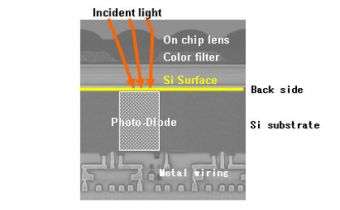
Sony Corporation today announced the development of a back-illuminated CMOS image sensor (pixel size: 1.75µm square pixels, five effective mega pixels, 60 frames/s) with significantly enhanced imaging characteristics, including nearly twofold sensitivity and low noise. This improved performance has been achieved by illuminating the backside of the silicon substrate, in contrast to conventional CMOS image sensors based on front-illumination technology.
The newly developed CMOS image sensor achieves a signal-to-noise ratio of +8dB(+6dB sensitivity, -2dB noise) in comparison to existing Sony CMOS image sensors of the same pixel size. Sony will apply this back-illuminated CMOS technology in consumer digital video camcorders and digital still cameras to deliver an even higher quality image experience.
Conventionally, consumer digital video camcorders and digital still cameras have been required to combine high resolution capable of capturing every detail of the subject matter, and miniaturization oriented to portability. In order to meet these needs, image sensor development has focused on miniaturizing pixel size, while maintaining imaging characteristics. However, in addition to these ongoing requirements, in recent years demand for improved levels of minimum subject illuminance and rapid image capture has also increased. This has led to the requirement of image sensors with improved signal-to-noise ratio and other features capable of realizing improved overall picture quality.
Sony has retained the advantages of CMOS image sensors such as low power consumption and high-speed operation, while radically realigning their fundamental pixel structure from front-illumination to back-illumination to successfully develop a prototype, back-illuminated CMOS image sensor (pixel size: 1.75µm square pixels, five effective mega pixels, 60 frames/s) with improved sensitivity and noise reduction - the key factors to enhancing image quality.
With a conventional front-illumination structure, the metal wiring and transistors on the surface of the silicon substrate that form the sensor's light-sensitive area (photo-diode) impede photon gathering carried out by the on-chip lens, and this has also been an important issue in the miniaturization of pixels and widening optical angle response.
A back-illuminated structure minimizes the degradation of sensitivity to optical angle response, while also increasing the amount of light that enters each pixel due to the lack of obstacles such as metal wiring and transistors that have been moved to the reverse of the silicon substrate.

However, compared to conventional front-illuminated structures, back-illuminated structures commonly causes problems such as noise, dark current, defective pixels and color mixture that lead to image degradation and also cause a decrease in the signal-to-noise ratio.
To overcome this Sony has newly developed a unique photo-diode structure and on-chip lens optimized for back-illuminated structures, that achieves a higher sensitivity of +6dB and a lower random noise of -2dB without light by reducing noise, dark current and defect pixels compared to the conventional front-illuminated structure. Additionally, Sony's advanced technologies such as high-precision alignment have addressed any color mixture problems.
Sony has continued to advance the speed and picture quality of its CMOS image sensors, such as "Exmor", with its unique "Column-Parallel A/D Conversion Technique" and dual noise reduction, in addition to the imaging expertise it has accumulated throughout its history of CCD development. With the development of this new back-illuminated structure, Sony has realized a CMOS image sensor with even higher sensitivity and lower noise. Furthermore, the back-illuminated structure also expands device potential in areas such as speed and dynamic range by enabling multiple metal wiring layers and greater flexibility in the transistor structure. Going forward, Sony will continue its development of image sensors that combine ease-of-use, advanced image quality and cutting-edge pixel miniaturization.
Source: Sony


