Fossils found in Tibet revise history of elevation, climate
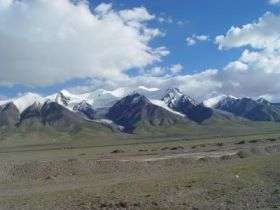
About 15,000 feet up on Tibet's desolate Himalayan-Tibetan Plateau, an international research team led by Florida State University geologist Yang Wang was surprised to find thick layers of ancient lake sediment filled with plant, fish and animal fossils typical of far lower elevations and warmer, wetter climates.
Back at the FSU-based National High Magnetic Field Laboratory, analysis of carbon and oxygen isotopes in the fossils revealed the animals' diet (abundant plants) and the reason for their demise during the late Pliocene era in the region (a drastic climate change). Paleo-magnetic study determined the sample's age (a very young 2 or 3 million years old).
That fossil evidence from the rock desert and cold, treeless steppes that now comprise Earth's highest land mass suggests a literally groundbreaking possibility:
Major tectonic changes on the Tibetan Plateau may have caused it to attain its towering present-day elevations -- rendering it inhospitable to the plants and animals that once thrived there -- as recently as 2-3 million years ago, not millions of years earlier than that, as geologists have generally believed. The new evidence calls into question the validity of methods commonly used by scientists to reconstruct the past elevations of the region.
"Establishing an accurate history of tectonic and associated elevation changes in the region is important because uplift of the Tibetan Plateau has been suggested as a major driving mechanism of global climate change over the past 50-60 million years," said Yang, an associate professor in FSU's Department of Geological Sciences and a researcher at the National High Magnetic Field Laboratory. "What's more, the region also is thought to be important in driving the modern Asian monsoons, which control the environmental conditions over much of Asia, the most densely populated region on Earth."
The fossil findings and implications are described in the June 15, 2008 issue of the peer-reviewed journal Earth and Planetary Science Letters. The journal can be accessed online at www.elsevier.com/locate/epsl.
Yang co-authored the paper ("Stable isotopes in fossil mammals, fish and shells from Kunlun Pass Basin, Tibetan Plateau: Paleoclimatic and paleoelevation implications") with paleontologists from the Department of Vertebrate Paleontology at the Natural History Museum of Los Angeles County, and the Institute of Vertebrate Paleontology and Paleoanthropology, Chinese Academy of Sciences (Beijing). The collaborative research project, which since 2004 has featured summer field study on the remote Tibetan Plateau, is funded by a grant from the Sedimentary Geology and Paleobiology Program of the U.S. National Science Foundation.
"The uplift chronology of the Tibetan Plateau and its climatic and biotic consequences have been a matter of much debate and speculation because most of Tibet's spectacular mountains, gorges and glaciers remain barely touched by man and geologically unexplored," Yang said.
"So far, my research colleagues and I have only worked in two basins in Tibet, representing a very small fraction of the Plateau, but it is very exciting that our work to-date has yielded surprising results that are inconsistent with the popular view of Tibetan uplift," she said.
This summer, Yang and her colleagues from Los Angeles and Beijing will conduct further fieldwork in areas near the Tibetan Plateau. "The next phase of our work will focus on examining the spatial and temporal patterns of long-term vegetative and environmental changes in and around the region," she said. "Such records are crucial for clarifying the linkages among climatic, biotic and tectonic changes."
There is much still to learn and understand about those changes.
"Many of the places we've visited in Tibet are now deserts, and yet we found those thick deposits of lake sediments with abundant fossil fish and shells," Yang said. "This begs the question: What came first and caused the disappearance of those lakes? Global climate change? Or, tectonic change?"
Source: Florida State University


