Study Finds New Properties in Non-Magnetic Materials
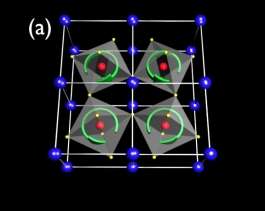
A team of Penn State researchers has shown for the first time that the entire class of non-magnetic materials, such as those used in some computer components, could have considerably more uses than scientists had thought. The findings are important because they reveal previously unknown information about the structure of these materials, expanding the number of properties that they potentially could have. A material's properties, such as electrical conductivity and mechanical strength, are what determine its usefulness. The research will be published in the journal Physical Review Letters.
A material's properties are determined by its structure, explained Venkatraman Gopalan, a researcher in Penn State's Center for Nanoscale Science, a professor of materials science and engineering, and the project's leader. "If I was out hiking and I found a rock that contained a quartz crystal, I could tell you what properties the crystal can and cannot have just based on what we call its symmetry--the number and arrangement of crystal planes it has. Symmetry results from the way the atoms are arranged in the quartz," he said. "It is an extremely powerful way of understanding our world."
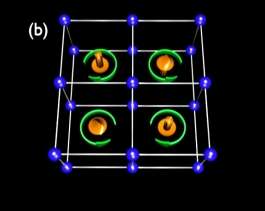
The non-magnetic materials that Gopalan and his colleagues studied were thought to have one of the 32 different crystal symmetries--called point group symmetries--known to exist in nature. On the other hand, magnetic materials have 90 different point group symmetries because their atomic particles have magnetic spins, which can be imagined as tiny loops of current. "Motion is an extremely important aspect of magnetism," said Gopalan. "Magnetism develops in nature as soon as charged particles start moving or spinning."
Scientists long have believed that symmetry allows magnetic materials to have more properties than non-magnetic materials because flipping the direction of spin creates an additional symmetry. But Gopalan's team has shown that non-magnetic materials, theoretically, can have just as many properties as magnetic materials. According to Gopalan, some non-magnetic materials have groups of atoms that distort by twisting or rotating. This slight movement is equivalent to a tiny loop of current and is enough to give the material some additional properties that previously were thought to belong only to magnetic materials.
The researchers tested their theory experimentally using strontium titanate, which is a non-magnetic material. They cooled the material and found that its oxygen atoms responded by twisting into a tighter postion to save energy and space. "The oxygen atoms don't rotate all the way around like a loop of current does in magnetic materials, but theoretical analyses show that they do twist and, therefore, it is possible that these materials could have previously unknown properties," said Gopalan.
Next, the team investigated whether the twisting movement translated into the expression of additional properties. In particular, they predicted and tested for an optical property that they call roto second harmonic generation, which is analogous to a well-known property called magnetic second harmonic generation. Second harmonic generation is found, for example, in the crystals that are used in green laser pointers to convert infrared laser light into green laser light. The group found that the strontium titanate material does have a small amount of roto second harmonic generation.
"Nobody has thought of relating magnetic symmetries to a non-magnetic material like strontium titanate, but that's precisely what our paper does," said Gopalan. "We first did a theoretical analysis in which we applied the symmetry framework that traditionally is used to describe magnetic materials to this vast class of non-magnetic materials. Then we did a laboratory experiment with a particular non-magnetic material and we found that it has a property that previously was thought to belong only to magnetic materials. We suggest that it is possible for the entire class of non-magnetic materials to have more symmetries and more properties than previously have been thought possible."
The team's findings could lead to an explosion of research into new properties of non-magnetic materials and to possible applications of these properties. "These materials are used in hundreds of applications," said Peter Schiffer, associate vice president for research and a professor of physics at Penn State, "but this new work holds great promise for finding many more uses."
Source: Penn State


